
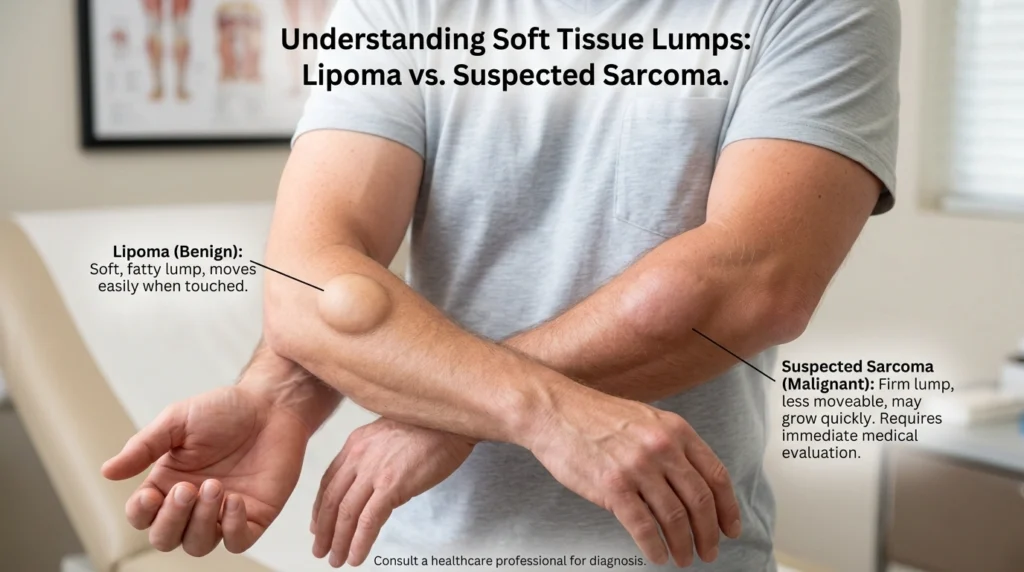
What Is a Lipoma?
A lipoma is a common benign growth made primarily of mature fat cells. It develops beneath the skin and is usually harmless.
Lipomas can occur at almost any age but are particularly common in middle-aged adults.
What Does a Lipoma Feel Like?
A typical lipoma is often:
- Soft or rubbery
- Easily movable beneath the skin
- Slow-growing
- Painless
- Located just beneath the skin
- Relatively well defined
Many lipomas are small, but some can become several centimeters across.
For example:
A person notices a soft lump on their upper arm that has remained almost unchanged for several years.
That pattern can be consistent with a lipoma.
Where Do Lipomas Occur?
Lipomas commonly appear on areas such as:
- Arms
- Shoulders
- Back
- Neck
- Torso
- Thighs
They can also develop in deeper tissues, where they may not be as easy to feel.
Are Lipomas Dangerous?
Most lipomas are benign, meaning they aren’t cancerous.
Many don’t require treatment unless they:
- Cause discomfort
- Interfere with movement
- Become bothersome
- Grow significantly
- Are cosmetically concerning
- Have features that make the diagnosis uncertain
A healthcare professional may remove a lipoma if necessary.
How Are Lipomas Diagnosed?
A clinician may initially identify a typical lipoma through a physical examination.
If the lump is unusual, deep, large, or uncertain, additional testing may include:
- Ultrasound
- MRI
- Other imaging
- Biopsy
The appropriate test depends on the location and characteristics of the mass.
A Short History of the Term
The word lipoma comes from Greek roots associated with fat and tumor. The term has long been used in medicine to describe benign tumors composed primarily of adipose tissue.
What Is Sarcoma?
Sarcoma is a broad group of cancers that develop from connective and supporting tissues.
Unlike carcinoma, which commonly begins in epithelial cells, sarcomas can arise in tissues such as:
- Muscle
- Fat
- Bone
- Cartilage
- Tendons
- Blood vessels
- Nerves
- Other connective tissues
There are many different types of sarcoma, and their behavior can vary considerably.
What Does a Soft-Tissue Sarcoma Look Like?
A soft-tissue sarcoma can present as a lump or mass.
Some concerning characteristics include:
- Progressive growth
- A firm or solid feel
- Deep location
- Limited mobility
- Larger size
- Pain in some cases
However, these features aren’t exclusive to cancer.
A lump that is painful can still be benign, and a sarcoma can sometimes be painless.
Can Sarcoma Develop in Fat?
Yes. Liposarcoma is a type of sarcoma that develops from fat-related tissue.
This is important because a liposarcoma and lipoma can both involve fatty tissue while having very different biological behavior.
A lipoma is benign, whereas a liposarcoma is malignant.
How Is Sarcoma Diagnosed?
Doctors may use a combination of:
- Medical history
- Physical examination
- Imaging
- Biopsy
- Laboratory and pathology analysis
If a sarcoma is suspected, the biopsy and treatment should generally be planned by specialists experienced in managing soft-tissue tumors.
A Short History of the Term
The word sarcoma comes from Greek sarkōma, referring to a fleshy growth.
Modern medicine recognizes many distinct sarcoma subtypes, each with different characteristics and treatment approaches.
Key Differences Between Sarcoma or Lipoma
When comparing sarcoma or lipoma, the most important difference is their biological nature: lipomas are benign, while sarcomas are malignant cancers.
- A lipoma is benign.
- A sarcoma is cancerous.
- Lipomas often grow slowly.
- Sarcomas can grow progressively and sometimes rapidly.
- Lipomas are often soft or rubbery.
- Sarcomas may feel firm or solid.
- Lipomas are often mobile under the skin.
- Sarcomas may be deeper or less mobile.
- Lipomas are commonly painless.
- Sarcomas can be painless or painful.
- A lump’s appearance alone cannot reliably establish the diagnosis.
- Imaging and biopsy may be necessary for suspicious masses.
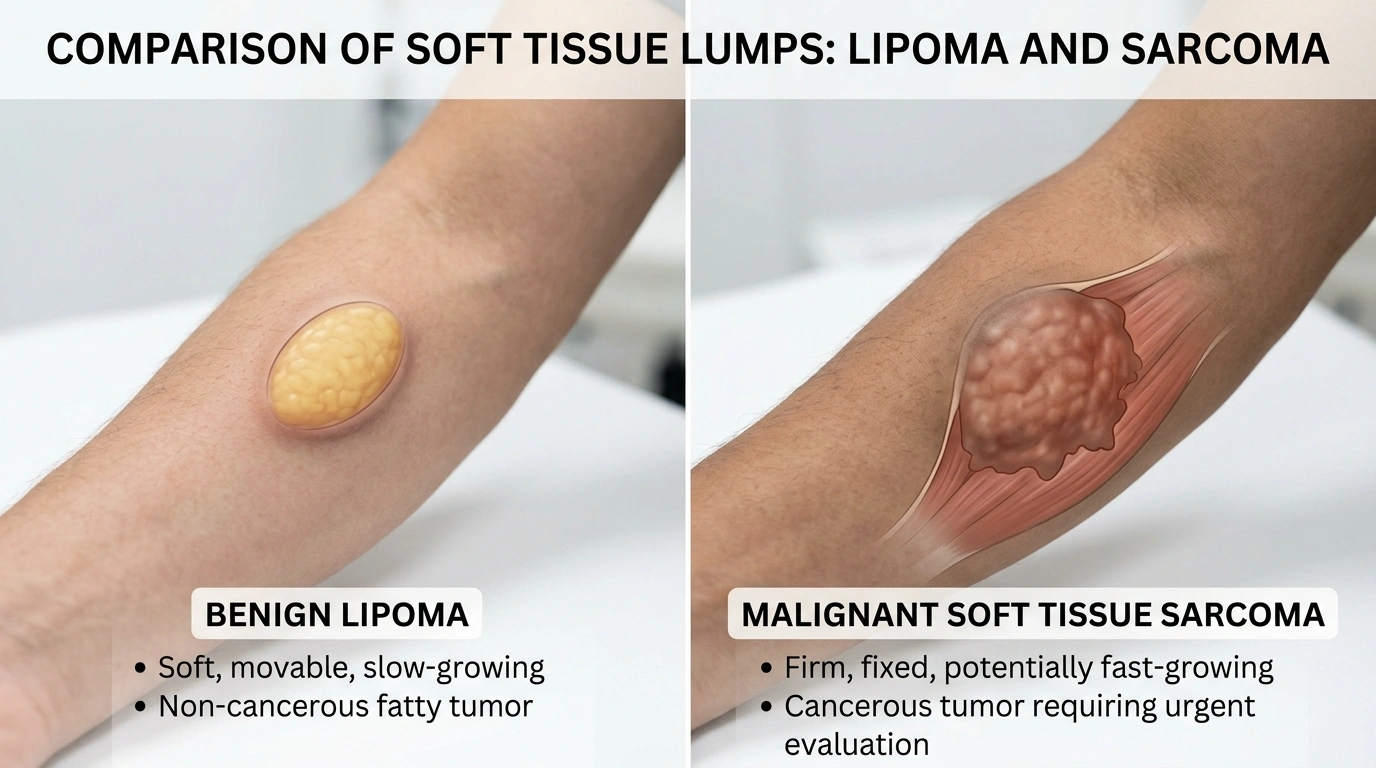
Sarcoma or Lipoma Comparison Table
| Feature | Lipoma | Sarcoma |
|---|---|---|
| Nature | Benign tumor | Malignant cancer |
| Tissue | Mature fat cells | Connective/supporting tissues |
| Growth | Usually slow | Can be progressive or rapid |
| Texture | Often soft or rubbery | May be firm or solid |
| Mobility | Often moves under the skin | May be less mobile, especially if deep |
| Pain | Usually painless | May or may not hurt |
| Location | Often superficial | Can be deep in soft tissue |
| Size | Often small, but can be large | May become large |
| Treatment | Often observation or removal | Usually requires specialist cancer treatment |
| Diagnosis | Often clinical; imaging if uncertain | Imaging and biopsy commonly needed |
Real-Life Conversation Examples
Dialogue 1: The Soft Lump
Sarah: “I found a soft lump on my shoulder.”
Emma: “How long has it been there?”
Sarah: “Several years, and it hasn’t changed much.”
Emma: “That can be consistent with a lipoma, but a doctor can confirm what it is.”
🎯 Lesson: A slow-growing, soft, mobile lump may be consistent with a lipoma, but it still deserves evaluation if you’re uncertain.
Dialogue 2: A Growing Mass
Mike: “The lump on my thigh has been getting bigger.”
James: “How quickly?”
Mike: “Noticeably over the last few months.”
James: “I’d get it checked rather than assuming it’s a lipoma.”
🎯 Lesson: Progressive growth is a reason to have a lump professionally evaluated.
Dialogue 3: Pain Isn’t Everything
Nina: “My lump doesn’t hurt, so it can’t be serious, right?”
Alex: “Not necessarily. Some serious masses can be painless.”
Nina: “So pain isn’t a reliable test?”
Alex: “Exactly.”
🎯 Lesson: Absence of pain doesn’t rule out a serious condition.
Dialogue 4: The Diagnosis
Tom: “The doctor thinks it’s a lipoma.”
Chris: “Did they do any tests?”
Tom: “They examined it and may order imaging because of its size.”
Chris: “That sounds sensible.”
🎯 Lesson: When a lump has unusual features, additional testing can help establish the diagnosis.
When to Consider Sarcoma or Lipoma
Understanding sarcoma or lipoma can help you recognize why a lump may need evaluation, but self-diagnosis isn’t reliable.
Features More Consistent With a Lipoma
A lump may be more consistent with a typical lipoma when it is:
- Soft
- Movable
- Painless
- Superficial
- Slowly growing
- Present for a long time without significant change
Even then, these characteristics don’t prove that the lump is a lipoma.
Warning Signs That Need Medical Evaluation
A lump should be assessed by a healthcare professional if it:
- Is growing
- Is larger than expected
- Feels deep beneath the tissue
- Is firm or hard
- Is difficult to move
- Becomes painful
- Returns after removal
- Causes unexplained functional problems
- Changes noticeably over time
One commonly used clinical warning threshold for soft-tissue masses is 5 centimeters or larger, particularly when combined with other concerning features. But smaller masses can also require evaluation.
Does Size Determine Whether It’s Cancer?
No.
A large lump isn’t automatically a sarcoma, and a small lump isn’t automatically harmless.
Size is only one factor. Location, depth, growth pattern, imaging findings, and pathology are much more informative when determining what a mass actually is.
What About a Lump That Suddenly Appears?
A newly noticed lump doesn’t necessarily mean it developed overnight. You may simply have become aware of an existing mass.
Still, a new or changing lump should be evaluated if it persists or has concerning features.
Why Imaging Matters
Depending on the situation, a healthcare professional may recommend an ultrasound or MRI.
MRI can be particularly useful for evaluating soft-tissue masses and determining their size, depth, and relationship with nearby structures.
If cancer is suspected, a biopsy may be needed to determine the exact type of tumor.
Don’t Remove a Suspicious Lump Yourself
If a lump could potentially be a soft-tissue tumor, it’s important to have it assessed before attempting removal.
The location and method of biopsy or surgery can matter for later treatment if the mass turns out to be malignant.
When to Seek Prompt Medical Attention
Contact a healthcare professional promptly for a lump that is rapidly enlarging, deep, firm, fixed, or otherwise unusual.
Seek urgent medical attention if a mass is associated with severe symptoms or sudden changes that could indicate another medical problem.
US vs UK Notes
The terms lipoma and sarcoma are used in both American and British English.
There is no meaningful US-versus-UK difference in their medical definitions.
You may encounter different healthcare pathways or terminology in different countries, but the underlying distinction remains the same: a lipoma is benign, while a sarcoma is malignant.