
What Is an Optician?
An optician is an eye-care professional who helps people obtain and properly fit corrective eyewear.
Opticians generally work from a prescription provided by an optometrist or ophthalmologist, although the exact rules vary by location.
What Does an Optician Do?
An optician may help you:
- Choose eyeglass frames
- Measure your eyes for lenses
- Prepare or order prescription lenses
- Adjust frames
- Fit certain contact lenses
- Repair eyewear
- Explain lens options and coatings
- Make sure glasses fit comfortably
For example:
After receiving her prescription, Maria visited an optician to choose frames and have her lenses fitted.
The optician’s job is largely about turning an existing prescription into correctly fitted eyewear.
Can an Optician Perform an Eye Exam?
This depends on the country and local regulations.
In many places, an optician does not perform comprehensive eye examinations or diagnose eye diseases. Instead, those responsibilities belong to optometrists or ophthalmologists.
Some jurisdictions may give dispensing opticians additional responsibilities, so it’s important to check local regulations.
Can an Optician Prescribe Glasses?
Typically, an optician dispenses eyewear according to a prescription rather than determining the prescription through a comprehensive eye examination.
If you need to find out whether your vision has changed, an optometrist or another qualified eye-care professional is generally the appropriate choice.
Short History of Opticians
Opticians developed alongside the growth of spectacles and other corrective eyewear.
As lenses and frame technology became more sophisticated, specialized professionals emerged to manufacture, adjust, and fit optical devices accurately.
What Is an Optometrist?
An optometrist is a healthcare professional who provides primary eye and vision care.
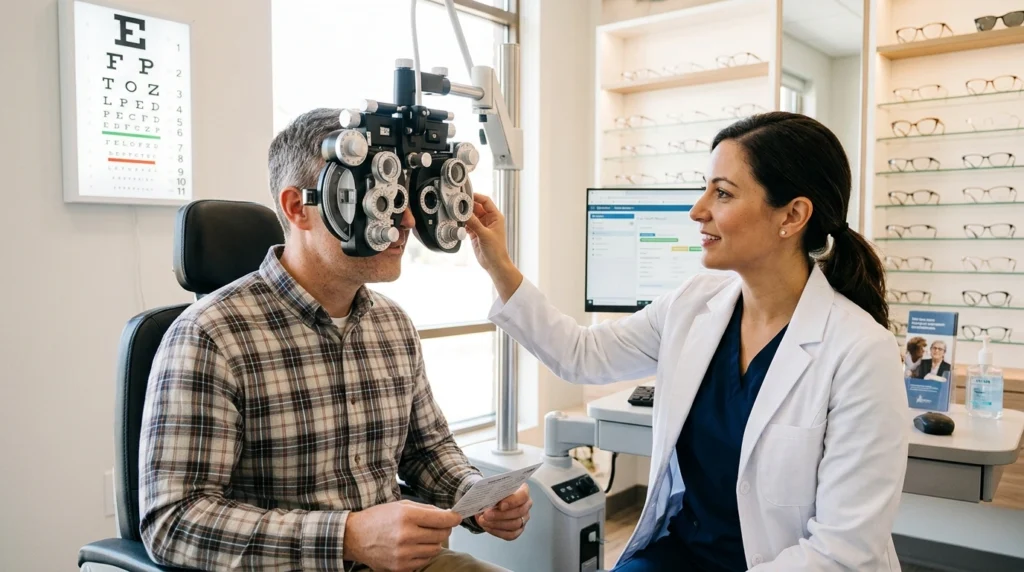
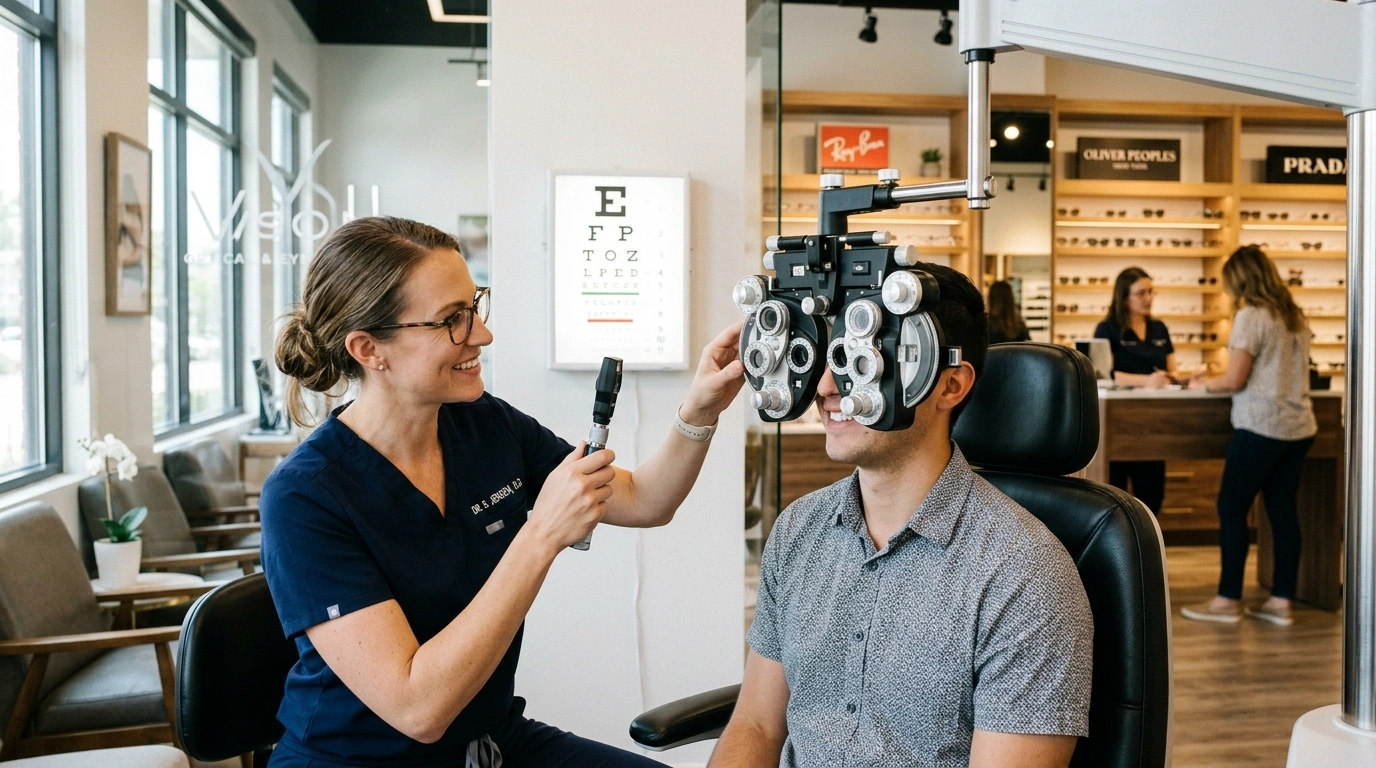
Optometrists examine the eyes, assess vision, diagnose many eye conditions, and prescribe corrective lenses and, depending on local laws, certain medications and treatments.
What Does an Optometrist Do?
An optometrist may:
- Perform comprehensive eye examinations
- Test visual acuity
- Check eye coordination
- Prescribe glasses
- Prescribe contact lenses
- Detect certain eye diseases
- Monitor eye health
- Manage some eye conditions
- Refer patients to ophthalmologists or other specialists when necessary
For example:
David visited an optometrist because he was having difficulty seeing clearly at night.
The optometrist can evaluate both vision and eye health, not simply help select glasses.
Can an Optometrist Prescribe Glasses?
Yes. In jurisdictions where optometrists are licensed to prescribe corrective lenses, they can determine the appropriate prescription for glasses and contact lenses.
The prescription may include measurements for:
- Near-sightedness
- Far-sightedness
- Astigmatism
- Presbyopia
Can an Optometrist Diagnose Eye Diseases?
Yes. Optometrists are trained to identify and manage many eye conditions.
During an examination, they may look for signs associated with conditions such as:
- Glaucoma
- Cataracts
- Diabetic eye disease
- Macular problems
- Dry-eye conditions
- Retinal abnormalities
When a condition requires specialized medical or surgical care, an optometrist may refer the patient to an ophthalmologist.
Short History of Optometry
Modern optometry developed from earlier optical and vision-testing practices. As scientific understanding of vision and eye disease advanced, optometry became a regulated healthcare profession with formal education and clinical training.
Key Differences Between Optician or Optometrist
The biggest difference between an optician or optometrist is their scope of work.
- An optician primarily prepares, fits, adjusts, and dispenses eyewear.
- An optometrist examines eyes and provides vision and primary eye care.
- An optometrist can generally determine a prescription for glasses or contacts where legally authorized.
- An optician usually works from an existing prescription.
- Optometrists can identify many eye diseases.
- Opticians generally don’t diagnose eye diseases.
- Opticians specialize in eyewear fitting and dispensing.
- Optometrists receive extensive clinical education in eye and vision care.
- An optometrist may refer patients to an ophthalmologist for complex disease or surgery.
- Local laws can affect exactly what each professional is permitted to do.
Optician or Optometrist Comparison Table
| Feature | Optician | Optometrist |
|---|---|---|
| Main role | Fits and dispenses eyewear | Provides eye and vision care |
| Comprehensive eye exams | Generally no | Yes |
| Determines vision prescription | Generally no | Yes, where licensed |
| Fits glasses | Yes | May assist with prescription |
| Adjusts frames | Yes | Not usually the primary role |
| Fits contact lenses | Often | Yes |
| Diagnoses eye disease | Generally no | Yes, within scope of practice |
| Prescribes treatment | Generally no | Depending on jurisdiction |
| Refers to specialists | Not usually the primary role | Yes |
| Main focus | Eyewear | Eye health and vision |
Real-Life Conversation Examples
Dialogue 1: Getting New Glasses
Sarah: “My glasses broke. Should I see an optometrist?”
Emma: “If your prescription is still current, an optician may be able to help you replace them.”
Sarah: “So I don’t necessarily need another eye exam?”
Emma: “Not necessarily, but you should follow the advice of your eye-care professional.”
🎯 Lesson: An optician is often the right person for fitting or replacing eyewear when you already have a valid prescription.
Dialogue 2: Blurry Vision
Mike: “My vision has become blurry.”
James: “I’d book an eye examination with an optometrist.”
Mike: “Why not an optician?”
James: “An optometrist can assess your vision and check for possible eye-health problems.”
🎯 Lesson: New or changing vision problems generally call for an eye examination.
Dialogue 3: Choosing Frames
Nina: “I have my prescription. Now I need frames.”
Alex: “An optician can help you with that.”
Nina: “Can they adjust them too?”
Alex: “Yes, that’s a major part of their role.”
🎯 Lesson: Opticians specialize in eyewear fitting, adjustment, and dispensing.
Dialogue 4: Eye Health
Tom: “My doctor mentioned checking for signs of an eye condition.”
Chris: “An optometrist can perform an eye examination and determine whether you need further care.”
Tom: “And if it’s serious?”
Chris: “They may refer you to an ophthalmologist or another specialist.”
🎯 Lesson: Optometrists can assess eye health and refer patients when specialist care is needed.
When to Use Optician or Optometrist
Choosing between optician or optometrist becomes much easier when you focus on what you need.
See an Optician When You Need Eyewear
An optician may be the appropriate professional when you need:
- New glasses made
- Frames adjusted
- Lenses fitted
- Eyewear repaired
- Help choosing frames
- Certain contact-lens fitting services
- Prescription lenses made from an existing prescription
For example:
“I already have my prescription and need new glasses.”
An optician is often the logical starting point.
See an Optometrist When You Need an Eye Examination
An optometrist is generally the better choice when you need:
- A routine eye examination
- A new vision prescription
- Contact-lens evaluation
- Assessment of blurry vision
- Evaluation of eye discomfort
- Monitoring of an existing eye condition
- Screening for signs of eye disease
What About an Ophthalmologist?
It’s also useful to know where an ophthalmologist fits into the picture.
An ophthalmologist is a medical doctor specializing in eye care. Ophthalmologists can diagnose and treat eye diseases and perform eye surgery.
A simplified way to remember the three professions is:
Optician → eyewear
Optometrist → vision and primary eye care
Ophthalmologist → medical and surgical eye care
There is some overlap, and exact responsibilities vary by country.
What If You Have Eye Pain?
Don’t assume eye pain simply means you need new glasses.
Significant or sudden eye pain, sudden vision loss, flashes or a sudden increase in floaters, severe redness, or other abrupt changes can require urgent medical assessment.
The appropriate service depends on the symptoms and your local healthcare system.
A Simple Memory Trick
Think:
Optician = optical products.
Optometrist = eye measurement and examination.
The words share the “opt” root because both relate to vision and optics, but their professional roles are different.
US vs UK Notes
The terms optician and optometrist are used in both American and British English, but their precise scopes of practice can vary.
In the United States, optometrists are licensed healthcare professionals whose permitted diagnostic and treatment responsibilities vary by state. Opticians are generally focused on dispensing and fitting eyewear.
In the United Kingdom, optometrists provide eye examinations and can identify signs of eye disease, while dispensing opticians specialize in supplying and fitting spectacles and other optical appliances. Regulatory requirements differ between professions.
Always check the rules and services available in your local area.