
What Is an Atom?
An atom is the smallest unit of a chemical element that retains the properties of that element.
Everything around you is made from atoms, including water, air, metals, plants, animals, and the human body.
Structure of an Atom
An atom contains three main subatomic particles:
- Protons — positively charged particles found in the nucleus
- Neutrons — particles with no electrical charge, also found in the nucleus
- Electrons — negatively charged particles found around the nucleus
A neutral atom has an equal number of protons and electrons.
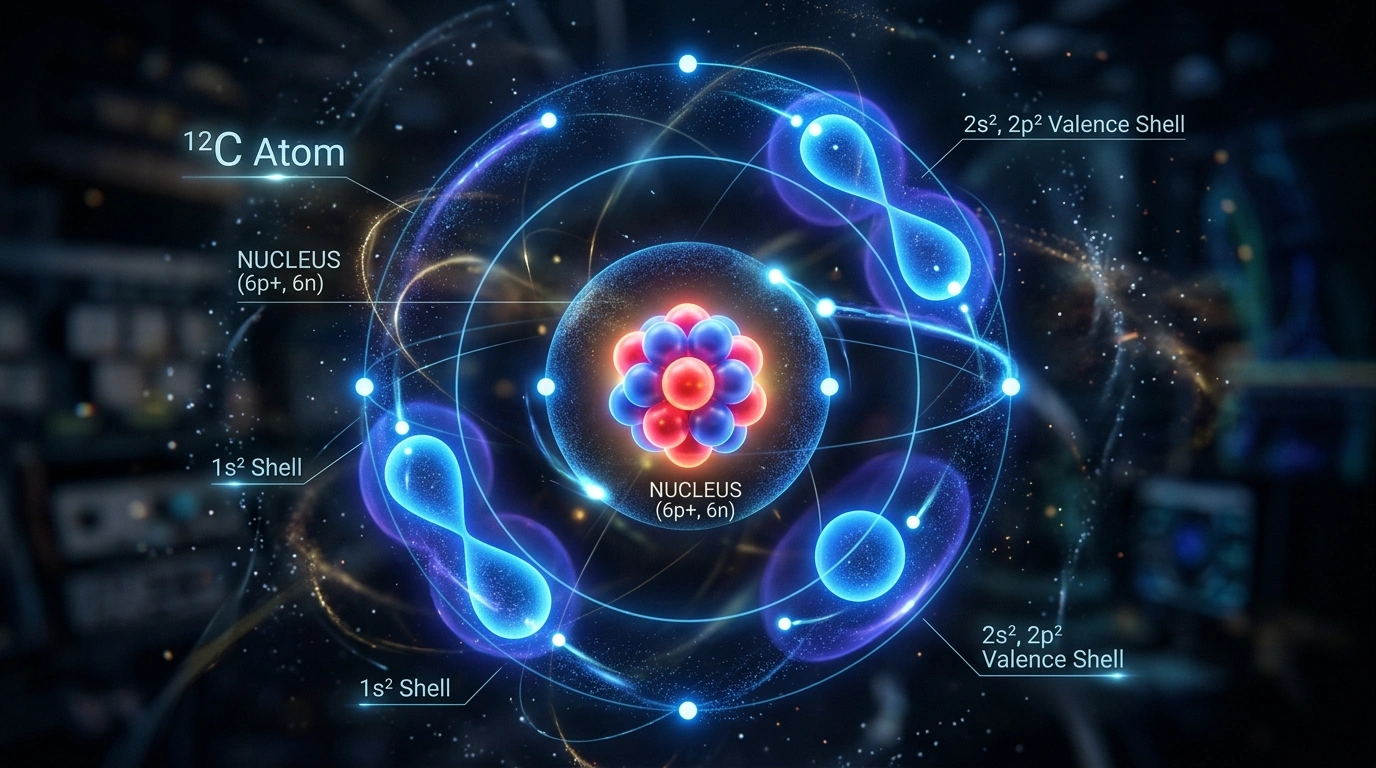
For example, a neutral carbon atom has:
- 6 protons
- 6 neutrons in its most common form
- 6 electrons
Because the positive and negative charges balance, the atom has no overall electrical charge.
How Atoms Are Used
Atoms combine with other atoms to form molecules and compounds. For example, two hydrogen atoms can combine with one oxygen atom to form water, H₂O.
Atoms can also participate in chemical reactions by gaining, losing, or sharing electrons.
Example Sentences
- “A neutral oxygen atom contains eight protons and eight electrons.”
- “Atoms can combine to form molecules.”
- “The carbon atom has six protons.”
History and Scientific Use
The idea of the atom dates back to ancient Greek philosophy, but the modern scientific concept developed much later. Scientists gradually discovered that atoms were not indivisible particles but contained smaller components such as electrons, protons, and neutrons.
Today, the term atom refers to a particle of an element that is electrically neutral when its number of electrons equals its number of protons.
What Is an Ion?
An ion is an atom or group of atoms that has an overall electrical charge because it has gained or lost electrons.
Unlike a neutral atom, an ion does not have equal numbers of protons and electrons.
How an Ion Forms
An atom becomes an ion when its electron count changes.
If an atom loses electrons, it becomes positively charged. This type of ion is called a cation.
If an atom gains electrons, it becomes negatively charged. This type of ion is called an anion.
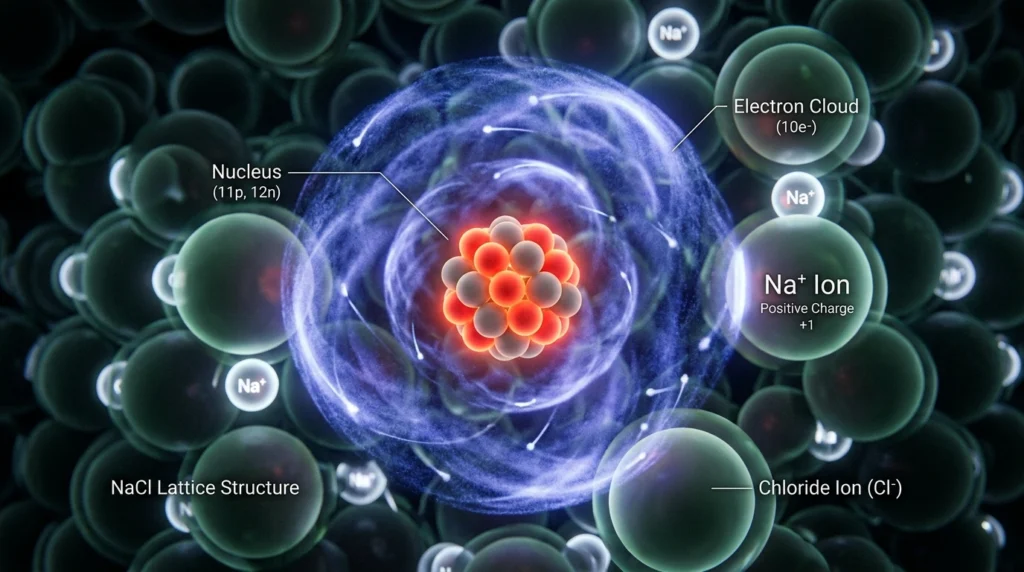
For example, a sodium atom normally has 11 protons and 11 electrons. If it loses one electron, it has 11 protons but only 10 electrons. It therefore has a +1 charge and becomes a sodium ion, written as Na⁺.
Cations and Anions
Cation
A cation has a positive charge because it has lost one or more electrons.
Examples include:
- Na⁺
- K⁺
- Ca²⁺
- Mg²⁺
Anion
An anion has a negative charge because it has gained one or more electrons.
Examples include:
- Cl⁻
- F⁻
- O²⁻
- S²⁻
Example Sentences
- “Sodium becomes an ion when it loses an electron.”
- “A chloride ion has a negative charge.”
- “Calcium forms a Ca²⁺ ion by losing two electrons.”
Spelling and Usage
The word ion is used broadly in chemistry and physics for electrically charged particles. Ions can be individual atoms, such as Na⁺, or groups of atoms, such as sulfate, SO₄²⁻.
This is an important distinction: not every ion is a single atom.
Atom or Ion: Key Differences
The easiest way to distinguish an atom or ion is to look at its electrical charge.
- An atom is electrically neutral when its protons and electrons are equal.
- An ion has a net electrical charge.
- An atom becomes an ion by gaining or losing electrons.
- Losing electrons produces a positive ion.
- Gaining electrons produces a negative ion.
- The number of protons determines the element’s identity.
- Changing the number of electrons changes the particle’s charge, not its elemental identity.
- An atom can become an ion during a chemical reaction.
- Ions play an important role in ionic bonding and electrical conductivity.
- An ion can consist of one atom or several bonded atoms.
Atom or Ion Comparison Table
| Feature | Atom | Ion |
|---|---|---|
| Electrical charge | Neutral | Positive or negative |
| Protons vs. electrons | Equal | Unequal |
| Electron number | Balanced with protons | Gained or lost |
| Can be one element? | Yes | Yes |
| Can contain multiple atoms? | No, an atom is one atom | Yes, polyatomic ions can |
| Example | Na | Na⁺ |
| Main change | Neutral particle | Electron gain or loss |
| Role in chemistry | Building block of matter | Important in bonding and reactions |
Real-Life Conversation Examples
Conversation 1: Sodium
Ali: “Is Na⁺ an atom?”
Sara: “It started as a sodium atom, but Na⁺ is a sodium ion.”
Ali: “Because it lost an electron?”
Sara: “Exactly.”
🎯 Lesson: A sodium atom becomes a sodium ion after losing an electron.
Conversation 2: Electrical Charge
Tom: “Why isn’t every particle an ion?”
Emma: “Because ions have a net electrical charge. Neutral atoms don’t.”
🎯 Lesson: The presence of an overall charge distinguishes an ion from a neutral atom.
Conversation 3: Chlorine
Jake: “Is Cl⁻ a chlorine atom?”
Mia: “It’s a chlorine ion. A neutral chlorine atom has 17 electrons, while Cl⁻ has gained one and has 18.”
🎯 Lesson: Gaining an electron turns a neutral chlorine atom into a negatively charged ion.
Conversation 4: Element Identity
David: “If sodium loses an electron, does it become a different element?”
Lena: “No. It is still sodium because it still has 11 protons.”
🎯 Lesson: Protons determine the element, while electrons determine the electrical charge.
When to Use Atom or Ion
Knowing when to use atom or ion becomes much easier if you focus on charge.
Use “Atom” When:
- You are talking about a neutral particle of an element.
- The number of protons equals the number of electrons.
- You are describing the basic unit of an element.
- You are discussing neutral elements before electron transfer.
Example: “A neutral magnesium atom has 12 protons and 12 electrons.”
Use “Ion” When:
- The particle has a positive or negative charge.
- An atom has gained or lost electrons.
- You are discussing ionic compounds.
- You are describing charged particles in a solution.
- You are talking about cations or anions.
Example: “Magnesium forms a Mg²⁺ ion by losing two electrons.”
Easy Memory Trick
Remember:
Atom = balanced charge.
Ion = charged particle.
You can also remember that ions are formed through changes in electrons. If the electron number changes while the proton number stays the same, the particle becomes an ion.
Why the Difference Matters in Chemistry
The distinction between an atom or ion is more than vocabulary. It explains how many chemical reactions work.
When sodium reacts with chlorine, sodium can lose an electron while chlorine gains one. Sodium becomes Na⁺, and chlorine becomes Cl⁻. Their opposite charges attract, helping form sodium chloride, or table salt.
This process illustrates why electron behavior is so important in chemistry.
Ions are also involved in solutions. When substances such as certain salts dissolve in water, they can separate into charged particles that allow the solution to conduct electricity.