

What Is “Parure”?
Parure is a French feminine noun. Its basic meaning is related to ornamentation, adornment, or a matching set of decorative jewelry. Depending on context, it can describe something that decorates a person or object, or a coordinated collection of jewelry.
The pronunciation is approximately “pa-rür”, although the exact sound is French and does not perfectly match an English pronunciation.
Meaning and Usage of Parure
In traditional French, parure can refer to the act or result of adorning something. It is related to the idea of making something more beautiful or decorative.
In the world of jewelry, une parure commonly means a matching jewelry set, such as earrings, a necklace, and a bracelet designed to be worn together.
For example:
Elle porte une belle parure.
She is wearing a beautiful jewelry set.Cette parure est très élégante.
This jewelry set is very elegant.La reine portait une magnifique parure.
The queen was wearing magnificent jewelry.
The exact English translation depends on context. Possible translations include adornment, decoration, finery, jewelry set, or matching set.
Grammar Rules for Parure
Because parure is a noun, it can appear with articles and adjectives.
For example:
une parure — a set/adornment
la parure — the set/adornment
cette parure — this set/adornment
une magnifique parure — a magnificent set
It is feminine, so adjectives associated with it normally follow feminine agreement.
A Short History of Parure
The French word parure is connected with the verb parer, meaning to adorn, decorate, or embellish. The word has a long history in French and has been particularly associated with clothing, decoration, royal presentation, and jewelry.
In historical fashion, a parure could be an elaborate coordinated jewelry collection. Wealthy women and members of royal courts often wore matching pieces designed as a complete ensemble.
Today, the jewelry meaning remains especially recognizable.
What Is “En”?
Unlike parure, en is not a noun. It is one of the most frequently used small words in French and can have several grammatical functions.
Depending on the sentence, en can work as a preposition or as a pronoun. Its English translation therefore changes according to context.
En as a Preposition
As a preposition, en can mean several things, including:
in
by
to
from
made of
For example:
Je suis en France.
I am in France.Il voyage en train.
He travels by train.Une table en bois.
A wooden table / a table made of wood.Elle est en vacances.
She is on vacation.
Notice that there is no single English translation that works for every use of en.
En as a Pronoun
French en can also replace a phrase introduced by de. In this role, it is often translated as some, any, of it, of them, or about it, depending on context.
For example:
Tu veux du café ? — Oui, j’en veux.
Do you want some coffee? — Yes, I want some.Tu as des livres ? — Oui, j’en ai.
Do you have books? — Yes, I have some.Il parle de son travail. Il en parle souvent.
He talks about his work. He talks about it often.
This makes en a highly flexible word.
Grammar Rules for En
When en functions as a pronoun, it normally appears before the conjugated verb.
For example:
J’en veux.
I want some.
J’en parle.
I talk about it.
With an infinitive, placement can change according to the construction:
Je vais en acheter.
I am going to buy some.
Understanding the grammatical role of en is therefore essential when learning French.
Parure or En: Key Differences
The biggest difference between parure or en is that they belong to completely different grammatical categories.
Key Differences at a Glance
Parure is a feminine noun.
En can function as a preposition or pronoun.
Parure commonly relates to adornment, decoration, or jewelry.
En expresses different relationships such as location, material, means, or replacement of a de phrase.
Parure can take an article, such as une parure.
En does not function like an ordinary noun and cannot normally be treated as une en or la en.
Parure has a specific lexical meaning.
En has several grammatical meanings determined by context.
Parure is usually translated with a noun.
En may require different English translations depending on how it is used.
Comparison Table
| Feature | Parure | En |
|---|---|---|
| Word type | Feminine noun | Preposition or pronoun |
| Basic meaning | Adornment, decoration, jewelry set | In, by, of it/them, some, etc. |
| Gender | Feminine | Not treated as a gendered noun |
| Main function | Names a thing or concept | Shows a relationship or replaces a phrase |
| Example | Une parure élégante | Je suis en France |
| English translation | Adornment, jewelry set, finery | In, by, some, of it, etc. |
| Article use | Yes | No ordinary noun article |
| Meaning depends on context | Somewhat | Very strongly |
| Common area | Fashion, jewelry, decoration | General French grammar |
Real-Life Conversation Examples
Dialogue 1: Talking About Jewelry
Marie: Qu’est-ce qu’elle porte ?
Luc: Elle porte une belle parure.
Marie: Une parure?
Luc: Oui, un ensemble de bijoux assortis.
🎯 Lesson: Parure can refer to a coordinated set of jewelry or decorative pieces.
Dialogue 2: Using En for Location
Paul: Où est Claire ?
Sophie: Elle est en France.
Paul: Ah, elle habite en France maintenant ?
Sophie: Oui.
🎯 Lesson: Here, en is a preposition meaning in and is used with France.
Dialogue 3: Using En for “Some”
Jean: Tu veux du chocolat ?
Anne: Oui, j’en veux.
Jean: Combien ?
Anne: Un petit peu.
🎯 Lesson: Here, en is a pronoun replacing du chocolat and can be understood as some.
Dialogue 4: Confusing the Two
Tom: Is parure a French preposition like en?
Claire: No. Parure is a noun.
Tom: So they have completely different jobs?
Claire: Exactly. Parure names something, while en performs a grammatical function.
🎯 Lesson: Parure and en are not interchangeable because they belong to different grammatical categories.
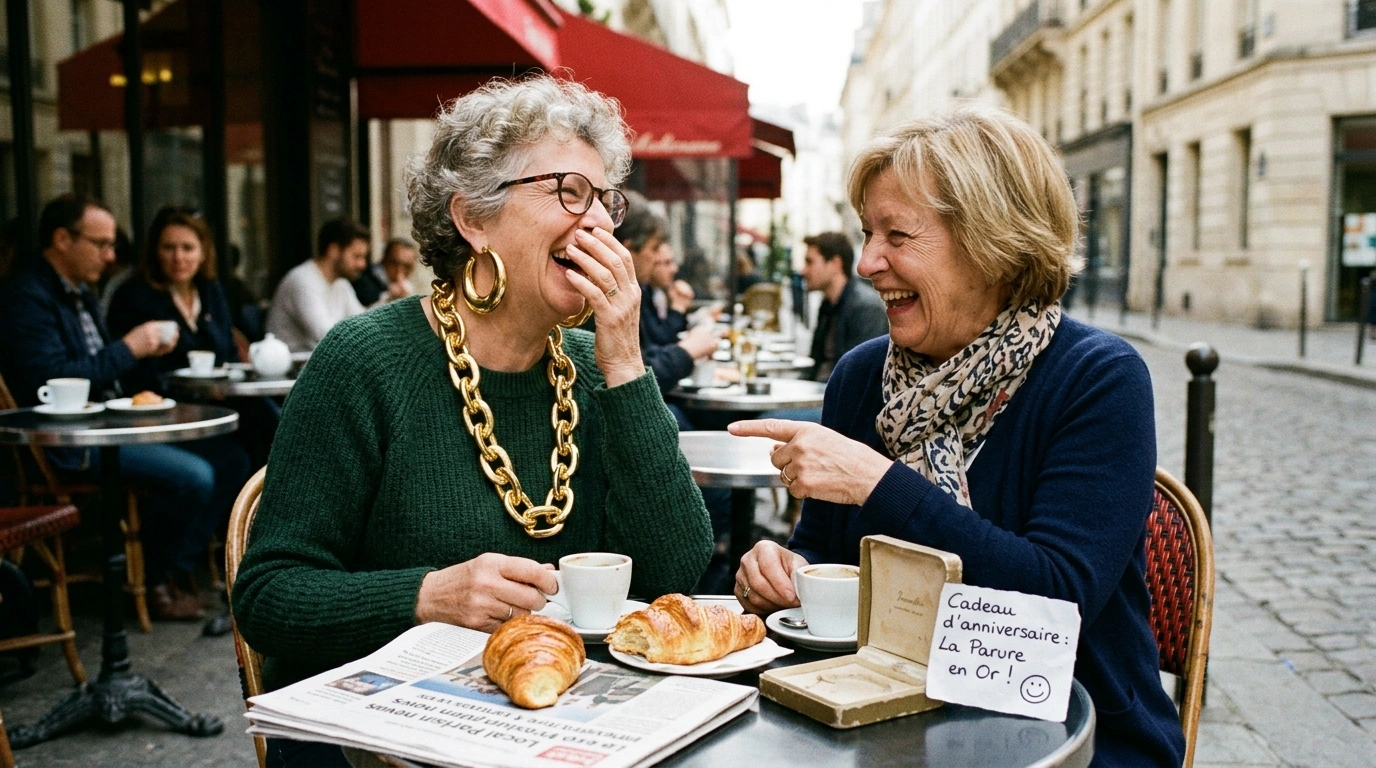
When to Use Parure or En
Knowing the definition is useful, but recognizing the correct word in a sentence is even more important.
Use Parure When You Mean Adornment or a Jewelry Set
Use parure when the sentence refers to:
A jewelry collection
Matching decorative pieces
Adornment
Finery
Decoration in a historical or literary context
For example:
Elle a acheté une parure de bijoux.
She bought a jewelry set.
If you can replace the word with jewelry set, adornment, or finery, parure may be the appropriate choice.
Use En When You Need a French Grammatical Connector
Use en when the sentence requires one of its grammatical functions.
For example:
Nous sommes en France.
We are in France.
Il voyage en voiture.
He travels by car.
Cette chaise est en bois.
This chair is made of wood.
J’en ai deux.
I have two of them.
The meaning of en comes from the sentence around it, so memorizing only one English translation can lead to mistakes.
A Simple Memory Trick
A useful way to remember parure or en is:
Parure = a thing.
En = a grammar word.
If you’re talking about jewelry, adornment, or decoration, think of parure.
If you’re connecting ideas involving place, material, means, or a phrase introduced by de, consider en.
This simple distinction can prevent many beginner-level French mistakes.
Common Mistakes With Parure and En
Mistake 1: Treating Parure as a Preposition
Because French has many short grammatical words, learners may assume unfamiliar vocabulary works in the same way.
However, parure is a noun, not a preposition.
Correct:
Une belle parure.
Incorrect idea:
Using parure in place of en in a grammatical construction.
Mistake 2: Translating En the Same Way Every Time
One of the biggest problems with en is assuming it always means in.
Sometimes it does:
Je suis en France.
But it can also mean by:
Je voyage en train.
It can indicate material:
Une bague en or.
And it can act as a pronoun:
J’en veux.
Context is essential.
Mistake 3: Assuming Similar-Looking Words Are Related in Function
When studying a foreign language, words can look unfamiliar or seem connected simply because they occur in similar texts.
With parure or en, the grammatical difference is much more important than any visual similarity.
Pronunciation: Parure vs En
Pronunciation is another area where French learners may need practice.
Parure contains the French u sound, which does not have an exact equivalent in standard English pronunciation. Learners may initially find this sound difficult.
En, meanwhile, is a short nasal French sound. Its pronunciation changes somewhat according to context and surrounding sounds.
If you’re learning French pronunciation, listening to native speakers is more reliable than trying to reproduce either word using English spelling.
The important point is that parure and en are not simply two pronunciation variants of the same word. They have completely different meanings and grammatical functions.
Regional and Grammar Notes
Unlike some English words that change significantly between American and British English, parure or en does not represent a major US-versus-UK vocabulary difference.
Both words belong to French.
The more important distinction is between standard French grammar and context. Learners may encounter en frequently in France, Canada, Belgium, Switzerland, and other French-speaking communities.
Parure may appear less frequently in everyday conversation because its jewelry and adornment meanings are more specific. It can be especially common in descriptions of fashion, antiques, historical clothing, luxury jewelry, or literature.
Regional French can vary in pronunciation and vocabulary, but the fundamental grammatical distinction between parure and en remains.
Fun Facts and History
1. Parure Has a Strong Connection With Historical Jewelry
The idea of a parure became especially associated with coordinated jewelry sets in European fashion. A wealthy wearer might have matching earrings, necklaces, bracelets, brooches, and other pieces designed to create a unified appearance.
This is why the word can still appear in descriptions of royal or antique jewelry.
2. En Is One of French’s Most Versatile Words
Despite being only two letters long, en performs several important grammatical functions. It can indicate relationships involving place, transportation, material, and quantities, while also replacing certain phrases beginning with de.
That makes it one of the small French words worth learning carefully rather than translating mechanically.
Why Understanding Parure or En Matters
Learning individual vocabulary words is only one part of mastering French. You also need to understand how words function inside sentences.
That’s particularly important with parure or en because they illustrate two very different aspects of the language.
Parure expands your vocabulary by giving you a precise noun connected with adornment and jewelry. En, on the other hand, teaches you how French grammar can express relationships and avoid repeating information.
Once you understand that difference, sentences become much easier to analyze.
For example, if you see:
Elle porte une parure.
You know that parure is naming something she is wearing.
But if you see:
Elle en porte une.
The role of en is completely different. It refers back to something previously mentioned, depending on the context.
This is why context matters so much when studying French.
Frequently Asked Questions
Is parure a French word?
Yes. Parure is a French feminine noun associated with adornment, decoration, finery, or a coordinated set of jewelry.
What does en mean in French?
En has several meanings and grammatical functions. Depending on context, it can mean in, by, made of, or represent something previously introduced with de.
Are parure and en interchangeable?
No. Parure and en have different grammatical roles and meanings, so you cannot normally substitute one for the other.
Is parure masculine or feminine?
Parure is feminine, so you say une parure rather than un parure.
Can en be a pronoun?
Yes. En can function as a pronoun, often replacing a phrase introduced by de or referring to an amount or quantity.
Does parure only mean jewelry?
Not necessarily. Although the word is strongly associated with jewelry, it can also refer more broadly to adornment, decoration, or finery, depending on context.
Is there a US and UK difference between parure and en?
No significant American-versus-British distinction applies because these are French terms. Their meanings are primarily determined by French grammar and context.