
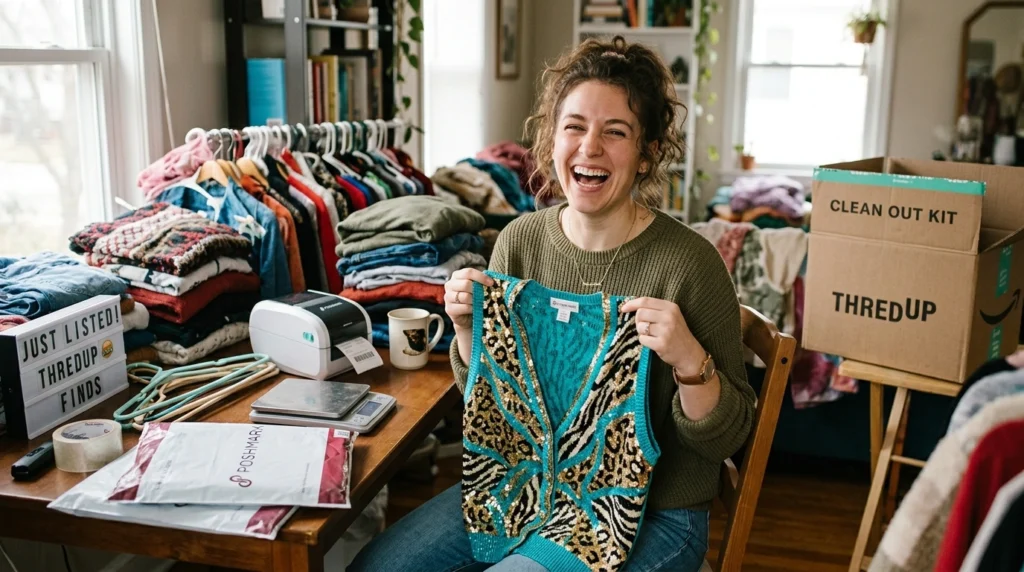
What Is Poshmark?
Poshmark is an online social marketplace focused primarily on fashion and lifestyle products. Individual users can list their own clothing, shoes, accessories, and other eligible items for sale.
Instead of sending everything to Poshmark first, sellers generally create their own listings and remain directly involved in the selling process.
How Poshmark Works
The process is relatively straightforward:
Create an account.
Photograph your item.
Add a description and price.
Publish the listing.
Wait for a buyer.
Ship the item after it sells.
Receive your earnings after the transaction is completed.
This model gives sellers considerable control over how their items are presented.
What Can You Buy on Poshmark?
Poshmark is particularly known for:
Clothing
Shoes
Handbags
Jewelry
Accessories
Beauty products
Home items
Designer and luxury fashion
The selection depends heavily on individual sellers, so inventory changes constantly.
Poshmark’s Marketplace Experience
One of Poshmark’s defining characteristics is its social shopping experience. Buyers and sellers can interact through listings, offers, comments, and other platform features.
This can make Poshmark feel more like a community marketplace than a traditional online clothing store.
Short History of Poshmark
Poshmark was founded in 2011 and grew into one of the major online marketplaces for secondhand fashion in the United States. Its model emphasizes peer-to-peer selling, making individuals a central part of the marketplace.
What Is ThredUp?
ThredUp is an online resale and consignment platform specializing in secondhand clothing, accessories, and related products.
Its model is different from Poshmark because sellers can send clothing to ThredUp rather than handling every individual listing themselves.
How ThredUp Works
A typical selling process involves:
Requesting or obtaining a selling kit when available.
Sending eligible clothing to ThredUp.
ThredUp processes and evaluates the items.
Eligible items are photographed and listed.
Items are sold through the platform.
The seller receives compensation according to the applicable terms.
This makes the process more hands-off for sellers.
What Can You Buy on ThredUp?
ThredUp offers a broad selection of secondhand:
Women’s clothing
Children’s clothing
Shoes
Handbags
Accessories
Designer items
Everyday fashion
Its inventory can be especially useful for shoppers who want to browse large quantities of pre-owned clothing in one place.
ThredUp’s Convenience
The biggest attraction for many sellers is reduced hands-on work.
You don’t necessarily have to photograph every garment, answer buyer questions, negotiate individual offers, or package each sale yourself.
That convenience comes with trade-offs, particularly around control and potential earnings.
Short History of ThredUp
ThredUp was founded in 2009 and developed from an online clothing exchange concept into a large-scale secondhand fashion marketplace and resale operation.
Poshmark or ThredUp: Key Differences
The biggest difference between Poshmark or ThredUp is the selling model.
Key Differences
Poshmark is primarily a peer-to-peer marketplace.
ThredUp operates more like a managed resale and consignment service.
Poshmark gives sellers more control over individual listings.
ThredUp handles much of the listing process for sellers.
Poshmark sellers generally photograph and describe their own products.
ThredUp processes submitted clothing before listing eligible items.
Poshmark can offer more direct interaction between buyers and sellers.
ThredUp can be more convenient for people who don’t want to manage individual sales.
Poshmark may be better for sellers who enjoy negotiating and controlling prices.
ThredUp may appeal more to people who prioritize convenience.
Poshmark or ThredUp Comparison Table
| Feature | Poshmark | ThredUp |
|---|---|---|
| Main model | Peer-to-peer marketplace | Managed resale/consignment |
| Seller lists items | Yes | ThredUp handles listing |
| Seller photographs items | Usually yes | ThredUp handles product photography |
| Seller controls listing | High | Lower |
| Buyer-seller interaction | More direct | More limited |
| Seller workload | Higher | Lower |
| Pricing control | More control | Less control |
| Convenience | Moderate | High |
| Best for | Active sellers | Hands-off sellers |
| Selection | Individual seller inventory | Large centralized inventory |
Real-Life Conversation Examples
Dialogue 1: Selling Clothes
Emma: I have a closet full of clothes to sell. Should I use Poshmark or ThredUp?
Liam: Do you want to handle the listings yourself?
Emma: Not really.
Liam: Then ThredUp may be more convenient.
🎯 Lesson: ThredUp is appealing when you want a more hands-off selling process.
Dialogue 2: Controlling the Price
Sarah: I have a designer jacket, and I know exactly what I want for it.
Mia: Poshmark may be better because you have more control over your listing and pricing.
Sarah: That sounds better for me.
🎯 Lesson: Poshmark is a stronger fit when sellers want more control over individual listings.
Dialogue 3: Buying Secondhand
Noah: I want to browse lots of used clothes without messaging individual sellers.
Olivia: ThredUp could be easier for that.
Noah: So it’s more like shopping through a large resale store?
Olivia: That’s a good way to think about it.
🎯 Lesson: ThredUp can provide a more centralized secondhand shopping experience.
Dialogue 4: Negotiating
Alex: Can I negotiate with sellers on Poshmark?
James: Yes, offers are an important part of the marketplace experience.
Alex: That’s useful.
James: It can help if you’re trying to get a lower price.
🎯 Lesson: Poshmark gives buyers and sellers more opportunities for direct price negotiation.

When to Use Poshmark or ThredUp
Choosing between Poshmark or ThredUp depends on whether you value control or convenience.
Choose Poshmark If You Want:
More control over your listings
Greater control over pricing
Direct interaction with buyers
The ability to negotiate
To sell individual pieces strategically
To photograph and describe your own items
A more interactive marketplace experience
Poshmark can be particularly attractive if you enjoy the selling process and don’t mind putting in some work.
Choose ThredUp If You Want:
Less hands-on selling
A simpler way to clear out clothing
Someone else to handle much of the listing process
A large centralized resale marketplace
Less direct communication with buyers
Convenience over maximum control
ThredUp can make more sense if your main goal is getting unwanted clothing out of your closet without managing dozens of individual listings.
A Simple Memory Trick
Think:
Poshmark = personal marketplace.
ThredUp = send it in and let the platform handle more of the work.
This simple distinction makes the platforms easier to remember.
Poshmark or ThredUp for Sellers
For sellers, the most important question is often profit versus effort.
With Poshmark, you generally have more control over the selling process. You decide how to photograph the item, how to describe it, what price to ask, and whether to negotiate.
That control can be useful for desirable brands, unique pieces, collectibles, or items you believe deserve a carefully optimized listing.
With ThredUp, convenience is a major advantage. You send clothing to the company, and it handles much of the operational process.
However, the trade-off is reduced control. You don’t have the same direct involvement in pricing, presentation, and individual buyer interactions.
Which Is Better for Making Money?
There is no universal winner.
Poshmark may be better if you are willing to invest time into creating strong listings, pricing strategically, responding to buyers, and managing sales.
ThredUp may be better if your priority is convenience and you are willing to accept less control over the selling process.
For high-value clothing, sellers may want to compare the expected payout carefully before choosing a platform.
Poshmark or ThredUp for Buyers
Buyers also experience the platforms differently.
Poshmark
Poshmark can be useful if you enjoy:
Searching individual listings
Making offers
Communicating with sellers
Finding specific brands
Negotiating prices
Shopping from individual closets
The experience can feel similar to browsing many small online boutiques.
ThredUp
ThredUp can be attractive if you prefer:
Centralized inventory
Standardized shopping
Large quantities of secondhand clothing
Searching by size and category
Browsing without negotiating with individual sellers
The experience can feel closer to shopping through a large online thrift store.
Poshmark or ThredUp for Designer Clothing
Both platforms can carry designer and premium brands, but their models are different.
Poshmark can be useful for sellers who want to personally highlight a designer item, provide detailed photographs, and communicate with potential buyers.
ThredUp can be convenient for shoppers who want to search a large inventory of pre-owned branded clothing without dealing with individual sellers.
For expensive items, buyers should always pay attention to descriptions, photographs, authenticity policies, condition, and the platform’s current terms.
Poshmark or ThredUp: Which Is Easier?
For sellers, ThredUp is generally easier if you don’t want to manage individual listings.
Poshmark requires more participation. You need to create listings, photograph items, write descriptions, manage prices, respond to buyers, and ship sold products.
ThredUp removes much of that work by handling the processing and listing side of the transaction.
However, easier does not automatically mean better. A seller who wants control over pricing may prefer Poshmark precisely because it requires more involvement.
Poshmark or ThredUp for Decluttering
If your primary goal is decluttering, ThredUp can be appealing because the process is designed around sending in unwanted clothing rather than creating dozens of individual listings.
Imagine having 30 pieces of clothing you no longer wear.
With Poshmark, you may need to:
Photograph each item
Write descriptions
Set prices
Manage questions
Handle offers
Ship individual sales
With ThredUp, the process is more centralized, although not every submitted item is necessarily accepted or sold.
For someone who values time more than maximum selling control, that distinction can be significant.
Fees and Payouts
Fees and payout structures can change over time, so it’s important to check the platform’s current seller terms before listing an item.
Generally, however, the two platforms approach seller compensation differently because their business models are different.
Poshmark uses transaction-based seller fees, with the exact structure depending on the applicable rules and sale amount.
ThredUp uses a consignment-style structure in which the seller’s payout can depend on the item’s selling price and other applicable conditions.
This means you should not compare platforms based solely on their headline fee.
Instead, consider the final amount you expect to receive after all applicable deductions.
Which Platform Has Better Selection?
The answer depends on what you’re shopping for.
Poshmark can be excellent for finding a specific item from a particular seller, especially if you know the exact brand, model, size, or style you’re looking for.
ThredUp can be appealing for browsing a large centralized selection of secondhand clothing across many categories.
Both inventories change constantly, so availability can vary from one day to another.
Fun Facts and History
1. Both Platforms Help Extend Clothing’s Life
Poshmark and ThredUp are part of the broader growth of the resale fashion market, which allows clothing to be sold again rather than immediately discarded.
2. Their Business Models Are Fundamentally Different
Poshmark emphasizes a social, peer-to-peer marketplace, while ThredUp built its business around processing and reselling secondhand clothing at scale.
That difference explains why the selling experience feels so different on each platform.