
What Is Pumice?
Pumice is a naturally occurring volcanic rock created when gas-rich volcanic lava cools rapidly. The quick cooling process traps tiny air pockets inside the rock, giving pumice its characteristic lightweight and porous structure.
Unlike some artificial growing amendments, pumice is a natural mineral material that can remain stable in soil for a very long time.
How Pumice Is Used in Gardening
Gardeners commonly add pumice to potting mixes because its pores can improve aeration and drainage while still allowing the growing medium to hold some moisture.
Pumice can be especially useful for:
Succulents
Cacti
Bonsai
Container plants
Plants that need excellent drainage
Heavy or compact potting mixes
For example:
“I added pumice to the cactus mix to improve drainage.”
Short History and Usage Note
Pumice has been used by humans for thousands of years for various purposes, including cleaning, polishing, construction, and agriculture. Its porous structure makes it useful well beyond gardening.
In horticulture, its durability is one of its major advantages. It does not quickly break down like many organic materials.
What Is Perlite?
Perlite is a lightweight volcanic glass that is heated to a very high temperature during processing. When heated, the water trapped inside the material expands rapidly, causing the particles to puff up.
The result is a lightweight, white, porous material that is widely used in commercial and home gardening.
How Perlite Is Used in Gardening
Perlite is commonly mixed into potting soil to improve drainage and air circulation. Its lightweight structure creates spaces within the growing medium, helping plant roots receive oxygen.
Perlite is often used for:
Houseplants
Seed-starting mixes
Cuttings
Container gardening
General potting soil
Hydroponic growing systems
For example:
“I mixed perlite into the potting soil to make it lighter and more breathable.”
Short History and Usage Note
Although perlite occurs naturally as volcanic glass, horticultural perlite is produced by heating the raw material until it expands. This creates the familiar lightweight particles used in gardening.
Because it is manufactured through heating, horticultural perlite is different from ordinary crushed volcanic rock.
Key Differences Between Pumice and Perlite
The biggest difference between pumice or perlite is how the materials are formed and how they behave in a growing medium.
Pumice is naturally porous volcanic rock.
Perlite is expanded volcanic glass.
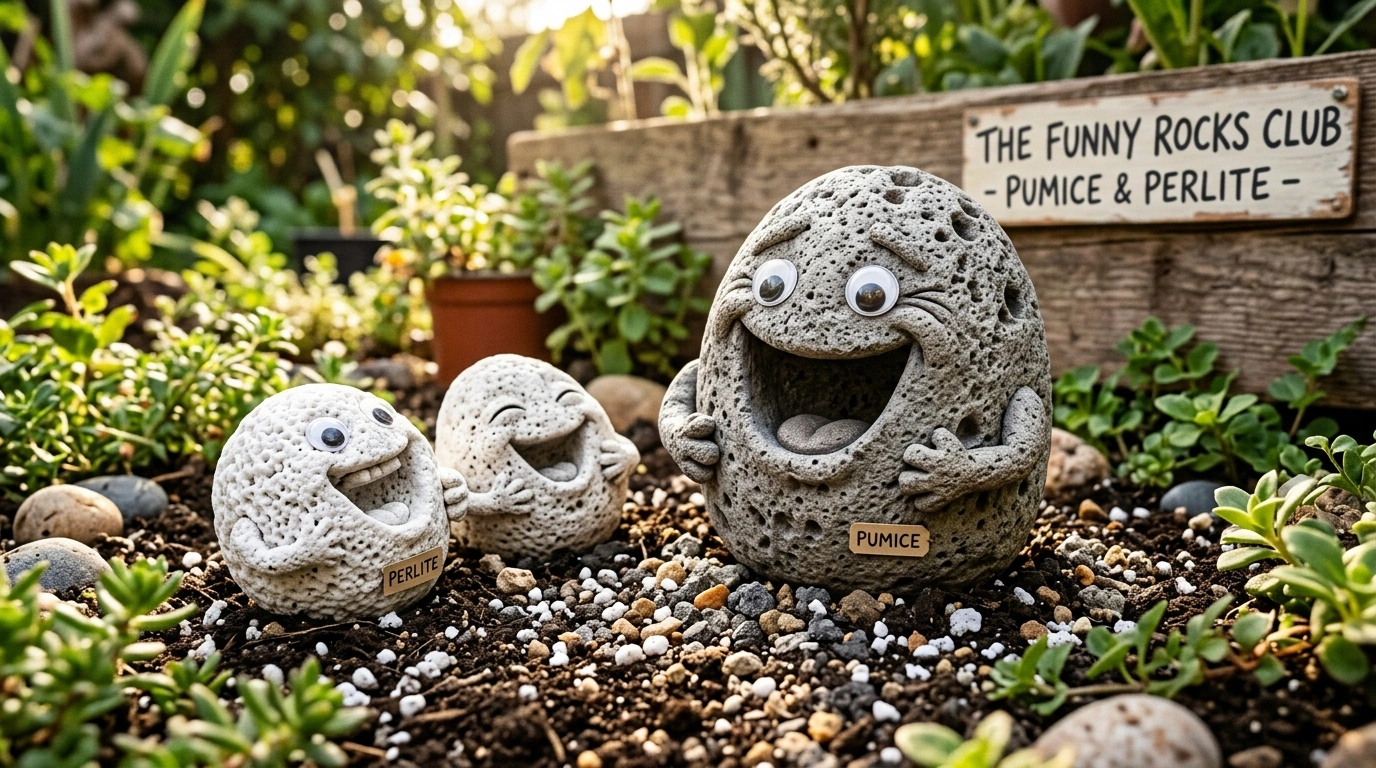
Pumice is generally heavier than perlite.
Perlite is extremely lightweight.
Pumice tends to be more durable and resistant to breaking down.
Perlite can gradually become crushed or move toward the surface of a potting mix.
Both improve drainage and aeration.
Pumice can retain and release some moisture through its pores.
Perlite primarily creates air spaces and improves drainage.
Pumice is often favored for long-term mixes.
Perlite is often inexpensive and widely available for general potting applications.
Comparison Table
| Feature | Pumice | Perlite |
|---|---|---|
| Origin | Natural volcanic rock | Expanded volcanic glass |
| Appearance | Usually gray, tan, or off-white | Usually bright white |
| Weight | Heavier | Very lightweight |
| Drainage | Excellent | Excellent |
| Aeration | Excellent | Excellent |
| Durability | High | Moderate |
| Water retention | Some | Relatively low |
| Best known for | Durable drainage and structure | Lightweight aeration and drainage |
| Common uses | Succulents, cacti, bonsai | Houseplants, seedlings, potting mixes |
| Can float? | Usually no | Often can |
| Long-term stability | High | Lower than pumice |
Real-Life Conversation Examples
Dialogue 1: Growing Succulents
Mia: “Should I add pumice or perlite to my succulent mix?”
Liam: “Either can improve drainage, but pumice is more durable.”
Mia: “So pumice could be useful for a long-term mix?”
Liam: “Yes.”
🎯 Lesson: Pumice is a durable option for plants that need excellent drainage.
Dialogue 2: Lightweight Potting Soil
Emma: “My potting mix feels too heavy.”
Noah: “Try adding some perlite.”
Emma: “Will that make the mix lighter?”
Noah: “Yes, and it can improve airflow around the roots.”
🎯 Lesson: Perlite is a convenient way to make many potting mixes lighter and more aerated.
Dialogue 3: Choosing for Seedlings
Alex: “What should I add to my seed-starting mix?”
Sara: “Perlite is commonly used because it’s lightweight and helps with drainage.”
🎯 Lesson: Perlite is widely used in seed-starting and general propagation mixes.
Dialogue 4: Comparing Durability
Jack: “Why does pumice cost more in some places?”
Olivia: “It can be more durable and doesn’t break down as quickly.”
🎯 Lesson: Pumice can offer better long-term structural stability.
When to Use Pumice or Perlite
Knowing when to choose pumice or perlite depends on the plant and the growing conditions.
Choose Pumice for Long-Term Structure
Pumice is a strong choice when you want a mineral amendment that will remain structurally stable for a long time.
It can work particularly well for:
Cacti
Succulents
Bonsai
Plants requiring excellent drainage
Long-term container mixes
Because pumice is relatively heavy, it can also add some weight to containers, which may help make tall plants or lightweight pots less likely to tip over.
Choose Perlite for Lightweight Mixes
Perlite is often the better choice when you want to improve aeration and drainage without adding much weight.
It is useful for:
Houseplants
Seedlings
Cuttings
General potting soil
Container gardening
It is also widely available and usually easy to mix into commercial potting soil.
Can You Use Both?
Yes. There is no rule saying you must choose only one.
A growing mix can contain both pumice and perlite if you want to combine their characteristics. The ideal ratio depends on the plant, climate, watering habits, container, and other ingredients in the mix.
Easy Memory Trick
Remember:
Pumice = durable volcanic rock.
Perlite = lightweight expanded volcanic glass.
If you want a long-lasting mineral component, pumice may be attractive. If you want an inexpensive, very lightweight material for aeration, perlite is often a practical choice.
Regional Notes
Both materials are sold internationally, but availability, particle size, and price can vary by region. Garden centers may also sell different grades, so comparing the actual particle size can be more useful than relying only on the product name.
Fun Facts or History
1. Pumice Can Be Light Enough to Float
Some pumice can float on water because its structure contains so many air-filled pores. Large volcanic pumice deposits can even accumulate on the surface of the ocean.
2. Perlite Expands Dramatically When Heated
Raw perlite contains water within its structure. When heated rapidly, that water turns to vapor and expands the material, creating the lightweight particles used in horticulture.