

What Is Canik?
Canik is a Turkish firearms manufacturer and a brand under Samsun Yurt Savunma (SYS). The company has produced various pistols for military, law-enforcement, competition, and civilian markets.
Canik became particularly recognized internationally for its TP9 series, followed by newer families such as the METE and SFx lines.
Canik’s General Characteristics
Canik pistols are often associated with:
Polymer frames
Modern striker-fired designs
Ergonomic grip shapes
Interchangeable backstraps on many models
Accessory rails
Optics-ready configurations on selected models
Competitive pricing
Feature-rich packages on some models
The exact specifications vary significantly by model.
Canik Example
A Canik pistol may include features that are optional or less common on an entry-level pistol from another manufacturer. Depending on the model, this can include an optics-ready slide, different grip components, extended controls, or additional accessories.
That makes specific model-to-model comparison especially important.
Short History and Usage Note
Canik’s roots trace back to Turkey, and the company expanded internationally through its growing pistol lineup. Its firearms have received attention in the commercial and competitive shooting markets, helping establish the brand outside its domestic market.
What Is Glock?
Glock is an Austrian firearms manufacturer founded by Gaston Glock. The company became internationally famous for its polymer-framed, striker-fired pistols.
The Glock 17, introduced in the early 1980s, became one of the company’s most recognizable models.
Glock’s General Characteristics
Glock pistols are commonly associated with:
Polymer frames
Striker-fired operation
Simple controls
Consistent trigger system
Broad model selection
Extensive aftermarket support
Straightforward maintenance
Long-standing law-enforcement and military adoption
Different Glock generations and models have introduced changes in ergonomics, texture, optics compatibility, and other features.
Glock’s Reputation
One of Glock’s biggest advantages is its long-established ecosystem.
Because Glock pistols have been widely used for decades, there is extensive familiarity among owners, instructors, armorers, and shooting organizations.
That doesn’t mean every Glock is automatically better than every competing pistol. It does mean the platform has a particularly mature support ecosystem.
Short History and Usage Note
Glock’s first major commercial pistol was the Glock 17. Its polymer frame and striker-fired design were unusual in the handgun market at the time and helped influence the development of many later polymer-framed pistols.
Key Differences Between Canik vs Glock
The most useful distinction between Canik vs Glock is their general approach.
Glock emphasizes simplicity, consistency, and a mature platform.
Canik often emphasizes features and included equipment.
Glock has a particularly large aftermarket ecosystem.
Canik often offers competitive pricing.
Both brands offer multiple sizes and configurations.
Both have polymer-framed striker-fired pistols.
Ergonomics differ considerably between individual models.
Optics compatibility depends on the specific configuration.
Reliability should be evaluated at the model level, not simply by brand.
Training and safe handling matter more than brand preference.
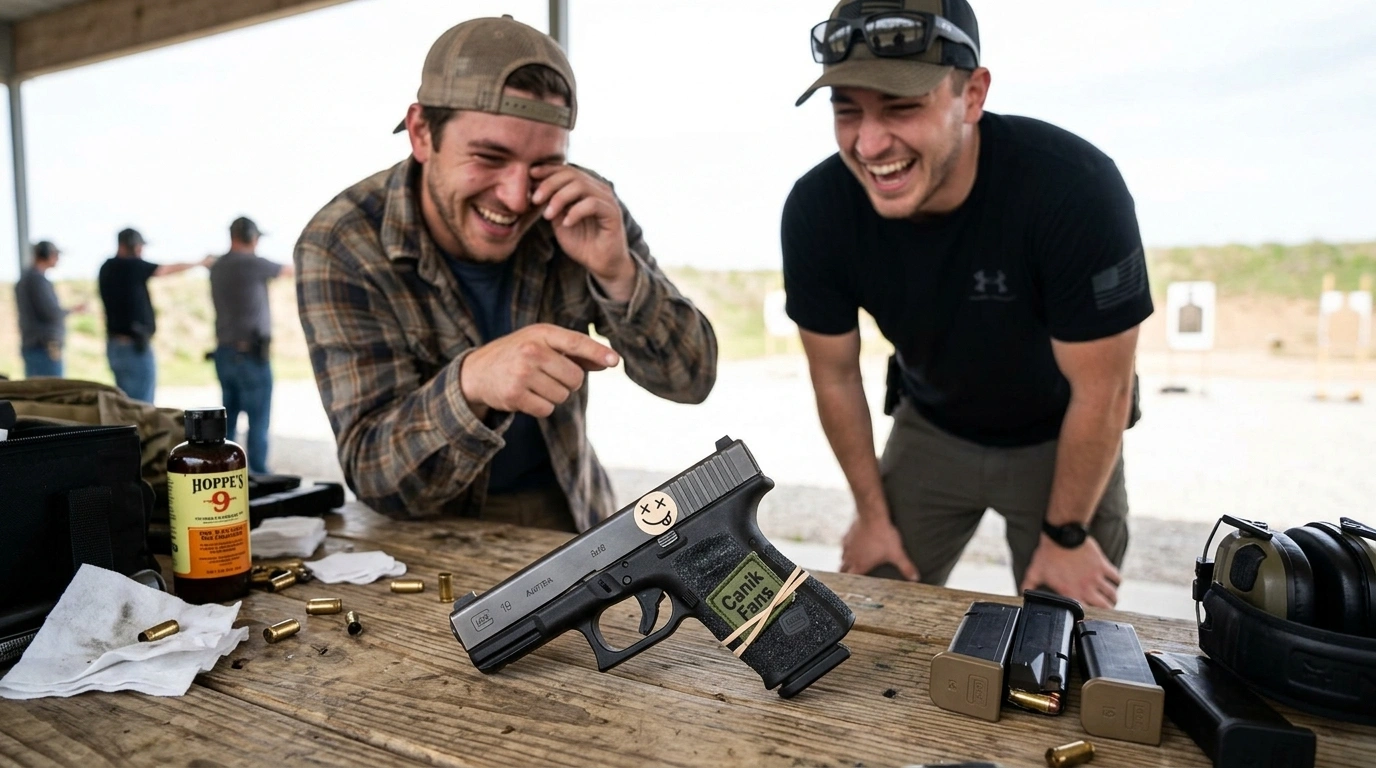
Canik vs Glock Comparison Table
| Feature | Canik | Glock |
|---|---|---|
| Origin | Turkey | Austria |
| Founded | 20th century | 20th century |
| Common construction | Polymer frame | Polymer frame |
| Common action | Striker-fired | Striker-fired |
| Main reputation | Feature-rich value | Simplicity and established platform |
| Model variety | Broad | Very broad |
| Ergonomics | Model dependent | Model dependent |
| Optics-ready options | Available on selected models | Available on selected models |
| Aftermarket support | Growing | Extremely extensive |
| Maintenance | Generally straightforward | Generally straightforward |
| Price positioning | Often competitive | Varies by model |
| Best comparison method | Compare exact model | Compare exact model |
Real-Life Conversation Examples
Dialogue 1: Comparing Brands
Alex: “Is Canik better than Glock?”
Ryan: “That depends on the specific models you’re comparing.”
Alex: “So the brand alone isn’t enough?”
Ryan: “Exactly.”
🎯 Lesson: Compare equivalent models rather than treating an entire brand as one product.
Dialogue 2: Discussing Features
Sam: “Why do people say Canik has a lot of features?”
John: “Some Canik models are packaged with a broad set of features and accessories.”
Sam: “Does that automatically make them better?”
John: “Not necessarily. It depends on what you actually need.”
🎯 Lesson: More features don’t automatically mean a better overall product.
Dialogue 3: Talking About Glock
Nina: “Why is Glock so widely recognized?”
Emma: “It has been around for decades and has a very large user and support ecosystem.”
🎯 Lesson: Glock’s long history contributes to its strong reputation and widespread familiarity.
Dialogue 4: Choosing Based on Ergonomics
Tom: “Which one feels better in the hand?”
Chris: “That’s very personal. Different people prefer different grip shapes and controls.”
🎯 Lesson: Ergonomics are subjective and should be evaluated safely and legally rather than assumed from the brand name.
When to Consider Canik vs Glock
If you’re legally evaluating these brands, focus on specific characteristics rather than brand loyalty.
Consider Canik’s Product Philosophy
Canik may appeal to people interested in a modern, feature-oriented design and competitive pricing.
Different Canik models provide different combinations of:
Grip configurations
Slide designs
Optics compatibility
Controls
Barrel lengths
Competition-oriented features
Consider Glock’s Platform Ecosystem
Glock may appeal to people who value a long-established platform with extensive familiarity and aftermarket availability.
Its broad product family includes compact, subcompact, full-size, and competition-oriented models.
Compare Equivalent Models
A meaningful comparison might involve two pistols with similar:
Overall size
Intended application
Operating system
Capacity category
Optics configuration
Price range
Comparing a compact Canik with a full-size Glock, for example, wouldn’t tell you much about the brands themselves.
Canik vs Glock for Reliability
Reliability should be evaluated at the individual model level.
Both manufacturers have large numbers of users and established production histories, but no mechanical product is completely immune to malfunctions.
Reliability can be influenced by:
Ammunition
Maintenance
Wear
Individual components
Manufacturing variation
Magazine condition
Environmental conditions
For serious evaluation, consult manufacturer documentation and reputable testing rather than relying solely on online anecdotes.
Canik vs Glock for Maintenance
Both platforms are generally known for relatively straightforward maintenance compared with more complicated firearm designs.
However, maintenance should always follow the manufacturer’s instructions for the exact model.
Basic firearm safety principles should always apply:
Treat every firearm as loaded.
Keep the muzzle pointed in a safe direction.
Keep your finger away from the trigger until you have a lawful reason to fire.
Know your target and what is beyond it.
Keep firearms secured from unauthorized access.
Follow local laws and regulations.
If you are unfamiliar with firearm handling, professional instruction from a qualified and legally authorized instructor is the safest way to learn.
Canik vs Glock: Ergonomics
Ergonomics are one of the areas where personal preference matters most.
Things that can differ between models include:
Grip angle
Grip texture
Grip circumference
Slide serrations
Magazine-release design
Controls
Trigger characteristics
Overall dimensions
There is no universal answer to which brand feels better.
A person’s hand size, experience, and preferences can make one design feel considerably more comfortable than another.
Canik vs Glock: Aftermarket Support
This is one area where Glock has a particularly mature ecosystem.
Because Glock pistols have been popular for decades, there is extensive availability of:
Replacement components
Holsters
Sights
Magazines
Training resources
Professional support
Canik’s aftermarket ecosystem has also grown substantially, particularly around popular models, but Glock’s long-established market presence gives it a significant advantage in ecosystem maturity.
Common Mistakes to Avoid
Assuming One Brand Is Always Better
There is no universal winner. A specific Canik can be more suitable than a specific Glock, and vice versa.
Comparing Different Sizes
Always compare similar-sized models when trying to understand meaningful differences.
Focusing Only on Price
The cheapest option isn’t necessarily the best value, and the most expensive option isn’t necessarily the best fit.
Ignoring Local Laws
Firearm ownership, possession, transportation, storage, and use are subject to local laws. Always verify the regulations applicable to your location.
Buying Based Only on Online Opinions
Internet discussions can be useful, but they should not replace manufacturer specifications, qualified instruction, or reputable technical information.
Fun Facts or History
1. Glock Helped Popularize Polymer-Framed Pistols
Glock’s early success demonstrated that a reliable service pistol could use a lightweight polymer frame, influencing the broader handgun industry.
2. Canik Expanded Internationally Through Its Pistol Lineup
Canik developed a strong international presence through its TP-series pistols and later product families, gaining attention in both commercial and competitive shooting markets.