
What Is Aerate?
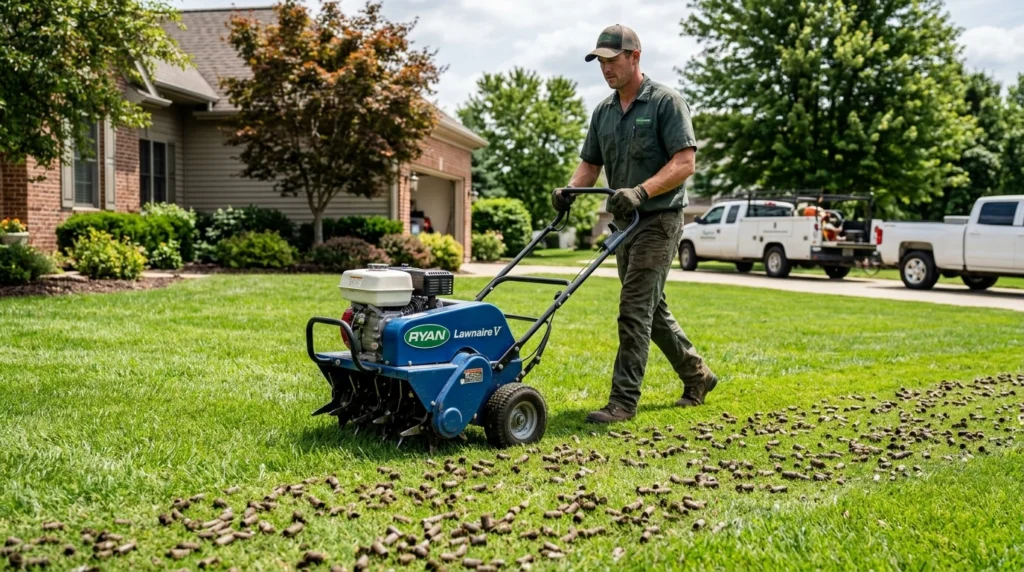
Aerating a lawn means creating holes or channels in the soil to reduce compaction and improve the movement of air, water, and nutrients around grass roots.
Meaning and Purpose
Over time, soil can become tightly packed. Foot traffic, children playing, pets, heavy equipment, and even repeated mowing can contribute to compaction.
When soil becomes compacted, grass roots struggle to access the resources they need. Water may sit on the surface instead of soaking in, and fertilizer may not reach the root zone effectively.
The main purpose of aeration is to loosen compacted soil and improve root-zone conditions.
How Lawn Aeration Works
There are several ways to aerate a lawn, but core aeration is generally one of the most effective methods.
A core aerator removes small plugs of soil from the lawn. These openings allow:
- More air to enter the soil
- Water to penetrate deeper
- Nutrients to reach roots
- Grass roots to grow more freely
- Compacted soil to gradually improve
Spike aerators make holes without removing soil. They can be useful in some situations, but they may not relieve serious compaction as effectively as core aeration.
Example of When to Aerate
Imagine your lawn receives heavy foot traffic. After rain, water collects in certain areas, and the grass looks thin despite regular watering and feeding.
That is a classic situation where aeration may help.
Regional and Lawn-Type Notes
The ideal time to aerate depends on the type of grass you have.
Cool-season grasses are generally best aerated during periods of active growth, often in early fall.
Warm-season grasses are commonly aerated during their active growing season, often in late spring or early summer.
Local climate and grass variety matter, so timing should always be adjusted to your lawn’s conditions.
What Is Dethatch?
Dethatching means removing excessive thatch from the surface of the soil.
Thatch is a layer made primarily from dead and living grass stems, roots, crowns, and other organic material that accumulates between the grass blades and soil surface.
Meaning and Purpose
A small amount of thatch is actually useful. It can help cushion the lawn and return organic matter to the soil.
The problem occurs when thatch becomes too thick.
An excessive thatch layer can prevent water and nutrients from reaching the soil properly. It can also create an environment where certain lawn problems become more likely.
Dethatching removes this excessive material so the grass and soil can interact more effectively.
How Dethatching Works
Dethatching can be done using different tools, including:
- Manual dethatching rakes
- Power dethatchers
- Specialized lawn machines
The tool pulls or cuts through the thatch layer and brings the accumulated material toward the surface, where it can be removed.
Example of When to Dethatch
Suppose your lawn feels spongy when you walk across it. You notice a thick, brown layer between the green grass and the soil, and water seems to have trouble reaching the ground.
In that situation, dethatching may be more appropriate than aeration.
Regional and Grass-Type Considerations
Some grass types naturally produce more thatch than others. Certain warm-season grasses, in particular, can develop significant thatch layers under favorable growing conditions.
However, you should not automatically dethatch every lawn every year. If the thatch layer is thin and healthy, aggressive removal can do more harm than good.
Aerate or Dethatch: Key Differences
The simplest way to understand aerate or dethatch is to identify what is causing your lawn problem.
- Aeration addresses compacted soil.
- Dethatching addresses excessive thatch.
- Aeration creates openings in the soil.
- Dethatching removes material above the soil surface.
- Aeration improves root access to air, water, and nutrients.
- Dethatching removes a barrier that can interfere with water and nutrient movement.
- Aeration is particularly useful after heavy foot traffic.
- Dethatching is useful when a thick thatch layer has developed.
- Core aeration physically removes small plugs of soil.
- Dethatching physically removes accumulated organic debris.
Aerate or Dethatch Comparison Table
| Feature | Aerate | Dethatch |
|---|---|---|
| Main purpose | Relieve soil compaction | Remove excessive thatch |
| Target problem | Compacted soil | Thick thatch layer |
| Where it works | Soil/root zone | Surface above soil |
| Main action | Creates holes or removes soil cores | Removes accumulated organic material |
| Helps water penetration | Yes | Yes, when thatch is blocking water |
| Helps root growth | Directly | Indirectly |
| Best indicator | Hard, compacted soil | Thick thatch layer |
| Common tool | Core aerator | Dethatching rake or machine |
| Can stress grass? | Yes, if poorly timed | Yes, especially if overly aggressive |
| Always necessary? | No | No |
How to Tell Whether Your Lawn Needs Aeration
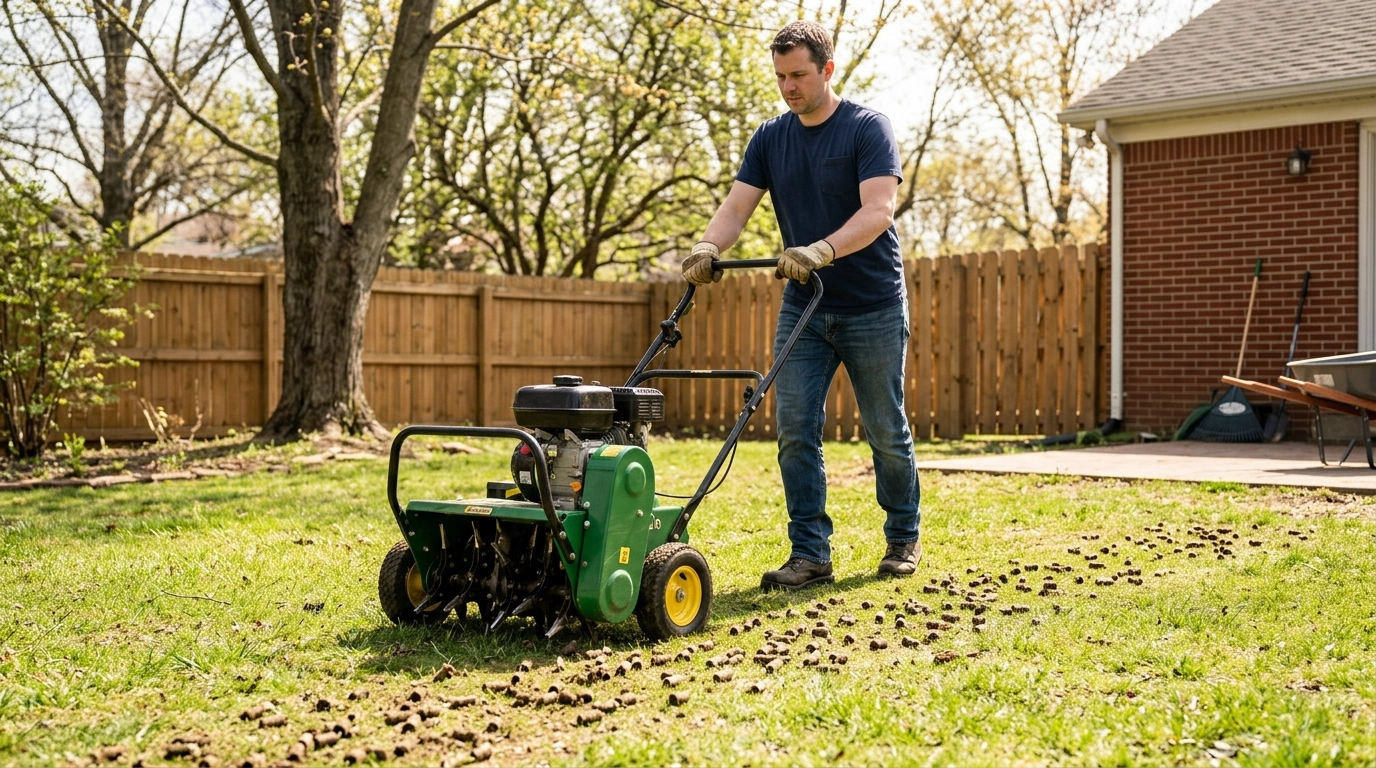
Before deciding between aerate or dethatch, inspect the lawn rather than treating it automatically.
Check for Compacted Soil
Push a screwdriver or similar narrow object into moist soil.
If it is unusually difficult to penetrate, the soil may be compacted.
Other signs include:
- Thin or weak grass
- Standing water after rain
- Poor drainage
- Heavy foot traffic
- Bare patches
- Shallow root growth
If several of these problems appear together, aeration may be the better solution.
Look at Water Behavior
Water that runs off the surface instead of soaking into the soil can indicate compaction.
Aeration can create pathways that allow water to move into the root zone more efficiently.
How to Tell Whether Your Lawn Needs Dethatching
Dethatching requires a different inspection.
Look for a Thick Thatch Layer
Part the grass and examine the area directly above the soil.
If you can clearly see a thick, tightly packed layer of brown organic material, your lawn may have excessive thatch.
A thin layer is generally normal. The concern is excessive accumulation.
Feel the Lawn
A lawn that feels unusually spongy or springy underfoot can sometimes have a significant thatch layer.
However, softness alone does not prove that dethatching is necessary. Soil moisture, grass variety, and other conditions can also affect how a lawn feels.
Can You Aerate and Dethatch at the Same Time?
Sometimes, yes—but you should not assume that every lawn needs both.
If your lawn has both excessive thatch and compacted soil, addressing both problems can make sense.
However, performing aggressive treatments at the wrong time can stress the grass.
Which Comes First?
When both treatments are genuinely necessary, dethatching is often performed first because it removes the dense organic layer from the surface. Aeration can then improve conditions deeper in the soil.
The exact order can depend on grass type, season, lawn condition, and the severity of each problem.
For heavily stressed lawns, a less aggressive approach may be safer than doing everything at once.
Real-Life Conversation Examples
Conversation 1: The Hard Lawn
Jake: “My lawn is hard and water keeps running off. Should I dethatch it?”
Megan: “Not necessarily. If the soil is compacted, aeration is probably what you need.”
Jake: “So dethatching won’t fix compacted soil?”
Megan: “Correct.”
🎯 Lesson: Aeration targets compacted soil, while dethatching targets excessive thatch.
Conversation 2: The Spongy Lawn
Lisa: “The grass feels really spongy when I walk on it.”
Mark: “Have you checked the thatch layer?”
Lisa: “No. I thought I needed to aerate.”
Mark: “Check the surface first. A thick thatch layer could be the issue.”
🎯 Lesson: A thick thatch layer can make dethatching more appropriate than aeration.
Conversation 3: Both Problems
Chris: “My lawn has thick thatch and compacted soil.”
Dan: “Then you may need both treatments.”
Chris: “Can I just do them whenever I want?”
Dan: “Timing matters. Make sure the grass is actively growing and can recover.”
🎯 Lesson: Some lawns need both, but treatment timing and intensity are important.
Conversation 4: The Healthy Lawn
Sara: “Should I dethatch my lawn every spring?”
Tom: “Not automatically.”
Sara: “Why not?”
Tom: “If your thatch layer is healthy, removing it unnecessarily can stress the grass.”
🎯 Lesson: Neither treatment should be performed simply because it is part of a routine.
When to Use Aerate or Dethatch
The decision becomes much easier when you match the treatment to the symptom.
Use Aeration When:
- Soil feels hard or compacted
- Water struggles to penetrate
- Your lawn receives heavy traffic
- Grass roots have limited room to grow
- The lawn has drainage problems related to compaction
- Grass growth is weak despite reasonable care
Use Dethatching When:
- Thatch has become excessively thick
- The lawn feels unusually spongy
- A dense organic layer is visible above the soil
- Water struggles to pass through the thatch
- The grass is being affected by excessive thatch buildup
Memory Trick
Think “air” when you hear aerate.
Aerate = give the soil more air and space.
Think “thatch” when you hear dethatch.
Dethatch = remove excessive thatch.
That simple connection makes the difference between aerate or dethatch much easier to remember.
US and UK Lawn-Care Notes
The basic distinction between aeration and dethatching remains the same in both American and British English.
In the United States, lawn professionals commonly use terms such as core aeration and dethatching.
In the UK and some other regions, you may hear scarifying used when discussing the removal of thatch and surface debris. A scarifier can perform a similar function to a dethatcher, although the exact equipment and depth of operation can vary.
Grass species and climate also differ significantly between regions, so recommended timing is not universal.