
What Is “Apple”?
Meaning and Usage
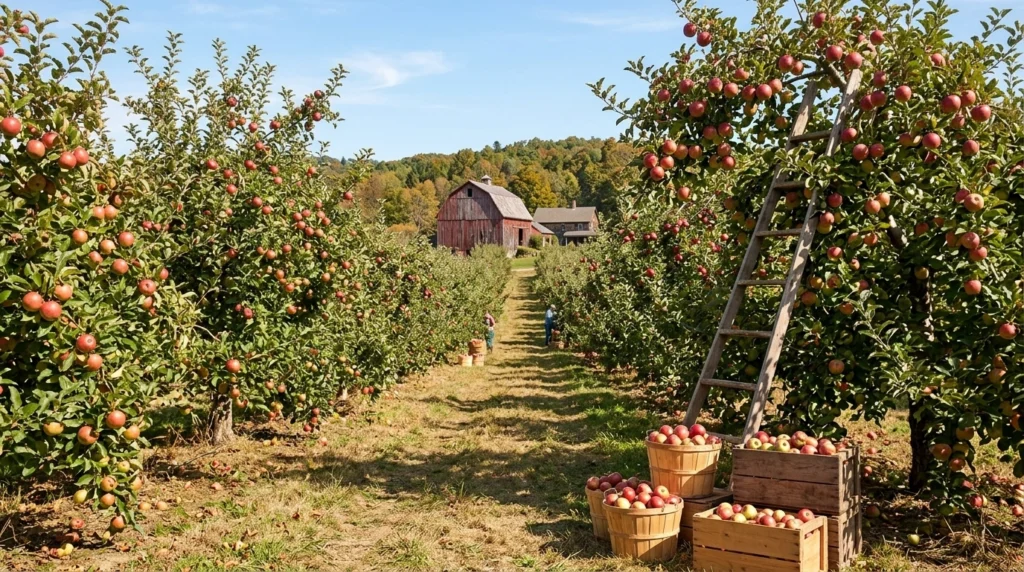
Apple is most commonly a noun referring to the round fruit produced by trees of the genus Malus. Apples come in many varieties and can be eaten fresh, cooked, baked, or turned into products such as juice and cider.
For example:
- “I ate an apple after lunch.”
- “This apple tastes sweet.”
- “She packed two apples for school.”
The word can also appear in names and expressions. Apple may refer to the technology company Apple, depending on capitalization and context.
Grammar Rules
As a noun, apple can be singular or plural:
- Singular: “I bought an apple.”
- Plural: “I bought three apples.”
Because apple begins with a vowel sound, we normally use an rather than a before the singular noun:
“She ate an apple.”
The word can also work as part of compound nouns, such as apple pie, apple juice, and apple tree.
A Short History Note
The English word apple has very old roots. It comes from forms of the word used in earlier Germanic languages and has been part of English vocabulary for centuries.
Apples themselves have a much older history, with domesticated apples originating from regions of Central Asia and spreading widely through human cultivation and trade.
What Is “Hard”?
Meaning and Usage
Hard is most commonly an adjective, but it can also function as an adverb, noun, or verb in certain contexts.
As an adjective, hard can describe something physically firm:
- “The floor is hard.”
- “The apple became hard after being refrigerated.”
It can also describe something difficult:
- “That was a hard question.”
- “Learning a new language can be hard.”
The word can describe effort as well:
“She worked hard to finish the project.”
Grammar and Different Meanings
One interesting feature of hard is its wide range of meanings.
It can mean:
- Firm: “The surface is hard.”
- Difficult: “The exam was hard.”
- Intense: “It rained hard.”
- Strenuous: “They trained hard.”
- Unkind or severe: “He was hard on himself.”
The exact meaning comes from context.
Regional Notes
Hard is used in both American and British English with essentially the same spelling and core meanings.
However, particular expressions involving hard can vary by region or situation. The basic word itself does not normally create a US-versus-UK spelling issue.

Key Differences Between Apple or Hard
The biggest difference between apple or hard is grammatical and semantic: one normally names a thing, while the other describes a quality or action.
- Apple is primarily a noun.
- Hard is primarily an adjective.
- Apple refers most commonly to a fruit.
- Hard can mean firm, difficult, intense, or demanding.
- Apple can be singular or plural.
- Hard usually stays unchanged regardless of the noun it describes.
- Apple often appears in food-related expressions.
- Hard has a much broader range of meanings.
- Neither word normally replaces the other.
| Feature | Apple | Hard |
|---|---|---|
| Main word class | Noun | Adjective |
| Basic meaning | A type of fruit | Firm, difficult, or intense |
| Plural form | Apples | Usually unchanged |
| Example | “I ate an apple.” | “The test was hard.” |
| Can describe difficulty? | No | Yes |
| Can name a physical object? | Yes | Not normally |
| Common compound phrases | Apple pie, apple juice | Hard work, hard surface |
| US/UK spelling difference | None | None |
Real-Life Conversation Examples
Example 1: Talking About Food
Emma: “What did you put in your lunch?”
Noah: “An apple and a sandwich.”
Emma: “Is the apple fresh?”
Noah: “Yes, but it’s quite hard.”
🎯 Lesson: Apple identifies the fruit, while hard describes its physical texture.
Example 2: Talking About Difficulty
Liam: “How was the exam?”
Sara: “It was hard.”
Liam: “Hard as in physically difficult?”
Sara: “No, hard as in difficult to answer!”
🎯 Lesson: Hard can describe something that is difficult rather than physically firm.
Example 3: Describing an Object
Jack: “Why can’t I squeeze this?”
Mia: “Because it’s hard.”
Jack: “Oh, I thought it was an apple.”
Mia: “It is an apple. It’s just a firm one.”
🎯 Lesson: Apple identifies what something is; hard describes one of its qualities.
Example 4: Talking About Work
Alex: “Why are you still working?”
Ben: “I have a deadline tomorrow, so I’m working hard tonight.”
Alex: “Good luck!”
🎯 Lesson: Hard can also describe the intensity of an action.
When to Use Apple or Hard
Use “Apple” When Naming the Fruit
Choose apple when you are talking about the fruit, the tree, food made from apples, or a name that specifically includes the word.
Examples include:
- “I bought an apple.”
- “The apple tree is flowering.”
- “We made apple pie.”
- “She prefers green apples.”
A useful memory trick is simple: apple = a thing.
Use “Hard” When Describing Something
Choose hard when you want to describe a quality such as firmness or difficulty.
Examples:
- “The bread is hard.”
- “The assignment was hard.”
- “He works hard.”
- “The ground is hard.”
Think of hard = a quality or condition.
When Both Words Appear Together
These words can naturally appear in the same sentence:
“The apple is hard.”
Here, apple tells you what the object is, while hard tells you what it is like.
This is a useful way to remember the distinction between apple or hard: they are not competing vocabulary choices. They can actually work together.