
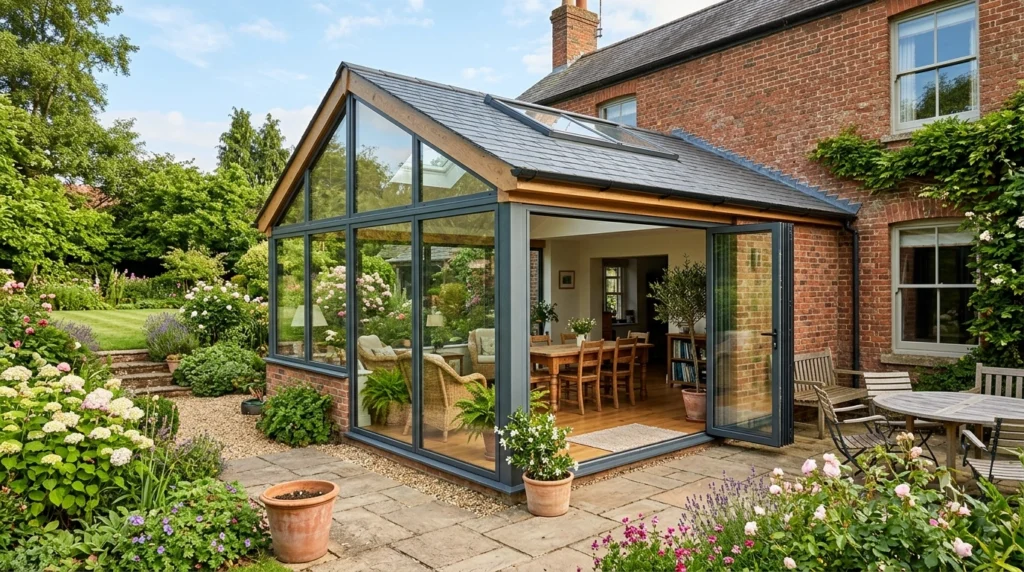
What Is a Conservatory?
A conservatory is a glazed structure attached to a house, traditionally designed with substantial areas of glass in its walls and often its roof. It creates an indoor space that feels closely connected to the garden or outdoor area.
Conservatories are particularly common in the UK and can take many forms.
Common Types of Conservatory
Popular designs include:
- Victorian conservatories
- Edwardian conservatories
- Lean-to conservatories
- Gable-end conservatories
- P-shaped conservatories
- Orangery-style designs
Each style has a different appearance and can suit different types of properties.
What Is a Conservatory Used For?
A conservatory can serve as:
- A dining area
- Garden room
- Lounge
- Home office
- Reading room
- Playroom
- Entertaining space
Because conservatories typically have extensive glazing, they can feel bright and spacious during daylight hours.
Advantages of a Conservatory
A well-designed conservatory can offer several benefits:
- Plenty of natural light
- Strong visual connection with the garden
- Attractive architectural feature
- Potentially lower construction cost than a large extension
- Variety of styles
- Relatively quick installation
- Additional living space
Modern conservatories can also include improved glazing, insulated roofs, underfloor heating, and better ventilation than older designs.
Disadvantages of a Conservatory
Traditional conservatories can have some drawbacks.
They may:
- Become too hot during summer
- Feel cold during winter
- Require additional heating
- Have limited wall space for furniture
- Need regular glass cleaning
- Be less flexible than a conventional extension
The quality of the glazing, roof, ventilation, insulation, and construction has a major effect on comfort.
What Is an Extension?
A house extension is a permanent addition that expands the existing structure of a property. Unlike a traditional conservatory, an extension can be designed with conventional insulated walls, a solid roof, large windows, rooflights, or a combination of materials.
Extensions can dramatically change how a house works.
Common Types of Extension
Popular options include:
- Rear extensions
- Side-return extensions
- Wraparound extensions
- Single-storey extensions
- Double-storey extensions
- Kitchen extensions
- Loft or upper-floor extensions
The best type depends on the property, available land, budget, and local planning requirements.
What Is an Extension Used For?
An extension can create space for:
- Larger kitchens
- Dining rooms
- Family rooms
- Home offices
- Bedrooms
- Bathrooms
- Utility rooms
- Open-plan living areas
Because an extension can be designed almost like any other part of the house, it usually offers greater flexibility.
Advantages of an Extension
An extension can provide:
- Better year-round comfort
- Greater design flexibility
- Strong insulation
- More usable wall space
- Better integration with the original house
- Larger floor areas
- Greater control over windows and doors
- Potential to add significant property value
Disadvantages of an Extension
Extensions can also be more demanding.
They may involve:
- Higher construction costs
- Longer construction periods
- More complicated structural work
- Building regulations
- Planning considerations
- More disruption during construction
- Higher design and professional fees
A larger extension can become a significant building project rather than a simple home improvement.
Conservatory or Extension: Key Differences
When comparing conservatory or extension, the biggest differences involve construction, insulation, design flexibility, and cost.
Main Differences
- A conservatory typically has extensive glazing.
- An extension usually uses conventional insulated walls.
- Conservatories often have a stronger visual connection with the garden.
- Extensions generally provide more usable wall space.
- A well-built extension is usually easier to integrate with the main house.
- Conservatories can be quicker to install.
- Extensions usually offer greater design flexibility.
- Modern conservatories can be comfortable year-round when properly designed.
- Extensions are generally better suited to major changes in the home’s layout.
- Both can increase usable living space and potentially add property value.
Comparison Table
| Feature | Conservatory | Extension |
|---|---|---|
| Main construction | Large areas of glazing | Conventional walls and glazing |
| Roof | Often glazed or lightweight | Solid, tiled, flat, or mixed |
| Natural light | Excellent | Excellent with suitable design |
| Year-round comfort | Depends heavily on specification | Generally easier to achieve |
| Design flexibility | Moderate | High |
| Wall space | Limited | More available |
| Construction time | Often shorter | Usually longer |
| Cost | Often lower | Usually higher |
| Heating requirements | Can be higher | Easier to insulate |
| Connection to garden | Excellent | Excellent |
| Layout flexibility | Moderate | High |
| Best for | Bright garden-connected room | Integrated living space |
Real-Life Conversation Examples
Conversation 1: Garden Room
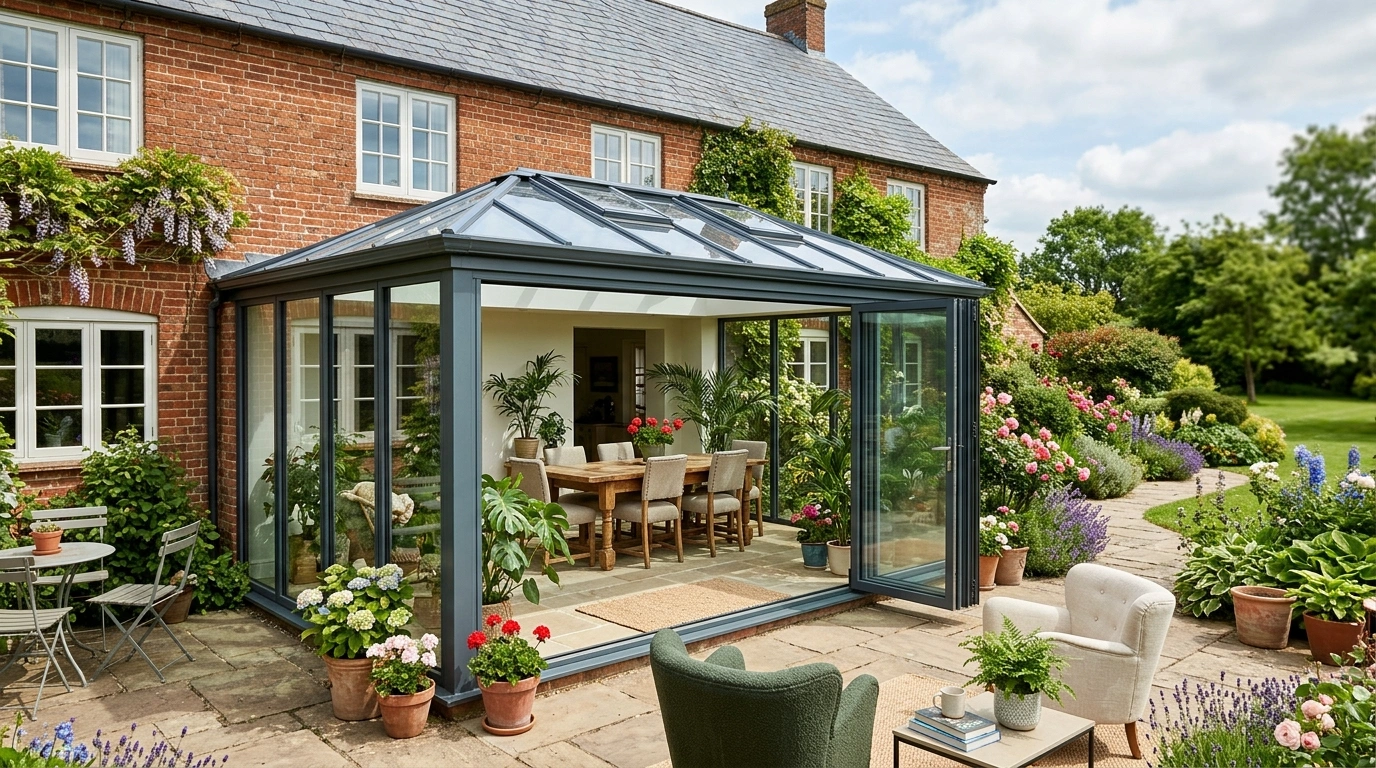
Emma: “I want somewhere bright where I can sit and look at the garden.”
James: “A conservatory could work really well.”
🎯 Lesson: A conservatory can be ideal when natural light and garden views are priorities.
Conversation 2: Bigger Kitchen
Sarah: “We need a much larger kitchen and dining area.”
Tom: “An extension would give you more flexibility.”
🎯 Lesson: An extension is generally better for substantial changes to the home’s layout.
Conversation 3: Year-Round Office
Alex: “I want a home office that stays comfortable in winter and summer.”
Mia: “Look at both options, but make insulation a major consideration.”
🎯 Lesson: Both can work, but year-round comfort depends heavily on the construction and specification.
Conversation 4: Budget
Daniel: “I want extra space, but my budget is limited.”
Lucy: “A smaller conservatory might cost less than a large extension.”
🎯 Lesson: Conservatories can be a more economical way to add space, although actual costs vary significantly.
When to Choose Conservatory or Extension
The right choice depends on your goals.
Choose a Conservatory If You Want:
A conservatory may suit you if you want:
- A bright room
- Strong garden views
- A relatively lightweight addition
- A dedicated garden room
- A dining or relaxation area
- Potentially lower construction costs
- A visually distinctive feature
It can be particularly attractive if your garden is an important part of your home’s character.
Choose an Extension If You Want:
An extension may be better if you need:
- A larger kitchen
- A new bedroom
- A substantial family room
- Better insulation
- More wall space
- A completely integrated living area
- Greater design flexibility
- A major change to your floor plan
An extension is usually the better option when you’re trying to solve a fundamental space problem rather than simply add a bright extra room.
Conservatory or Extension for Year-Round Use
One of the biggest questions when choosing a conservatory or extension is whether you’ll use the space throughout the year.
Older conservatories sometimes developed a reputation for being:
- Too hot in summer
- Too cold in winter
- Expensive to heat
- Poorly ventilated
Modern designs can perform much better.
How to Make a Conservatory More Comfortable
You can improve performance with:
- High-performance glazing
- Insulated frames
- An insulated roof
- External shading
- Appropriate ventilation
- Underfloor heating
- Efficient heating systems
- Good-quality construction
An extension generally starts with an advantage because it can use conventional insulated walls and roof structures.
Winner for easier year-round comfort: Extension.
However, a high-quality modern conservatory can still provide comfortable year-round accommodation.
Conservatory or Extension Cost
Cost is one of the biggest reasons homeowners compare these options.
A conservatory can often be less expensive than a similarly sized conventional extension because its construction can involve less extensive structural work.
An extension can cost more because you may need:
- Foundations
- Structural calculations
- More extensive brickwork
- Roofing
- Insulation
- Plumbing
- Electrical work
- Internal finishing
- Architectural services
However, there is no universal price difference.
The final cost depends on:
- Size
- Location
- Materials
- Ground conditions
- Structural requirements
- Glazing
- Roof design
- Interior finish
- Heating
- Plumbing
- Contractor rates
For an accurate decision, compare quotes for complete finished projects, rather than comparing only the basic structure.
Conservatory or Extension and Property Value
Both can potentially improve a home’s appeal and usability, but neither automatically guarantees a particular increase in property value.
A poorly designed addition can actually make a property less attractive.
A successful project should:
- Suit the existing house
- Provide genuinely useful space
- Have good proportions
- Meet building standards
- Work well with the garden
- Avoid creating awkward layouts
An extension can potentially add more valuable floor area because it can become an integrated part of the house.
However, a well-designed conservatory can also be a desirable feature, particularly where it complements the property.
Planning and Building Regulations
Planning and building requirements depend on the property’s location, size, design, and other factors.
In the UK, some home improvements may qualify for permitted development rights, while others may require planning permission. Building regulations can apply even when planning permission isn’t required.
Because rules can change and vary by circumstances, check current requirements with the relevant local authority or a qualified professional before starting work.
This is particularly important for:
- Larger extensions
- Properties in conservation areas
- Listed buildings
- Properties with previous extensions
- Projects close to boundaries
Don’t assume that a project is exempt simply because it is called a “conservatory.”
Conservatory or Extension for a Kitchen
If your main goal is a larger kitchen, an extension will usually offer more flexibility.
You can design the space around:
- Kitchen islands
- Dining areas
- Storage
- Utility spaces
- Rooflights
- Large doors
- Open-plan layouts
A conservatory can work as a dining area connected to a kitchen, but its extensive glazing may limit where cabinets and appliances can be positioned.
Winner for kitchen expansion: Extension.
Conservatory or Extension for Garden Views
If your priority is maximizing the feeling of being surrounded by the garden, a conservatory can be extremely effective.
Large glazed walls and roofs can bring in abundant daylight and create a strong visual connection between indoors and outdoors.
A modern extension can achieve a similar effect with:
- Bifold doors
- Sliding doors
- Large windows
- Rooflights
- Glazed roof sections
So the choice ultimately depends on whether you prefer a glass-heavy garden room or a more conventional living space with carefully designed glazing.