
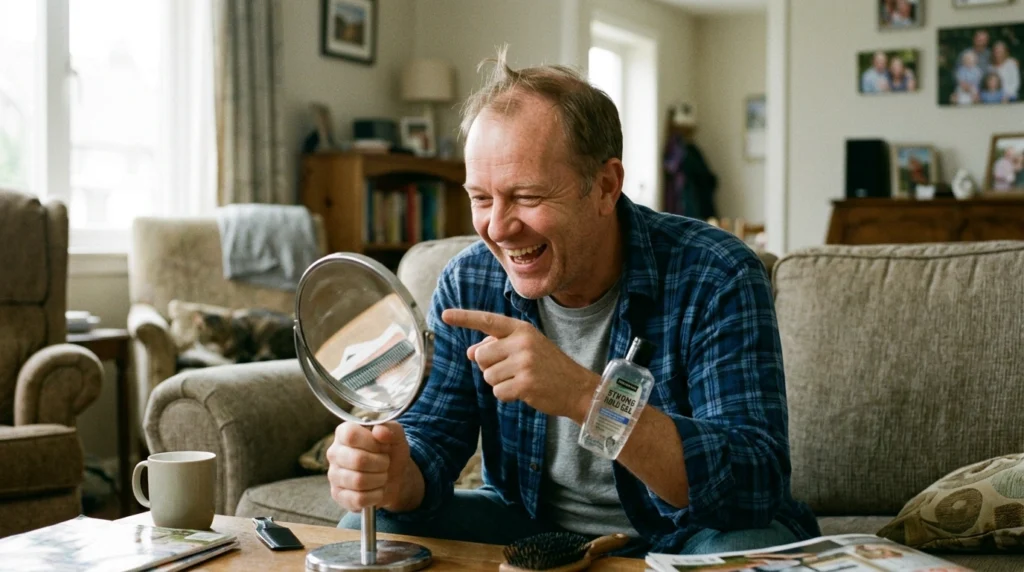
What Is a Cowlick?
A cowlick is a section of hair that grows or naturally sits in a direction that differs from the surrounding hair. Instead of lying smoothly with the rest of the hair, the strands may stick up, spiral, separate, or form a noticeable swirl.
Cowlicks are especially common around the crown of the head, although they can occur near the hairline, temples, or other areas.
A cowlick does not automatically mean that you are losing hair. In many cases, it is simply part of your natural hair-growth pattern.
How Is a Cowlick Used?
The term cowlick is informal and is generally used to describe the appearance of hair rather than a medical condition.
For example:
“I have a cowlick at the back of my head.”
“My hair always sticks up because of a cowlick.”
“The barber knows how to cut around my cowlick.”
“My cowlick becomes obvious when my hair is wet.”
A cowlick can be present from childhood and remain noticeable throughout adulthood.
What Does a Cowlick Look Like?
A cowlick may appear as:
A circular swirl
Hair sticking upward
A section that refuses to lie flat
Strands growing in a different direction
A visible part or opening in the hair
A stubborn area that changes shape depending on styling
The important point is that the hair itself may still be relatively dense.
A Short History of the Term
The word “cowlick” comes from the appearance of a young cow’s hair after its mother licks it. The hair can appear to stand or separate in an unusual direction.
Today, the word is commonly used for stubborn or differently oriented sections of human hair.
What Is Thinning?
Hair thinning refers to a reduction in the density or amount of visible hair. Unlike a cowlick, thinning can involve fewer hairs covering an area of the scalp.
Thinning can occur gradually or, depending on the cause, more suddenly. It may affect the crown, hairline, temples, or other areas.
There are many possible reasons for changes in hair density, including genetics, aging, hormonal changes, nutritional issues, certain medications, stress-related shedding, and other conditions. Because the causes vary, persistent or noticeable changes may warrant professional evaluation.
How Does Thinning Look?
Hair thinning may involve:
A progressively wider part
More scalp becoming visible
Reduced density at the crown
Receding areas around the temples
A smaller-looking ponytail
More noticeable scalp under normal lighting
Increased shedding in some cases
One important clue is change over time. If an area has always looked the same and the hair density remains stable, it may simply be a natural pattern such as a cowlick.
Does Thinning Always Mean Hair Loss?
Not necessarily.
Hair naturally goes through cycles of growth and shedding. Temporary shedding can occur for various reasons, while progressive thinning can have different causes.
That is why appearance alone cannot always tell you exactly what is happening.
If you notice a persistent or rapidly changing pattern, a dermatologist or qualified healthcare professional can help determine the underlying cause.
Cowlick or Thinning: Key Differences
The biggest difference between cowlick or thinning is that a cowlick primarily involves hair direction, while thinning involves hair density.
1. Hair Direction
A cowlick causes hair to grow or sit in an unusual direction.
Thinning does not necessarily change the direction of the remaining hair.
2. Hair Density
A cowlick can exist even when the area has normal hair density.
Thinning means there is less visible hair density in the affected area.
3. Stability
Cowlicks are often stable for years.
Thinning may gradually become more noticeable.
4. Appearance When Wet
Both can make the scalp easier to see when hair is wet. However, wet hair can exaggerate a cowlick because strands separate and follow their natural growth direction.
5. Hairline Changes
A cowlick can occur near the hairline without causing recession.
Thinning may sometimes involve the temples or hairline, depending on the underlying pattern.
6. Styling
Cowlicks often respond differently to brushing, drying, or haircutting.
Thinning can remain visible even after styling because the underlying issue is reduced density.
7. Progression
A cowlick generally does not progressively expand simply because it is a cowlick.
Progressive changes in density deserve more attention.

Cowlick vs Thinning Comparison Table
| Feature | Cowlick | Thinning |
|---|---|---|
| Main issue | Hair direction | Reduced hair density |
| Usually natural? | Yes | Can have many causes |
| Scalp visibility | May appear more visible | Often increases |
| Hair direction | Often unusual or swirling | May remain normal |
| Present since childhood | Common | Not necessarily |
| Changes over time | Usually stable | May progress |
| Styling effect | Often changes noticeably | May remain visible |
| Crown involvement | Common | Also possible |
| Requires treatment? | Usually not | Depends on the cause |
| Professional evaluation | Usually unnecessary | Useful if persistent or concerning |
Real-Life Conversation Examples
Conversation 1: The Crown
Alex: “Why does the back of my hair look so thin?”
Sam: “Does it actually have fewer hairs, or does the hair just spiral there?”
Alex: “It has always spiraled in that spot.”
Sam: “That sounds more like a cowlick.”
🎯 Lesson: A stable swirl with normal density may simply be a cowlick.
Conversation 2: A Changing Hairline
Mia: “My hairline looks different this year.”
Emma: “Has the shape always been like that?”
Mia: “No, I’ve noticed more scalp over the past several months.”
🎯 Lesson: A noticeable change in density over time is more consistent with thinning than a longstanding cowlick.
Conversation 3: Wet Hair
Tom: “My scalp looks really visible after I shower.”
Jake: “Does it look the same once your hair dries?”
Tom: “Not really. It looks much fuller when dry.”
🎯 Lesson: Wet hair can make natural growth patterns and scalp visibility appear more dramatic.
Conversation 4: Styling
Sarah: “This section always sticks up.”
Lisa: “Does brushing it in another direction help?”
Sarah: “Only temporarily. It always goes back.”
🎯 Lesson: Hair that repeatedly returns to the same direction may be following a natural cowlick pattern.
When to Use Cowlick vs Thinning
The distinction between cowlick or thinning becomes easier when you focus on whether you are seeing a difference in direction or density.
Signs That May Point Toward a Cowlick
A cowlick may be more likely if:
The area has looked similar for years.
Hair naturally forms a swirl.
Strands point in different directions.
The hair appears fuller when styled.
The pattern becomes more obvious when hair is wet.
The area does not appear to be progressively expanding.
Signs That May Point Toward Thinning
Thinning may be more likely if:
You notice a gradual reduction in density.
More scalp is visible than before.
Your part appears wider.
The crown appears increasingly sparse.
The hairline or temples are changing.
Your ponytail or overall hair volume seems smaller.
You are experiencing persistent or unusual shedding.
These signs are not a diagnosis. Hair changes can have many explanations, and a professional evaluation is the most reliable way to identify the cause of persistent changes.
A Simple Memory Trick
Remember:
Cowlick = direction.
Thinning = density.
If the main problem is that your hair changes direction, think cowlick.
If the main change is that you have less hair covering the area, think thinning.
This simple distinction can help you describe what you are seeing more accurately.
Can a Cowlick Look Like Thinning?
Yes. This is one reason people search for cowlick or thinning in the first place.
A cowlick can create a small opening in the hair where the scalp becomes visible. When viewed from above, especially under bright light, that opening may look like a thinning patch.
The effect can become even more noticeable when:
Hair is wet
Hair is oily
Hair is very short
Bright overhead lighting is present
Hair is naturally fine
The surrounding hair is lying flat
One useful clue is whether the pattern is stable. A cowlick that has looked the same for years is generally different from an area that is steadily losing density.
Can Thinning Look Like a Cowlick?
Yes. Early thinning, particularly around the crown, can sometimes be mistaken for a normal hair swirl.
The crown naturally has a spiral pattern, so reduced density in that area can be difficult to recognize at first.
Instead of focusing on one photograph or one day, compare the area over time under similar lighting and with similar hair conditions.
If you notice a clear change in density, it is worth discussing the change with a dermatologist or other qualified healthcare professional.
How Hair Length Can Affect the Appearance
Hair length can dramatically change how a cowlick or thinning area looks.
Short hair may stand up around a cowlick, making the swirl obvious. Longer hair may weigh the strands down and make the pattern less noticeable.
Thinning can also appear different depending on hairstyle. A longer style may cover a sparse area, while a short haircut may make changes in density easier to see.
This is why comparing photographs taken with completely different hairstyles can be misleading.
For a more useful comparison, use similar lighting, hairstyle, and camera angle.
Styling a Cowlick
If the issue is a cowlick rather than thinning, styling techniques can make the area easier to manage.
You can try:
Blow-drying the hair in the opposite direction.
Using a lightweight styling product.
Asking your barber or stylist to work with the growth pattern.
Avoiding a haircut that emphasizes the swirl.
Using the natural direction of the hair instead of fighting it.
A skilled stylist can often identify a cowlick and adjust the haircut accordingly.
When Should You Pay Attention to Hair Thinning?
A changing hair pattern does not automatically indicate a serious problem, but persistent, sudden, or noticeable hair loss deserves attention.
Consider speaking with a dermatologist or healthcare professional if you notice:
Sudden or rapid hair loss
Clearly expanding areas of reduced density
Significant changes in the hairline
Persistent heavy shedding
Scalp symptoms such as redness, scaling, pain, or itching
Hair loss occurring alongside other concerning changes
The cause matters because different types of hair loss require different approaches.
Avoid assuming that every visible scalp area is thinning simply because it looks different under bright lighting.
Fun Facts About Cowlicks and Hair
1. Cowlicks Are Natural Growth Patterns
A cowlick is not necessarily a sign of damaged or unhealthy hair. It is often simply the direction in which hair naturally grows.
2. The Crown Is a Common Location
Many people have a natural swirl around the crown. Because this area naturally separates the hair, it can sometimes make the scalp more visible.
Cowlick or Thinning: Which One Is It?
When deciding between cowlick or thinning, start by asking one simple question:
Has the hair direction changed, or has the hair density changed?
If your hair forms a stable swirl, sticks up in one particular area, and has looked similar for years, a cowlick may explain the appearance.
If the area is becoming progressively less dense, the scalp is increasingly visible, or the hairline is changing, thinning may be a more relevant possibility.
Remember that appearance alone cannot determine the exact cause of hair loss. If you are concerned about a noticeable or progressive change, getting professional advice is the safest way to understand what is happening.