

What Is Epoxy?
Epoxy is a type of polymer material commonly supplied as a two-part system consisting of an epoxy resin and a hardener or curing agent.
When the two components are mixed in the correct ratio, they undergo a chemical reaction that transforms the liquid mixture into a solid material.
How Epoxy Works
A typical epoxy system includes:
- Part A: Epoxy resin
- Part B: Hardener or curing agent
The two parts must be mixed according to the manufacturer’s specified ratio.
Unlike materials that simply dry because water or solvent evaporates, epoxy generally cures through a chemical reaction.
This distinction is important.
Drying and curing are not necessarily the same thing.
Epoxy can become solid while continuing to develop its final properties during the curing process.
Common Uses of Epoxy
Epoxy is widely used for:
- Adhesives
- Wood coatings
- Tables and countertops
- Garage floors
- Jewelry
- Art projects
- Electrical encapsulation
- Composite materials
- Protective coatings
- Repairs
Its combination of strength, adhesion, and durability makes it useful in both hobby and industrial applications.
Why Is Epoxy So Popular?
Epoxy can provide excellent adhesion to many properly prepared surfaces.
It can also offer:
- Good chemical resistance
- Strong bonding
- Water resistance after proper curing
- Durability
- A smooth finish
- Low shrinkage in many formulations
However, performance varies significantly between products.
A tabletop epoxy isn’t necessarily suitable for structural bonding, and a structural adhesive isn’t necessarily designed for thick decorative pours.
A Short History of Epoxy
Epoxy chemistry developed during the 20th century, with important developments occurring in the 1930s and 1940s.
The technology eventually became important in adhesives, coatings, electronics, aerospace, construction, and composite materials.
Today, epoxy is used in everything from small craft projects to advanced industrial applications.
What Is Resin?
Resin is a much broader term. In simple language, it refers to a wide family of materials that can be natural or synthetic and that can often be transformed into solid polymers or used as components of polymer systems.
In modern manufacturing and crafts, “resin” frequently refers to synthetic resin materials.
Different Types of Resin
There are many resin families, including:
- Epoxy resin
- Polyester resin
- Polyurethane resin
- Acrylic resin
- Silicone-based materials in certain applications
These materials don’t all behave the same way.
That’s why simply asking whether something is “resin” isn’t always enough to determine its properties.
Resin in Crafting
In the craft world, the word resin is often used to describe liquid systems that cure into hard, glossy objects.
For example, people may use resin to make:
- Jewelry
- Coasters
- Keychains
- Decorative pieces
- Art panels
- Paperweights
- Small molds
- Embedded objects
But the specific resin chemistry determines how the finished product behaves.
Resin and Natural Materials
The word resin has an older meaning too.
Natural resins are plant-derived substances produced by certain trees and plants. Pine resin is a familiar example.
Modern synthetic resins are chemically different from traditional natural tree resins, although the shared name reflects their resin-like properties.
A Short History of the Word
The word resin comes from Latin resina, referring to resinous substances obtained from plants.
Natural resins have been used for thousands of years in applications such as adhesives, coatings, incense, varnishes, and waterproofing.
Modern synthetic resins expanded the meaning of the term dramatically as polymer chemistry developed.
Key Differences Between Epoxy or Resin
When comparing epoxy or resin, the most important point is that epoxy is a type of resin.
- Resin is a broad category.
- Epoxy refers to a particular class of resin systems.
- Epoxy commonly uses a resin component plus a hardener.
- Different resin types have different curing mechanisms.
- Epoxy is often valued for strong adhesion and durability.
- Polyester resin is commonly used in certain fiberglass and composite applications.
- Some resins cure faster than epoxy.
- Some resin systems are more flexible than epoxy.
- Appearance, strength, shrinkage, and chemical resistance vary by formulation.
- You should choose based on the specific application, not simply the word “resin” on the label.
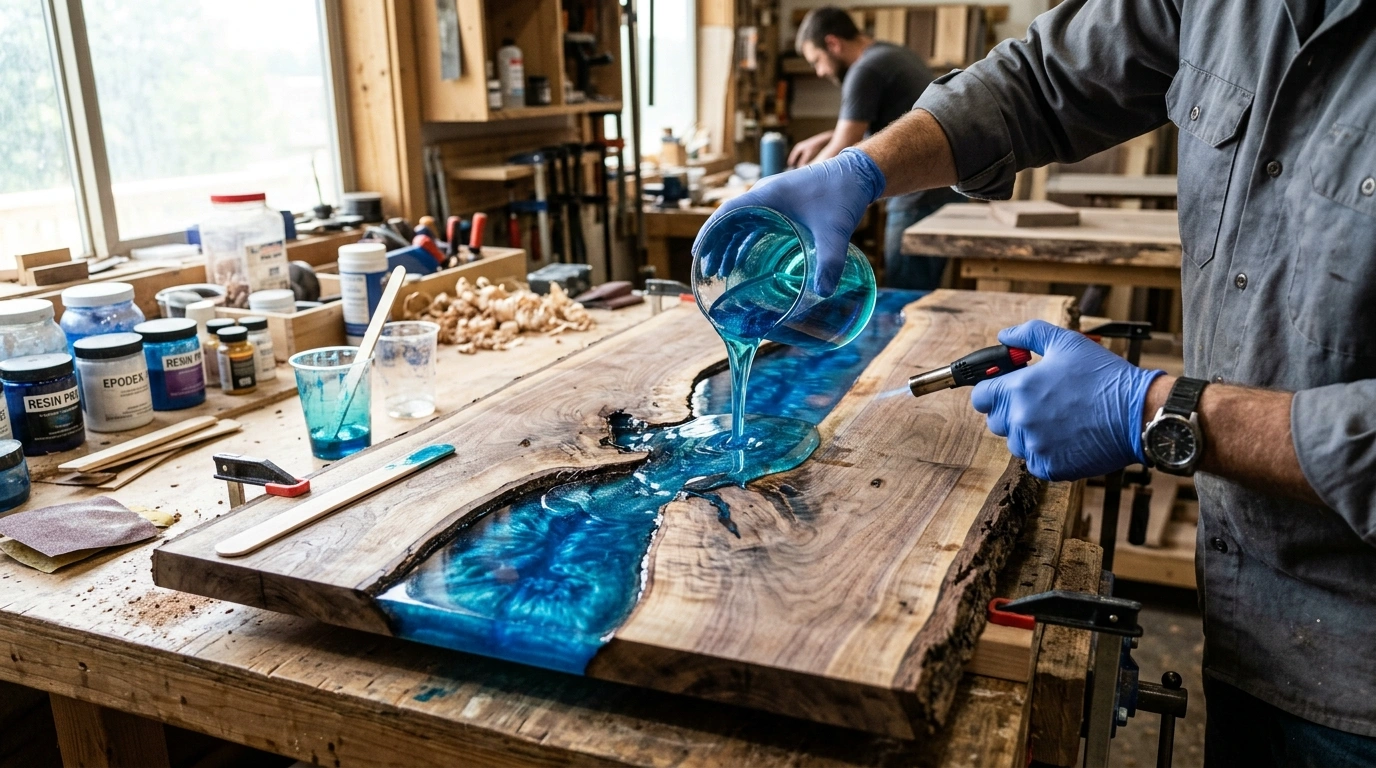
Epoxy or Resin Comparison Table
| Feature | Epoxy | Resin |
|---|---|---|
| What is it? | A specific type of resin system | Broad category of materials |
| Common form | Two-part system | Depends on resin type |
| Curing | Usually chemical reaction with hardener | Varies by type |
| Adhesion | Generally excellent in suitable applications | Varies widely |
| Strength | Often high | Depends on formulation |
| Chemical resistance | Often good | Varies |
| Common craft use | Coatings, art, jewelry, wood projects | Art, casting, composites, coatings |
| Curing time | Product dependent | Product dependent |
| Flexibility | Usually formulation dependent | Varies greatly |
| Best choice | Strong coatings, bonding, durable finishes | Depends on specific resin type |
Real-Life Conversation Examples
Dialogue 1: The Basic Question
Sarah: “Is epoxy the same thing as resin?”
Emma: “Not exactly. Epoxy is a type of resin.”
Sarah: “So resin is the broader term?”
Emma: “Exactly.”
🎯 Lesson: Epoxy is a specific type of resin, while resin is the broader category.
Dialogue 2: A Craft Project
Mike: “I want to make a glossy coaster. Should I buy resin?”
James: “Check exactly what type of resin the product is.”
Mike: “Why?”
James: “Different resin systems have different curing and performance characteristics.”
🎯 Lesson: Don’t choose a product based only on the word resin; check its chemistry and intended use.
Dialogue 3: Woodworking
Nina: “Can I use craft resin to repair this wooden chair?”
Alex: “I’d check whether the product is designed for structural bonding.”
Nina: “So decorative resin isn’t automatically a strong adhesive?”
Alex: “Right.”
🎯 Lesson: A resin designed for art or coating isn’t necessarily appropriate for structural repairs.
Dialogue 4: The Mixing Ratio
Tom: “I mixed equal amounts of the two epoxy components.”
Chris: “Was the product actually designed for a 1:1 ratio?”
Tom: “I assumed all epoxy was.”
Chris: “That’s a common mistake.”
🎯 Lesson: Always follow the manufacturer’s specified mixing ratio.
When to Use Epoxy or Resin
The choice between epoxy or resin depends largely on the project.
Choose Epoxy for Strong Bonding and Durable Coatings
Epoxy is often a good choice when you need:
- Strong adhesion
- A protective coating
- Good chemical resistance
- A durable surface
- Wood sealing
- Certain structural or repair applications
- Electrical encapsulation
However, select an epoxy specifically formulated for the intended job.
Choose Another Resin When Its Properties Fit Better
A different resin may be preferable when you need:
- Faster curing
- Specific flexibility
- Particular casting properties
- Lower material cost
- Specialized composite performance
- A formulation designed for a particular manufacturing process
For example, polyester resin is widely used in fiberglass-related applications and can have different handling characteristics from epoxy.
Epoxy vs Resin for Art
If you’re making resin art, don’t assume every epoxy product will produce the same results.
Look for products specifically labeled for:
- Art
- Casting
- Deep pours
- Coating
- Jewelry
- Tabletop applications
Pay attention to the manufacturer’s maximum pour depth, working time, curing time, pigment compatibility, and recommended thickness.
Epoxy vs Resin for Wood
For woodworking, the right product depends on what you’re doing.
For coating: A tabletop or coating epoxy may be appropriate.
For filling cracks: A casting or deep-pour epoxy may be better suited.
For structural bonding: Use an adhesive specifically designed for bonding wood and appropriate for the expected load.
A decorative resin isn’t automatically a structural adhesive.
Which Is Stronger?
You cannot meaningfully answer whether epoxy or resin is stronger because epoxy is itself a resin category.
The useful question is:
Which specific resin formulation is stronger for my application?
A properly formulated epoxy can be extremely strong, but another resin system may outperform it for a particular purpose.
Which Cures Faster?
There is no universal answer.
Some epoxy products cure within hours, while others require considerably longer. Other resin systems can cure faster or slower depending on formulation, temperature, catalyst, thickness, and environmental conditions.
Always follow the product’s technical instructions.
Which Is Easier to Use?
For beginners, a product with a simple mixing ratio and clear instructions is usually easier.
However, epoxy isn’t simply “pour and forget.”
Good results may require:
- Accurate measuring
- Thorough mixing
- Correct temperature
- Proper surface preparation
- Appropriate ventilation
- Controlled humidity
- Correct curing time
Is Epoxy Safe?
Once fully cured, many epoxy products are relatively stable. However, uncured epoxy components can pose health risks, including skin irritation and sensitization.
When working with epoxy or other resins:
- Follow the manufacturer’s safety instructions.
- Wear appropriate protective equipment.
- Avoid skin contact.
- Work in suitable ventilation.
- Don’t assume a household mask provides adequate protection from all resin vapors.
- Keep products away from children and pets.
- Follow the product’s disposal instructions.
The exact hazards depend on the formulation, so always read the Safety Data Sheet (SDS) when available.
US vs UK Notes
The terms epoxy, epoxy resin, and resin are used in both American and British English.
The bigger difference is often between consumer and industry terminology. In crafting communities, “resin” may casually refer to a specific product, while engineers and manufacturers may use more precise chemical names.