
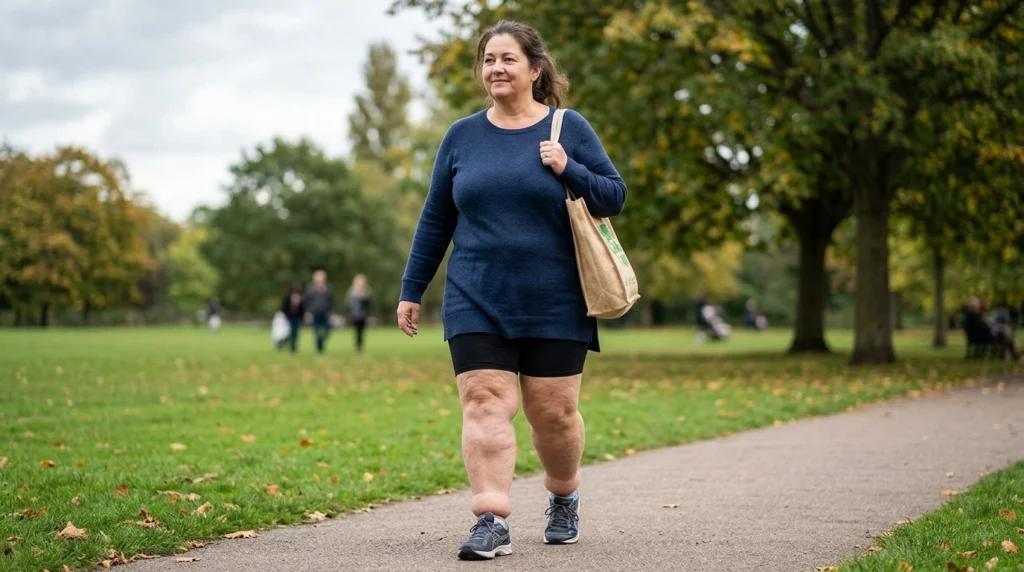
What Is Fat?
Body fat, also called adipose tissue, is a normal type of connective tissue that stores energy and performs several important biological functions.
Everyone needs some body fat for normal health.
What Does Body Fat Do?
Body fat has several important roles, including:
- Storing energy
- Helping insulate the body
- Cushioning organs
- Supporting hormone-related functions
- Providing energy during periods when food intake is lower
The amount and distribution of body fat vary considerably from person to person.
Where Does Body Fat Occur?
Normal adipose tissue can be found throughout the body, including the:
- Abdomen
- Hips
- Thighs
- Buttocks
- Arms
- Back
- Chest
Genetics, hormones, age, sex, activity levels, diet, and other factors can influence where the body stores fat.
How Does Ordinary Fat Usually Change?
When a person loses weight, body fat often decreases across multiple areas, although the amount lost from each area can vary.
For example, someone might lose noticeable fat from their face and waist before seeing much change in their thighs.
This variation is normal.
Is All Fat Unhealthy?
No. Body fat itself is not inherently unhealthy.
Healthy bodies require a certain amount of adipose tissue. Health depends on many factors, and body size or the presence of visible fat alone cannot determine someone’s overall health.
A Short History of the Term
The word fat has been used in English for centuries. In biology and medicine, the more precise term adipose tissue is commonly used.
Adipose tissue is now understood to be metabolically active rather than simply an inert energy-storage material.
What Is Lipedema?
Lipedema is a chronic condition characterized by an abnormal and disproportionate accumulation of adipose tissue, most commonly in the legs and sometimes the arms.
It occurs predominantly in women and is thought to involve genetic and hormonal factors.
What Does Lipedema Look Like?
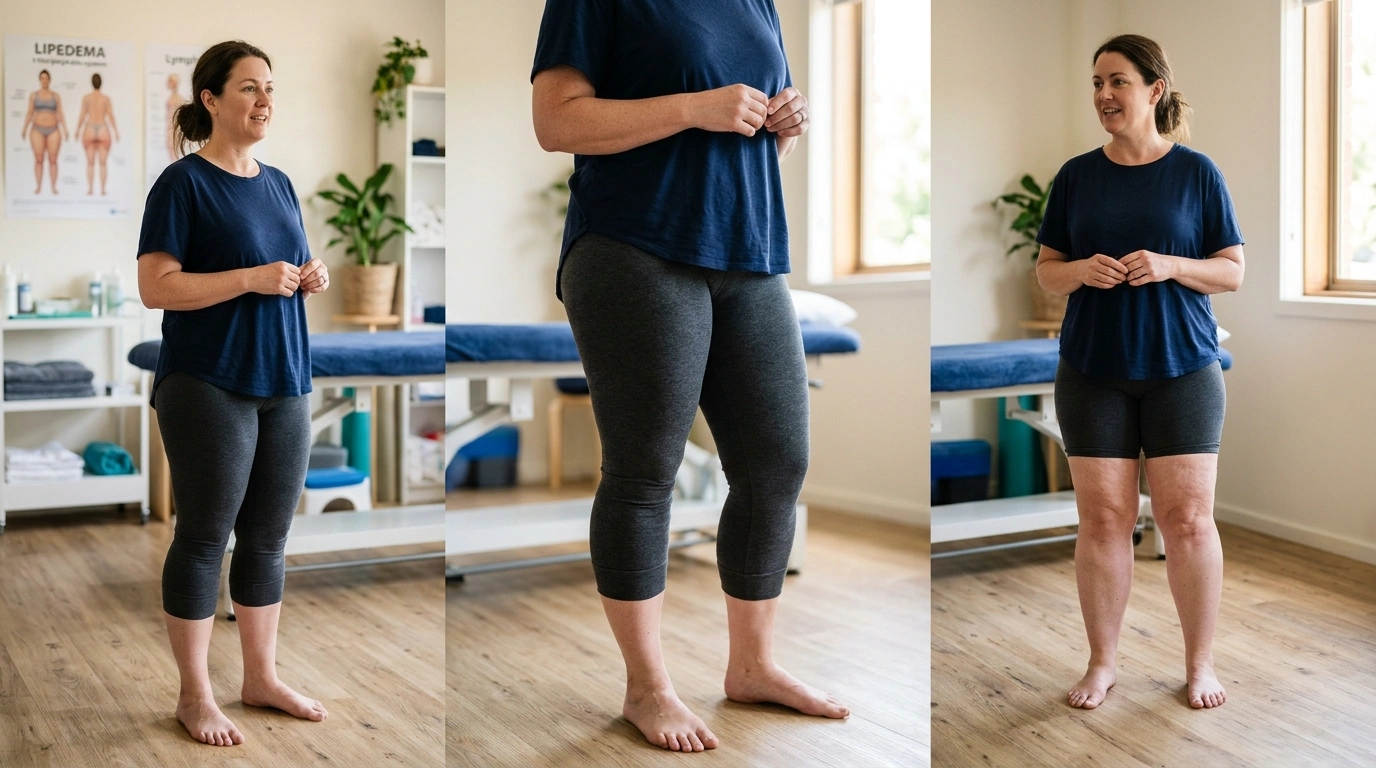
Lipedema commonly causes bilateral, symmetrical enlargement of the affected limbs.
Typical patterns can include:
- Both legs being affected
- Disproportion between the upper and lower body
- Enlargement extending from the hips toward the ankles
- Feet often being relatively spared
- Arms sometimes being affected
- A relatively symmetrical appearance
However, not every person with lipedema has exactly the same pattern.
Pain and Tenderness
One feature that can help distinguish lipedema from ordinary body fat is pain or tenderness.
People with lipedema may experience:
- Tenderness when the affected tissue is touched
- Aching or heaviness
- Discomfort after prolonged standing
- Sensitivity in affected areas
Pain isn’t required in every case, so its absence does not automatically rule out lipedema.
Easy Bruising
Some people with lipedema report that affected areas bruise easily.
Easy bruising can occur for many other reasons, though, so bruising alone cannot establish a diagnosis.
What About the Feet?
A commonly described feature of lipedema is relative sparing of the feet.
This can create a noticeable transition around the ankles, sometimes described as a “cuff.”
However, swelling of the feet can occur if another condition, such as lymphedema, develops alongside lipedema.
A Short History of Lipedema
Lipedema was first described medically in the 1940s by researchers at the Mayo Clinic.
Since then, understanding of the condition has developed considerably, although questions remain about its exact causes, mechanisms, and diagnostic criteria.
Key Differences Between Fat or Lipedema
When comparing fat or lipedema, the biggest difference is that ordinary body fat is a normal tissue, while lipedema is a specific medical condition involving abnormal adipose-tissue distribution.
- Ordinary body fat occurs throughout the body.
- Lipedema typically affects the legs and sometimes the arms.
- Lipedema is commonly symmetrical.
- Lipedema can involve tenderness or pain.
- Easy bruising is commonly reported with lipedema.
- The feet are often relatively spared in lipedema.
- Ordinary fat can decrease with overall weight loss.
- Lipedema tissue may be disproportionately resistant to conventional weight loss.
- Lipedema is strongly associated with hormonal and genetic factors.
- A person’s appearance alone cannot confirm lipedema.
Fat or Lipedema Comparison Table
| Feature | Ordinary Body Fat | Lipedema |
|---|---|---|
| What is it? | Normal adipose tissue | Chronic disorder involving abnormal fat distribution |
| Distribution | Can occur throughout the body | Usually legs; sometimes arms |
| Symmetry | May vary | Often bilateral and symmetrical |
| Pain/tenderness | Usually not a defining feature | May occur |
| Easy bruising | Not a defining feature | Commonly reported |
| Feet | Can contain normal fat | Often relatively spared |
| Weight loss response | Usually decreases with overall fat loss | Affected areas may be disproportionately resistant |
| Hormonal influence | Multiple factors | Often associated with hormonal changes |
| Genetic component | Yes | Thought to have a genetic component |
| Diagnosis | Not usually needed for normal fat | Requires professional assessment |
Real-Life Conversation Examples
Dialogue 1: Symmetrical Leg Enlargement
Sarah: “Both of my legs seem much larger than my upper body.”
Emma: “Has a healthcare professional evaluated it?”
Sarah: “Not yet. I assumed it was just body fat.”
Emma: “There can be several explanations, so it’s worth discussing with a clinician.”
🎯 Lesson: Symmetrical disproportion can be seen in lipedema but isn’t enough by itself to diagnose it.
Dialogue 2: Tenderness
Mike: “My legs are unusually tender when I press them.”
James: “Does that happen consistently?”
Mike: “Yes, and they also feel heavy.”
James: “That sounds worth mentioning to your doctor.”
🎯 Lesson: Tenderness and heaviness can occur with lipedema and deserve professional evaluation when persistent.
Dialogue 3: Weight Loss
Nina: “I’ve lost weight everywhere except my legs.”
Alex: “That doesn’t automatically mean you have lipedema.”
Nina: “So there could be other reasons?”
Alex: “Definitely. Fat distribution varies naturally, too.”
🎯 Lesson: Resistance to weight loss in one area isn’t enough to diagnose lipedema.
Dialogue 4: Easy Bruising
Tom: “I seem to bruise very easily on my legs.”
Chris: “Have you mentioned that to your doctor?”
Tom: “No.”
Chris: “You should, especially if it’s new or unexplained.”
🎯 Lesson: Easy bruising has many possible causes, so it should not automatically be attributed to lipedema.
When to Consider Fat or Lipedema
Understanding fat or lipedema is useful, but self-diagnosis can be unreliable because several conditions can produce similar-looking changes.
Ordinary Fat May Be More Likely When
General body-fat distribution is a more likely explanation when:
- Fat is distributed across several body regions
- There is no unusual tenderness
- There is no persistent swelling
- The distribution changes with overall weight changes
- There is no striking asymmetry between the upper and lower body
These are general observations, not diagnostic criteria.
Lipedema May Be Worth Discussing With a Clinician When
Consider asking a healthcare professional about lipedema if you have a combination of:
- Symmetrical enlargement of the legs
- Disproportion between the trunk and limbs
- Persistent tenderness or pain
- A sensation of heaviness
- Easy bruising
- Relative sparing of the feet
- A history of similar symptoms in female relatives
- Changes that appeared or worsened around hormonal transitions
A clinician may consider your medical history, symptoms, physical findings, and other possible causes before reaching a diagnosis.
What About Weight Loss?
One of the most misunderstood aspects of fat or lipedema is weight loss.
Having difficulty reducing fat in a particular body area does not automatically mean lipedema. Normal body-fat distribution is strongly influenced by genetics and hormones, and certain areas can be more resistant to weight loss than others.
With lipedema, the affected tissue can remain disproportionately enlarged even when a person loses weight elsewhere.
Could It Be Lymphedema Instead?
Lipedema can sometimes be confused with lymphedema, another condition involving swelling.
One useful distinction is that classic lipedema usually affects the limbs symmetrically and often spares the feet, while lymphedema can involve the feet.
However, the conditions can coexist, and real cases aren’t always textbook examples.
When Should You Seek Medical Advice?
It’s worth speaking with a healthcare professional if you have new, persistent, painful, or unexplained swelling or changes in limb size.
Seek prompt medical attention for sudden swelling, particularly if one leg becomes swollen, painful, warm, or red, because conditions such as a blood clot can require urgent evaluation.
Don’t assume sudden swelling is simply body fat or lipedema.
A Simple Memory Trick
Think:
Ordinary fat = normal energy-storage tissue.
Lipedema = abnormal, often symmetrical fat distribution with possible pain, tenderness, and easy bruising.
The pattern matters more than any single symptom.
US vs UK Notes
Lipedema is the spelling commonly used in American medical English. In some British and European sources, you may also encounter lipoedema.
The underlying condition is the same. Terminology can vary between healthcare systems and medical sources.