
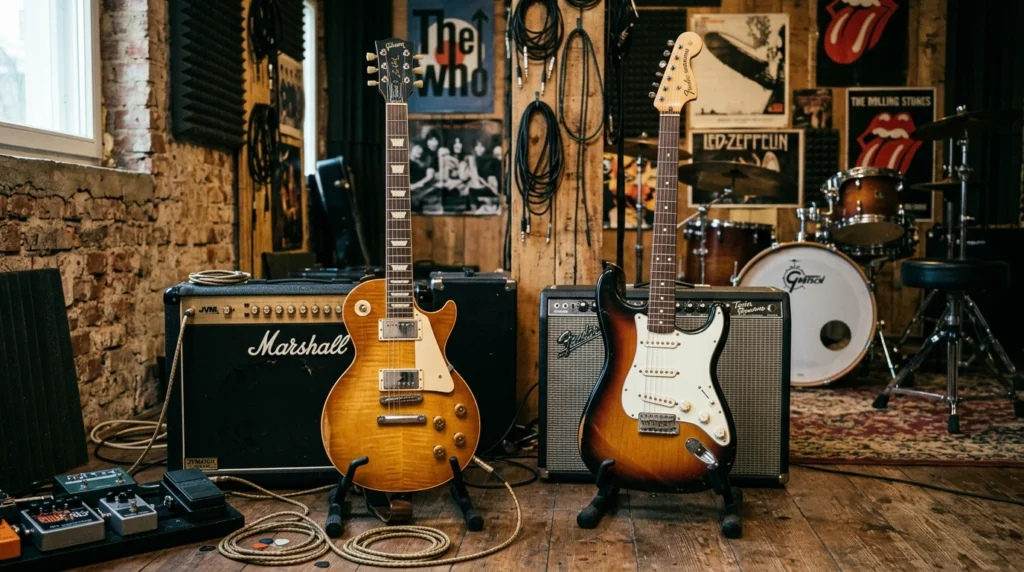
What Is Gibson?
Gibson is an American guitar manufacturer with a long history dating back to the early 20th century. The company became particularly famous for electric guitars such as the Les Paul, SG, ES-335, and Flying V.
Gibson guitars are commonly associated with:
- Humbucker pickups
- Set-neck construction
- Mahogany and maple combinations
- Shorter guitar scale lengths
- Warm, powerful tones
- Sustain
- Classic rock and blues sounds
Gibson’s Main Strengths
Gibson guitars often appeal to players who want a fuller, thicker, and more powerful sound.
Humbucker-equipped Gibson models tend to produce a stronger and warmer character than traditional Fender single-coil guitars, although Gibson’s lineup includes many different pickup configurations.
A Les Paul, for example, is known for its substantial sound, sustain, and ability to work well with overdriven and distorted tones.
Gibson Playability
Gibson and Fender guitars can feel noticeably different in the hands.
Many Gibson models use a 24.75-inch scale length, although specifications vary by model. The shorter scale can contribute to a slightly different string feel compared with Fender’s traditional 25.5-inch scale.
Gibson neck profiles also vary significantly. Some players love the substantial feel of a traditional Gibson neck, while others prefer the slimmer or differently shaped necks found on certain Fender models.
Gibson Example
Imagine a guitarist who primarily plays blues, classic rock, hard rock, or heavier music.
They might prefer a Les Paul-style guitar because its humbuckers, sustain, and thick tone can work especially well with driven amplifiers.
That doesn’t mean Gibson guitars are limited to rock. Their range is much broader than that.
Short History of Gibson
Gibson was founded in 1902 in Kalamazoo, Michigan. The company initially became known for mandolins and acoustic instruments before becoming a major force in electric guitars.
The introduction of the Les Paul in the 1950s helped establish Gibson as one of the most influential electric-guitar brands in history.
What Is Fender?
Fender is another legendary American guitar manufacturer. The company was founded by Leo Fender in the 1940s and became one of the most influential names in electric guitar history.
Fender is particularly famous for:
- Stratocaster
- Telecaster
- Precision Bass
- Jazz Bass
Fender’s Main Strengths
Fender guitars are often associated with:
- Bright, clear tones
- Single-coil pickups
- Comfortable contours
- Longer scale lengths
- Tremolo systems on many Stratocasters
- Excellent note definition
- Versatility
The Stratocaster is especially famous for its three-pickup configuration and expressive tremolo system.
The Telecaster, meanwhile, is known for its straightforward design, strong attack, and distinctive bridge pickup sound.
Fender Playability
Traditional Fender electric guitars commonly use a 25.5-inch scale length, which can produce a somewhat different string tension and feel compared with shorter-scale Gibson models.
Fender necks come in many shapes and specifications, so not every Fender feels identical.
The contoured body of a Stratocaster can also feel particularly comfortable when played while standing.
Fender Example
Suppose you’re a guitarist who plays funk, pop, blues, country, indie, rock, or clean rhythm parts.
A Fender Stratocaster or Telecaster may appeal because of its clarity, attack, and broad range of clean tones.
Again, Fender guitars aren’t restricted to these genres. Players have used them successfully in everything from jazz to heavy rock.
Short History of Fender
Leo Fender founded the company that became Fender in Southern California in the 1940s. The Telecaster emerged in the early 1950s, followed by the Stratocaster in 1954.
Those instruments became foundational designs that influenced generations of guitar builders.
Key Differences Between Gibson or Fender
The biggest differences between Gibson or Fender are found in construction, pickups, scale length, controls, and tonal character.
- Gibson: Often associated with humbuckers and thicker tones.
- Fender: Often associated with single-coil pickups and brighter tones.
- Scale length: Traditional Gibson electrics commonly use a shorter scale than traditional Fender electrics.
- Neck construction: Many Gibson models use set necks, while many Fender models use bolt-on necks.
- Body design: Gibson frequently uses carved or multi-piece body constructions, while Fender is known for straightforward, contoured designs.
- Tremolo: Many Stratocasters feature a tremolo system; many classic Gibson models use fixed bridges.
- Tone: Gibson often emphasizes warmth and sustain; Fender often emphasizes clarity and attack.
- Weight: Some Gibson models can be relatively heavy, while many Fender designs are lighter, although individual models vary.
- Price: Both brands offer instruments across different price levels.
- Versatility: Both can cover many genres, but their traditional sounds differ.
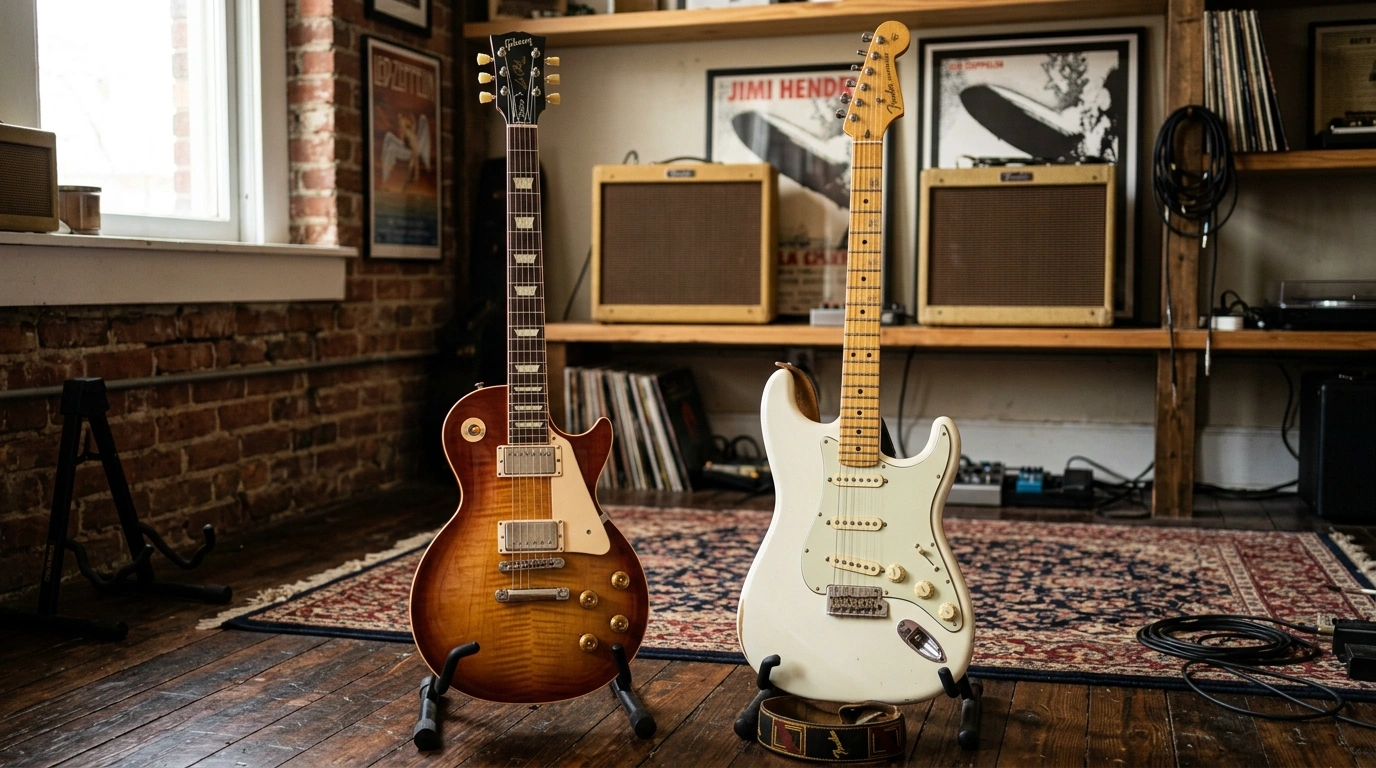
Gibson or Fender Comparison Table
| Feature | Gibson | Fender |
|---|---|---|
| Founded | 1902 | 1940s |
| Famous models | Les Paul, SG, ES-335 | Stratocaster, Telecaster |
| Common pickup type | Humbucker | Single-coil |
| Traditional scale | Around 24.75 inches on many models | 25.5 inches on many models |
| Neck construction | Often set neck | Often bolt-on |
| Typical tone | Warm, thick, powerful | Bright, clear, articulate |
| Tremolo | Model dependent | Common on Stratocaster |
| Famous genres | Rock, blues, hard rock | Rock, blues, country, funk, pop |
| Customization | Strong | Strong |
| Beginner options | Available | Available |
| Best known for | Sustain and powerful tones | Clarity and versatility |
Real-Life Conversation Examples
Dialogue 1: The Tone Question
Jake: “I want a thick rock tone. Should I buy Gibson or Fender?”
Mike: “I’d start by trying a Gibson with humbuckers.”
Jake: “Why?”
Mike: “That combination is traditionally associated with a fuller, heavier sound.”
🎯 Lesson: Gibson’s humbucker-equipped guitars are often favored for thick, powerful tones.
Dialogue 2: The Clean Sound
Sarah: “I love bright, clean guitar sounds.”
Emma: “Then try a Stratocaster or Telecaster.”
Sarah: “Is Fender better for clean tones?”
Emma: “It’s a great place to start, especially if you like traditional single-coil sounds.”
🎯 Lesson: Fender’s traditional single-coil designs are famous for clear, articulate tones.
Dialogue 3: The Neck Feel
Tom: “Why does this Gibson feel different from my Fender?”
Chris: “Scale length, neck shape, bridge design, and setup can all affect how a guitar feels.”
Tom: “So it’s not just the neck?”
Chris: “Exactly.”
🎯 Lesson: Scale length and overall construction influence guitar feel.
Dialogue 4: The Genre Question
Nina: “I play several genres. Should I get Gibson or Fender?”
Alex: “Both can be versatile.”
Nina: “So which one?”
Alex: “Try several models and choose the one whose sound and feel inspire you.”
🎯 Lesson: Genre can guide your choice, but your playing style and personal preference matter most.
When to Use Gibson or Fender
Choosing between Gibson or Fender is easier when you focus on the sound and feel you want.
Choose Gibson If You Want a Thick, Powerful Sound
Gibson may be the better fit if you:
- Prefer humbucker tones.
- Play rock or blues.
- Want strong sustain.
- Like shorter-scale guitars.
- Prefer a more substantial neck feel on certain models.
- Want classic Les Paul or SG styling.
- Frequently use overdrive or distortion.
A Gibson can be especially satisfying for players who want a guitar that sounds large and powerful.
Choose Fender If You Want Clarity and Attack
Fender may be the better choice if you:
- Love single-coil tones.
- Play funk, country, blues, pop, or rock.
- Want bright, articulate notes.
- Like Stratocaster or Telecaster designs.
- Prefer a longer traditional scale.
- Want a Strat-style tremolo.
- Prefer lightweight, contoured guitar bodies on certain models.
Fender guitars can provide an enormous range of sounds, especially when combined with pickup switching and amplifier effects.
Which Is Better for Beginners?
Neither brand is automatically better for beginners.
A beginner should prioritize:
- Comfortable neck shape
- Reasonable weight
- Good setup
- Appropriate price
- Reliable tuning
- An amplifier that suits the guitar
- A guitar that encourages regular practice
If a Fender feels more comfortable in your hands, buy the Fender. If a Gibson-style instrument feels better, choose that instead.
Which Is More Versatile?
Both can be extremely versatile.
A Stratocaster can cover clean, bluesy, funky, pop, and rock sounds. A Les Paul can cover blues, rock, hard rock, jazz, and many other styles.
Pickup configuration matters enormously. A modern guitar with multiple pickup types can blur the traditional Gibson-versus-Fender distinction even further.
Which Has Better Tone?
There is no objectively “better” tone.
Tone depends on:
- Pickups
- Wood
- Scale length
- Strings
- Amplifier
- Effects
- Playing technique
- Guitar setup
- Pick attack
A guitarist can make a Fender sound aggressive and heavy or make a Gibson sound clean and delicate.
Which Is Easier to Maintain?
Both are relatively straightforward to maintain, but different hardware requires different care.
Routine maintenance includes:
- String changes
- Neck adjustments when needed
- Intonation checks
- Pickup-height adjustments
- Cleaning
- Fret care
- Bridge maintenance
A professional setup can make a dramatic difference in how either guitar feels.
Which Is More Expensive?
Both Gibson and Fender offer instruments across broad price ranges.
However, the specific model matters much more than the brand name. A high-end Fender can cost considerably more than an entry-level Gibson-branded instrument, and vice versa.
When comparing prices, look at the exact model, construction, hardware, pickups, and country of manufacture.
US vs UK Notes
Gibson and Fender are American guitar brands with global distribution. Models, pricing, availability, and warranty arrangements can vary between the United States, United Kingdom, and other markets.
If you’re buying internationally, also consider taxes, shipping, dealer support, and local warranty coverage.