
What Is Listerine?
Meaning and Usage
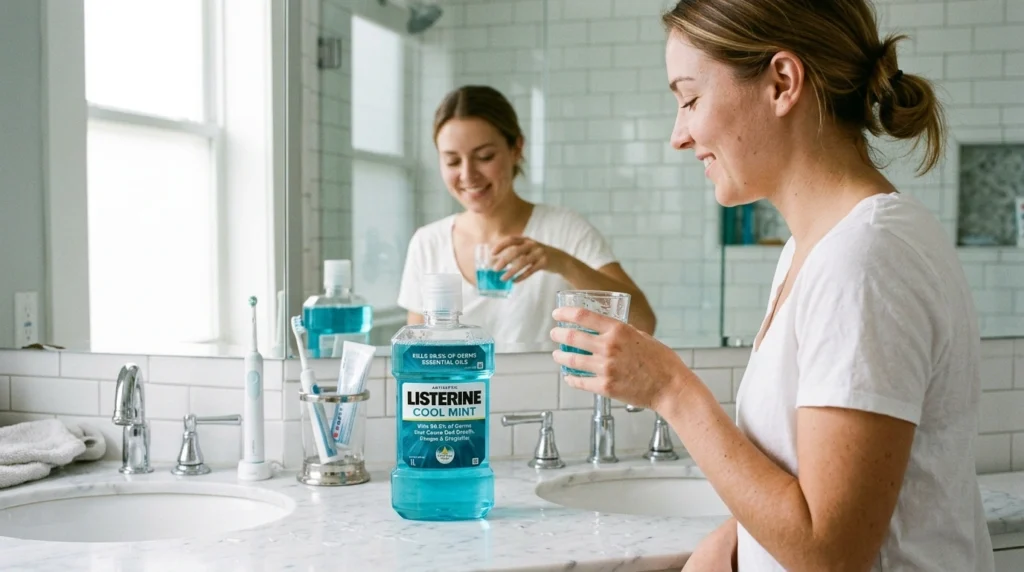
Listerine is a widely recognized mouthwash brand with a broad range of oral-rinse products. Its lineup includes formulas targeting bad breath, plaque, gingivitis, cavities, tartar, tooth sensitivity, whitening, and other oral-care concerns.
Many classic Listerine antiseptic formulas use a combination of eucalyptol, menthol, methyl salicylate, and thymol as active ingredients. Listerine says these essential oils help target germs associated with plaque, gingivitis, and bad breath.
For example:
- “I use Listerine as part of my oral-care routine.”
- “This Listerine formula is designed for gingivitis.”
- “I prefer an alcohol-free Listerine.”
Alcohol and Alcohol-Free Options
One important point is that not all Listerine products contain alcohol.
The brand currently offers both alcohol-containing and alcohol-free formulas. For example, Listerine Citrus Mint Alcohol Free contains no alcohol, while Listerine Clinical Solutions Gum Health lists alcohol among its ingredients.
That means it is inaccurate to say simply that “Listerine has alcohol.” The exact product matters.
Plaque and Gingivitis
Certain Listerine antiseptic products are specifically marketed for plaque and gingivitis. Listerine Original, for example, is ADA accepted and marketed to help reduce plaque and gingivitis when used as directed.
However, mouthwash should complement—not replace—regular brushing and flossing. Listerine itself states that its mouthwash is not intended to replace brushing or flossing.
A Short History Note
Listerine has been marketed as an oral antiseptic for more than a century and has become one of the most recognizable mouthwash brands worldwide.
What Is Therabreath?
Meaning and Usage
Therabreath is another major oral-care brand offering mouthwashes for different needs, particularly bad breath, gum health, cavities, dry mouth, and whitening.
Many Therabreath formulas are alcohol-free, and the brand specifically promotes non-burning mouthwash options. Its Fresh Breath rinse, for example, is alcohol-free and uses sodium chlorite as a breath-freshening ingredient.
For example:
- “I use Therabreath because I don’t like the burning sensation.”
- “Therabreath makes a mouthwash for bad breath.”
- “This Therabreath formula contains fluoride.”
Alcohol-Free Formulas
One of Therabreath’s most recognizable characteristics is its focus on alcohol-free rinses.
Its Fresh Breath formula is free of alcohol, colors/dyes, and saccharin, while its Deep Clean rinse is also alcohol-free.
That can make Therabreath appealing to people who dislike the strong sensation associated with some traditional mouthwashes.
Different Formulas for Different Needs
Therabreath isn’t one single formula. For example, its Complete Mouthwash contains sodium fluoride and is intended to provide multiple oral-care benefits, while its Deep Clean rinse uses cetylpyridinium chloride (CPC) as an active ingredient.
Therefore, comparing Listerine or Therabreath without identifying the exact product can be misleading.
A Short History Note
Therabreath was developed by dentist Harold Katz, with the brand’s history dating back to the 1990s. The company says the original formulas were developed in 1993.
Key Differences Between Listerine or Therabreath
The most important differences between Listerine or Therabreath involve their individual formulas, active ingredients, alcohol content, and the oral-care concern being targeted.
- Listerine offers both alcohol-containing and alcohol-free formulas.
- Many Therabreath rinses are alcohol-free.
- Listerine is particularly known for essential-oil antiseptic formulas.
- Therabreath offers several formulas focused heavily on bad breath.
- Some Therabreath products contain fluoride for cavity protection.
- Some Listerine products also contain fluoride.
- Both brands offer products targeting plaque and gingivitis.
- Both brands offer formulas for specific oral-care concerns.
- Neither brand is automatically better in every situation.
- The exact formula matters more than the brand name.
- Mouthwash should supplement brushing and flossing rather than replace them.
| Feature | Listerine | Therabreath |
|---|---|---|
| Main product focus | Broad oral care | Broad oral care, especially breath |
| Alcohol-free options | Yes | Yes |
| Alcohol-containing options | Yes, depending on formula | Many products are alcohol-free |
| Essential oils | Common in classic formulas | Varies by product |
| Bad-breath products | Yes | Yes |
| Gingivitis products | Yes | Yes |
| Fluoride products | Yes | Yes |
| Dry-mouth products | Available in some markets/products | Yes |
| Non-burning options | Available | Strong emphasis |
| Best comparison method | Compare exact formula | Compare exact formula |
Real-Life Conversation Examples
Example 1: Bad Breath
Emma: “My main problem is bad breath. Should I buy Listerine or Therabreath?”
Noah: “Look at the specific breath-focused formulas from both brands rather than choosing based only on the brand.”
🎯 Lesson: For bad breath, compare the active ingredients and intended use of individual products.
Example 2: Burning Sensation
Liam: “I don’t like mouthwash that burns.”
Sara: “Then look for an alcohol-free formula. Therabreath has many alcohol-free options, and Listerine also makes alcohol-free products.”
🎯 Lesson: You don’t have to choose an entire brand based on alcohol content.
Example 3: Cavity Protection
Jack: “I want mouthwash that helps protect against cavities.”
Mia: “Look for a fluoride-containing rinse and follow its directions.”
🎯 Lesson: For cavity prevention, fluoride content matters more than whether the bottle says Listerine or Therabreath.
Example 4: Gum Problems
Alex: “My gums bleed when I brush.”
Ben: “That’s a reason to talk with a dentist rather than relying only on mouthwash.”
🎯 Lesson: Persistent bleeding gums deserve professional evaluation, regardless of the mouthwash brand.
When to Use Listerine or Therabreath
Choose Listerine If You Want More Formula Variety
Listerine may appeal to you if you want a broad selection of products targeting:
- Plaque
- Gingivitis
- Bad breath
- Cavities
- Tartar
- Sensitivity
- Whitening
Its current product lineup includes alcohol-free options as well as formulas containing alcohol.
Consider Therabreath for Alcohol-Free Breath Care
Therabreath may be attractive if you prioritize:
- Alcohol-free formulas
- A gentler mouthwash experience
- Bad-breath control
- Fluoride options
- Dry-mouth products
- Non-burning rinses
For example, Therabreath’s Fresh Breath rinse is explicitly marketed as alcohol-free and designed around breath freshness.
What About Gingivitis?
If gingivitis is your concern, don’t compare brands based on advertising alone. Look at the active ingredients and specific claims of the exact product.
Listerine has antiseptic formulas specifically marketed for gingivitis. Therabreath also offers products designed for gum health and antiseptic care.
If your gums frequently bleed, swell, or remain painful, a dentist should evaluate the underlying cause.
What About Fluoride?
If your main goal is cavity prevention, look specifically for a fluoride mouthwash.
Therabreath’s Complete Mouthwash contains 0.02% sodium fluoride, while its Anticavity Oral Rinse contains 0.05% sodium fluoride.
Listerine also offers fluoride-containing products. Its current lineup identifies fluoride as an ingredient category across several products.
What About Alcohol?
This is one of the easiest ways to narrow down your options.
If you prefer an alcohol-free mouthwash, check the label carefully rather than assuming based on the brand.
Listerine has alcohol-free products, including its Citrus Mint Alcohol Free formula. Therabreath’s Fresh Breath and Deep Clean rinses are also alcohol-free.
A Simple Memory Trick
Think:
Listerine = broad range and classic antiseptic formulas.
Therabreath = strong focus on breath and alcohol-free options.
It’s only a memory aid—not a rule. Both brands now offer a wide variety of formulas.