
What Is a Mink?
Meaning and Usage
A mink is a semi-aquatic mammal in the weasel family, Mustelidae. In North America, the American mink (Neogale vison) is the species most commonly meant by the word.
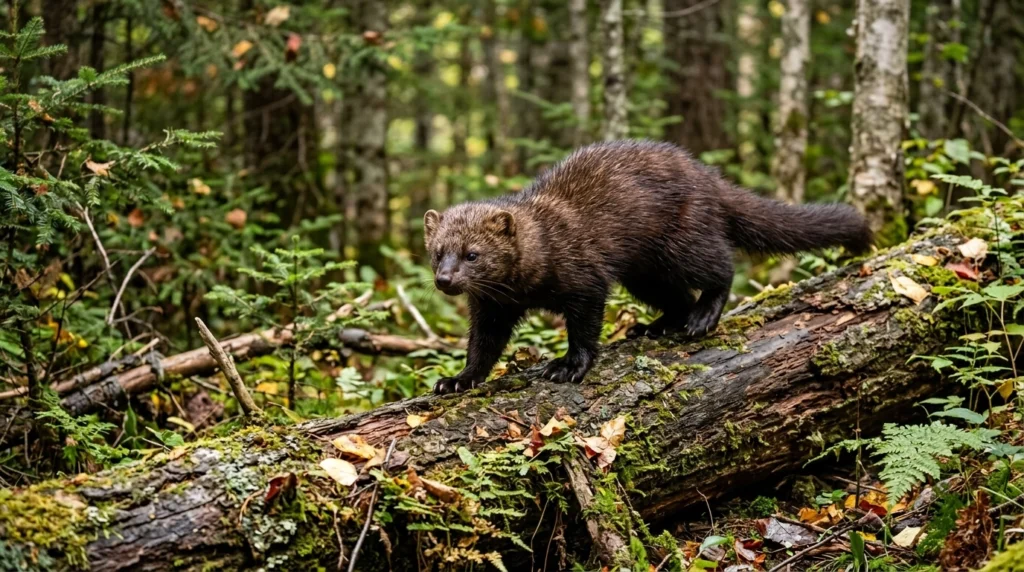
Mink have long, slender bodies, relatively short legs, small rounded ears, and dense dark fur.
For example:
- “We saw a mink near the stream.”
- “The mink disappeared into the vegetation.”
- “A mink was hunting along the riverbank.”
Appearance
Mink typically have a slender, elongated body and relatively short tail. Their fur is usually dark brown to nearly black, and many individuals have a lighter patch around the chin or throat.
An adult mink is generally much smaller than a fisher.
Males are larger than females, so size can vary, but mink typically have a more delicate, streamlined appearance.
Habitat and Behavior
Mink are strongly associated with water. They can live around:
- Rivers
- Streams
- Lakes
- Marshes
- Ponds
- Wetlands
They are excellent swimmers and often hunt fish, amphibians, crayfish, small mammals, and birds.
Mink are generally solitary and territorial. Their connection with waterways is one of the most useful clues when distinguishing mink or fisher.
A Short History Note
American mink have a broad native range across much of North America. Mink have also been raised historically for their fur, and escaped or released farm mink have established populations in some areas outside their original ranges.
What Is a Fisher?
Meaning and Usage
A fisher is a medium-sized carnivorous mammal in the weasel family. Its scientific name is Pekania pennanti.
Despite its name, the fisher is not primarily a fish-eating animal, and its name does not mean it is a specialized fisher of fish.
Fishers are primarily associated with forested habitats, where they hunt and forage across large areas.
For example:
- “We saw a fisher moving through the forest.”
- “The fisher disappeared between the trees.”
- “A fisher left tracks in the snow.”
Appearance
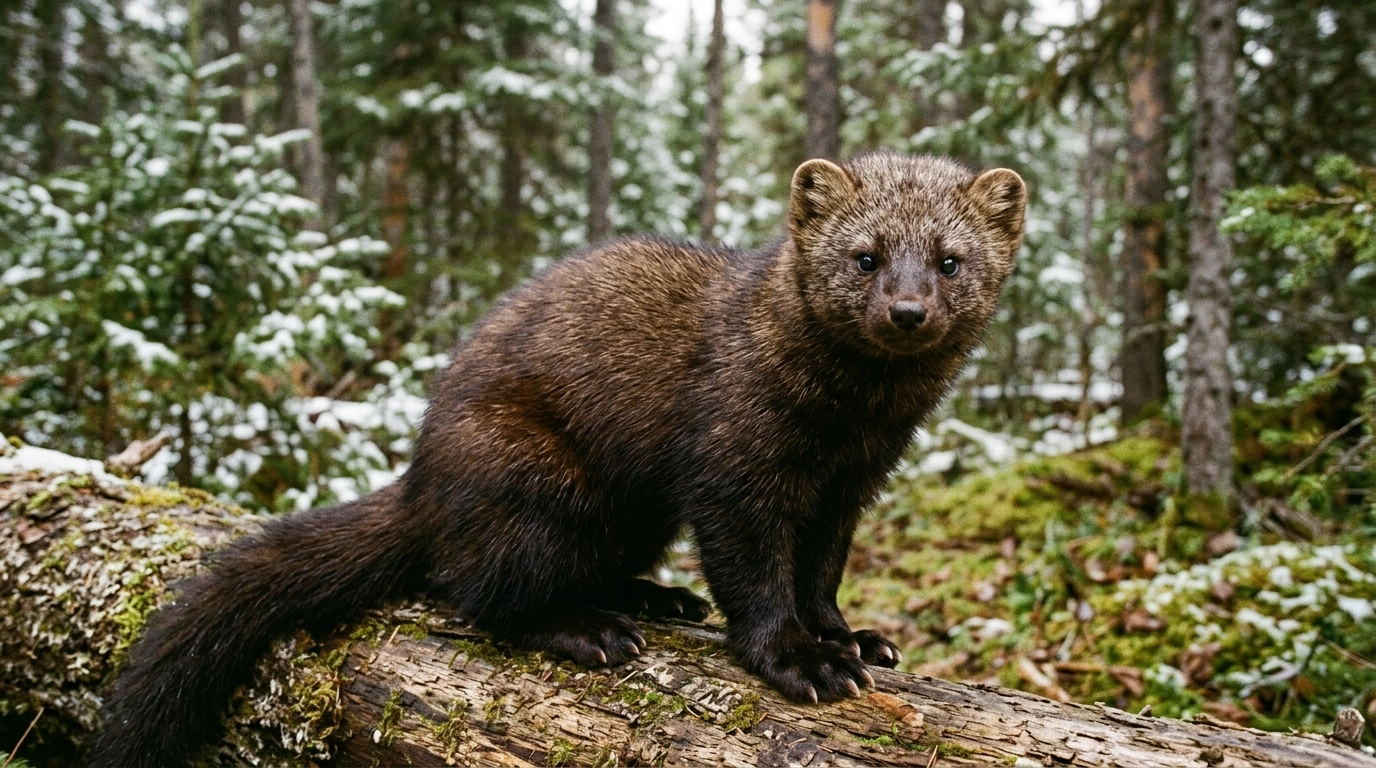
Fishers have a longer and heavier body than mink. Their fur can range from dark brown to nearly black, often with lighter or grizzled coloring around the head, shoulders, or body.
Their tails are long and bushy compared with those of mink.
A fisher can look somewhat like an oversized weasel, but its larger size and fuller body make it easier to distinguish from a mink once you know what to look for.
Habitat and Behavior
Fishers are strongly associated with forested landscapes. They can climb trees and move through dense woodland while hunting a wide variety of prey.
Their diet can include:
- Small mammals
- Birds
- Carrion
- Porcupines
- Other small animals
Fishers are powerful predators for their size and are particularly well known for their ability to hunt in forest environments.
Regional Notes
Fishers occur primarily in parts of Canada and the northern and northeastern United States, with populations also present in some western and other regions following natural range expansion or reintroduction.
Their distribution varies considerably by location, so local wildlife information can be useful when identifying one.
Key Differences Between Mink or Fisher
The most useful clues when comparing mink or fisher are size, body shape, habitat, and behavior.
- Mink are generally smaller and more slender.
- Fishers are larger and heavier-bodied.
- Mink are strongly associated with waterways.
- Fishers are primarily associated with forests.
- Mink are excellent swimmers.
- Fishers are capable climbers.
- Mink generally have smaller, less bushy tails.
- Fishers have long, noticeably bushier tails.
- Both have dark fur and elongated bodies.
- Both are members of the weasel family.
- Both are predators and generally solitary.
- A mink near a stream is much more plausible than a fisher in the same setting, although wildlife can travel beyond its preferred habitat.
| Feature | Mink | Fisher |
|---|---|---|
| Scientific name | Neogale vison | Pekania pennanti |
| Family | Mustelidae | Mustelidae |
| General size | Smaller | Larger |
| Body shape | Slender and elongated | Longer and heavier-bodied |
| Tail | Relatively narrow | Long and bushier |
| Fur | Usually dark brown to black | Brown, dark brown, or blackish |
| Habitat | Rivers, streams, wetlands, lakes | Forests and woodland |
| Swimming ability | Excellent | Capable |
| Climbing ability | Capable | Excellent |
| Typical prey | Fish, amphibians, crayfish, small mammals | Small mammals, birds, carrion, porcupines |
| Social behavior | Generally solitary | Generally solitary |
| Geographic range | Broad North American range | Mainly northern and northeastern North America, with additional populations |
Real-Life Conversation Examples
Example 1: Near a Stream
Emma: “I saw a dark, skinny animal running beside the creek.”
Noah: “A mink could fit that description, especially if it was close to the water.”
Emma: “It was moving really fast.”
Noah: “That fits, too.”
🎯 Lesson: A small, slender dark mammal near a waterway is a strong clue for mink.
Example 2: In a Forest
Liam: “We saw a large dark animal moving through the trees.”
Sara: “Was it bigger and heavier than a typical mink?”
Liam: “Definitely.”
Sara: “A fisher is worth considering.”
🎯 Lesson: A larger weasel-like mammal in dense forest is more consistent with a fisher.
Example 3: Comparing Tails
Jack: “The animal had a really fluffy tail.”
Mia: “If it was also fairly large and forest-dwelling, that could point toward a fisher.”
🎯 Lesson: A long, bushier tail is a useful fisher clue.
Example 4: Wildlife Identification
Alex: “Can I identify a mink or fisher from one quick sighting?”
Ben: “Sometimes, but size can be misleading. Habitat, body shape, tail, movement, and location together give you a much better answer.”
🎯 Lesson: Use multiple physical and environmental clues instead of relying on one characteristic.
When to Use Mink or Fisher
Think “Mink” Near Water
The word mink is more appropriate when you’re describing a small, slender mustelid frequently seen around water.
Look for clues such as:
- Stream or river habitat
- Small body size
- Very slender shape
- Dark brown or black fur
- Strong swimming ability
- Shorter-looking, less bushy tail
Think “Fisher” in Forested Areas
A fisher is more likely when the animal is:
- Larger than a mink
- Heavy-bodied
- Found in forest
- Equipped with a long, bushy tail
- Moving through woodland
- Showing climbing behavior
A Simple Memory Trick
Try this:
Mink = water.
Fisher = forest.
It’s not a perfect rule because wildlife doesn’t always follow neat boundaries, but it is an excellent starting point when you’re trying to distinguish mink or fisher.
US vs. Canadian Notes
Both animals occur in North America, but their ranges are not identical. Mink have a broad distribution across much of the continent, while fishers are particularly associated with forested areas of Canada and parts of the northern and northeastern United States.
Local distribution maps can therefore be extremely helpful if you’re trying to identify an animal in a particular region.