
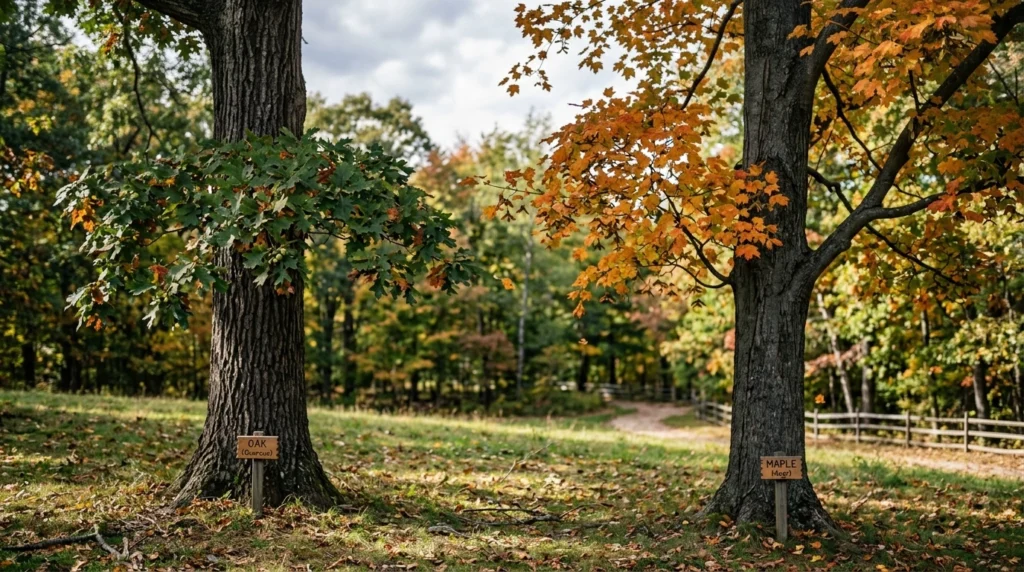
What Is “Oak”?
Meaning and Botanical Classification
Oak is the common name for trees and shrubs in the genus Quercus. There are hundreds of oak species, including both deciduous and evergreen varieties.
Oaks are especially well known for their lobed leaves, sturdy wood, acorns, and impressive longevity. Depending on the species, an oak can grow into a broad shade tree or remain relatively small.
For example:
- “The old oak provides shade over the garden.”
- “We found several acorns beneath the oak tree.”
- “The park has several mature oak trees.”
Leaves and Appearance
Oak leaves vary considerably between species, but many have rounded or pointed lobes. Some species have smooth-edged leaves instead.
A useful identification clue is the presence of acorns. If a tree is producing acorns, it belongs to the oak group.
Oak bark also changes with age. Young trees may have relatively smooth bark, while mature trees often develop thick, ridged, or deeply furrowed bark.
Wood and Common Uses
Oak wood is widely valued for its strength, hardness, durability, and attractive grain. It has traditionally been used for furniture, flooring, cabinetry, barrels, and various construction applications.
Different oak species have different properties, so “oak” does not describe one single type of wood.
Regional Notes and History
Oaks occur naturally across much of the Northern Hemisphere, with particularly high diversity in North America and Asia. They have played important roles in human history, providing timber, fuel, food resources, and habitat.
Acorns have also been an important food source for various wildlife species and, historically, for some human communities after appropriate processing.
What Is “Maple”?
Meaning and Botanical Classification
Maple refers to trees and shrubs in the genus Acer. Like oaks, maples include numerous species with different sizes, shapes, and growing requirements.
Maples are especially recognizable for their distinctive leaves, winged seeds, and brilliant fall colors.
Common examples include:
- Sugar maple
- Red maple
- Silver maple
- Norway maple
- Japanese maple
For example:
- “The maple turned bright red in autumn.”
- “A maple seed landed on the sidewalk.”
- “We planted a maple tree near the driveway.”
Leaves and Appearance
Maple leaves are often palmately lobed, meaning several lobes radiate outward from a central point. However, leaf shapes vary between species.
Maple fruits are another useful clue. They are commonly called samara pairs or “helicopters” because the winged seeds spin as they fall.
Wood and Common Uses
Maple wood is known for being hard, durable, and often finely grained. It is used for furniture, flooring, cabinetry, sports equipment, musical instruments, and other products.
Some maple species are also famous for producing maple syrup, particularly sugar maple.
Regional Notes
Maples are native to parts of Asia, Europe, North Africa, and North America, depending on the species. They are popular ornamental trees because many varieties offer attractive foliage throughout the year.
Japanese maples, for instance, are especially popular in gardens because of their delicate leaves and ornamental forms.
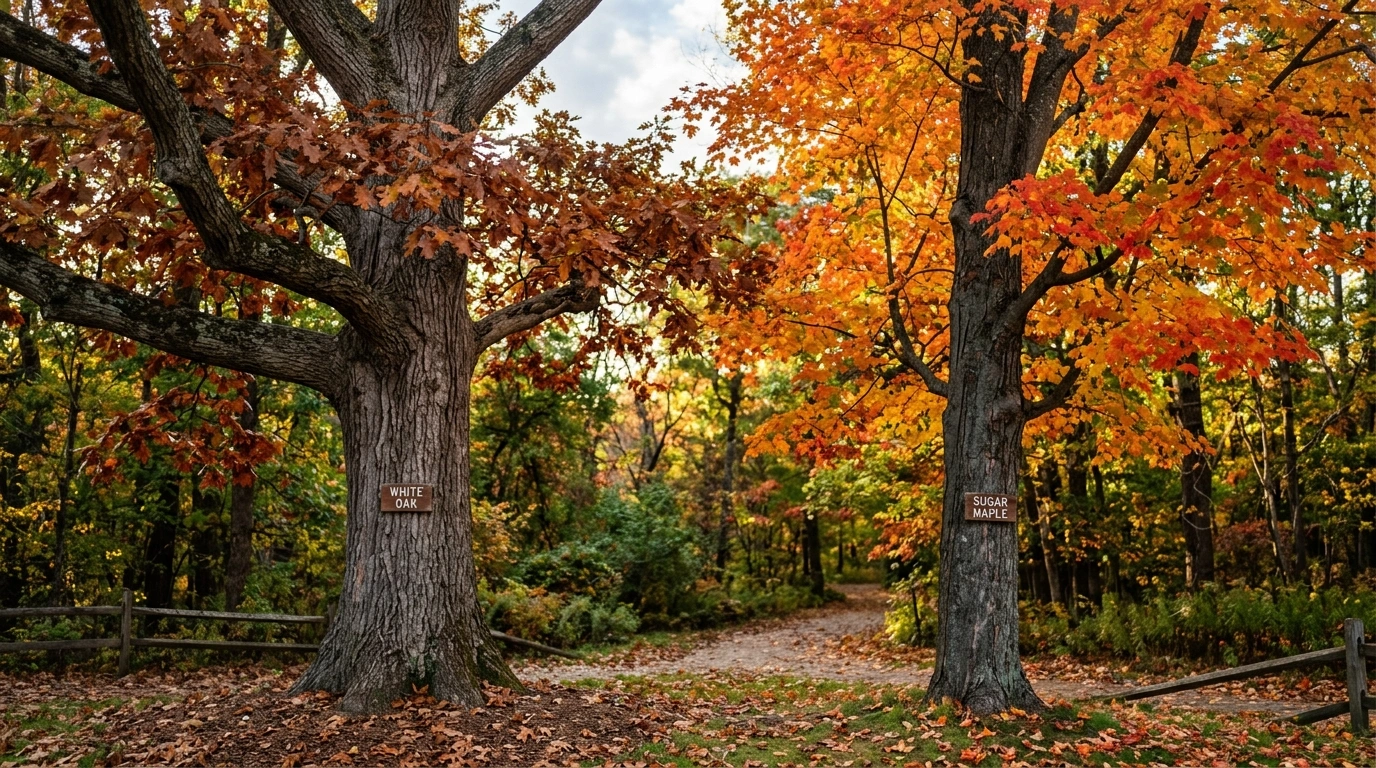
Key Differences Between Oak or Maple
Although both are familiar hardwood trees, oak or maple differences become obvious when you examine their seeds, leaves, bark, and typical uses.
- Oak belongs to the Quercus genus.
- Maple belongs to the Acer genus.
- Oaks produce acorns.
- Maples produce winged samaras, often called helicopters.
- Oak leaves commonly have lobes or varied margins.
- Maple leaves are often palmately lobed.
- Both can produce excellent hardwood.
- Sugar maple is particularly associated with maple syrup.
- Oak is especially associated with acorns and durable timber.
- Both can provide valuable shade and wildlife habitat.
- Autumn color depends heavily on the individual species and growing conditions.
| Feature | Oak | Maple |
|---|---|---|
| Genus | Quercus | Acer |
| Seed/fruit | Acorn | Winged samara |
| Common leaf shape | Often lobed or variable | Often palmately lobed |
| Wood | Strong and durable | Hard and often fine-grained |
| Famous product | Oak timber | Maple syrup |
| Fall color | Often brown, red, yellow, or bronze depending on species | Often yellow, orange, or red depending on species |
| Wildlife value | Very high | High |
| Common use | Furniture, flooring, barrels, construction | Furniture, flooring, instruments, cabinetry |
| Longevity | Many species can live for centuries | Many species are also long-lived |
Real-Life Conversation Examples
Example 1: Identifying a Tree
Emma: “Is that an oak or maple?”
Ryan: “Look at the ground. There are acorns underneath it.”
Emma: “Right. That points to oak.”
🎯 Lesson: Acorns are one of the easiest clues for identifying an oak.
Example 2: Autumn Leaves
Liam: “That maple looks amazing this year.”
Sara: “The leaves are almost completely red.”
Liam: “That’s one reason people love maples in fall.”
🎯 Lesson: Maples are especially famous for colorful autumn foliage.
Example 3: Talking About Wood
Noah: “Should we use oak or maple for the furniture?”
Mia: “Both are hardwoods, so the best choice depends on the design, species, and desired appearance.”
🎯 Lesson: Oak and maple can both be excellent woodworking materials, but their characteristics vary by species.
Example 4: Looking at Seeds
Jack: “What are those little spinning things?”
Ava: “Those are maple seeds.”
Jack: “So that means the tree is probably a maple?”
Ava: “Exactly.”
🎯 Lesson: Winged “helicopter” seeds are a classic maple clue.
When to Use Oak or Maple
Choose “Oak” When You Mean the Quercus Group
Use oak when you’re talking about a tree belonging to the Quercus genus or wood derived from an oak species.
For example:
- “The oak has produced hundreds of acorns.”
- “The table is made from oak.”
- “We planted an oak tree in the yard.”
Choose “Maple” When You Mean the Acer Group
Use maple when you’re referring to a tree in the Acer genus or its wood.
For example:
- “The maple has turned orange.”
- “This cabinet is made from maple.”
- “Maple syrup comes from certain maple species.”
A Simple Memory Trick
Think “oak = acorn” and “maple = helicopter.”
If you see an acorn, think oak.
If you see paired winged seeds spinning through the air, think maple.
This quick association can make identifying oak or maple much easier.