

What Is Phono?
Phono refers to an audio signal from a phonograph or turntable cartridge. It is much weaker than a standard line-level signal and requires special processing before it can be fed into a normal line input.
What Makes a Phono Signal Different?
A phono cartridge produces a relatively small electrical signal.
A traditional moving-magnet (MM) cartridge typically produces a higher output than a moving-coil (MC) cartridge, but both still require appropriate amplification and equalization.
A phono signal also has a frequency response that must be corrected using the RIAA equalization curve.
This means a phono signal normally needs two things:
- Significant amplification
- RIAA equalization
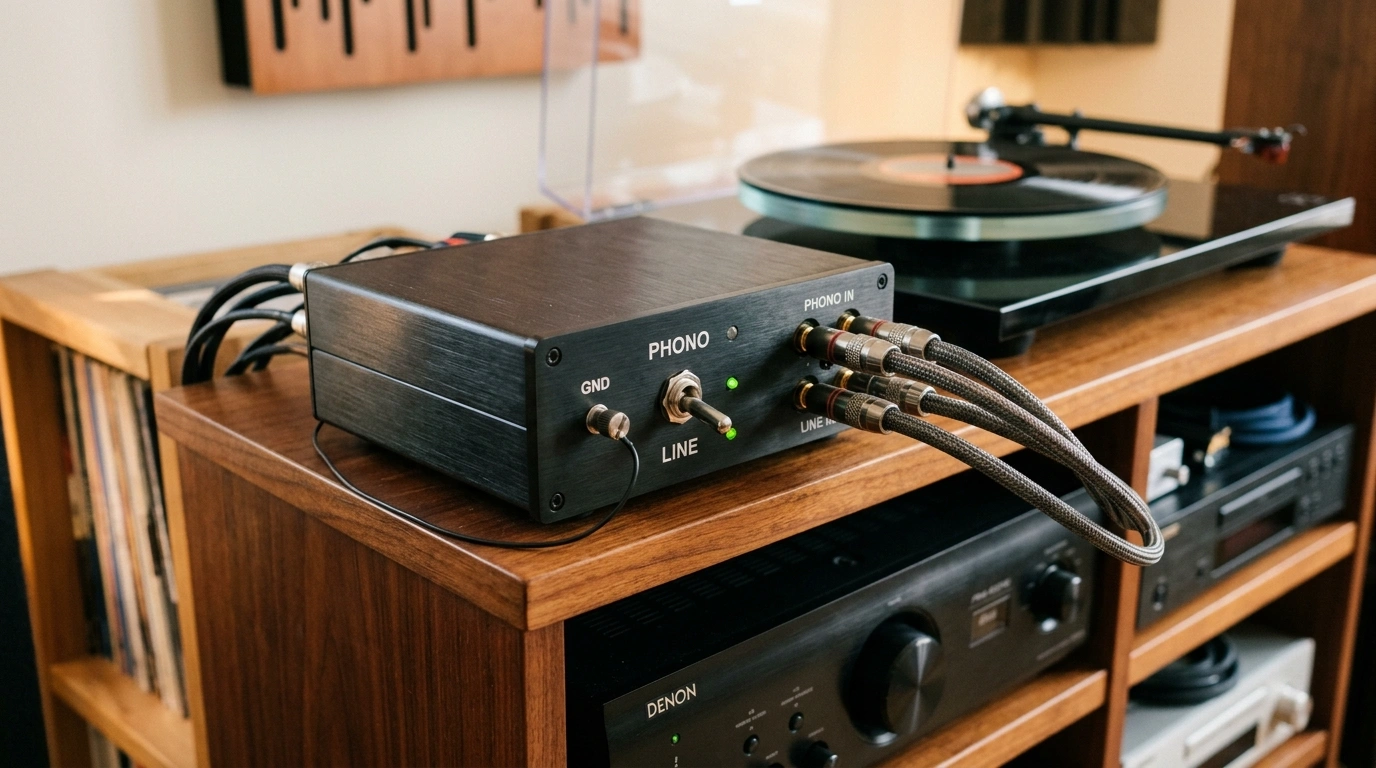
A phono preamp, also called a phono stage, performs these functions.
Where Do You Find a Phono Input?
A dedicated phono input may be found on:
- Stereo receivers
- Integrated amplifiers
- Preamplifiers
- Some older audio systems
- Some modern hi-fi equipment
A turntable connected directly to a dedicated phono input can therefore receive the appropriate gain and equalization.
Example
Turntable with a phono output → PHONO input on an amplifier
This setup works when the turntable is sending an unamplified phono-level signal and the amplifier contains a phono preamp.
What Happens If You Connect Phono to Line?
If you connect a turntable’s raw phono output directly to a standard LINE input, the music will usually sound extremely quiet and lacking the correct tonal balance.
That’s because the line input does not provide the specialized gain and RIAA equalization that the cartridge signal requires.
What Is Line?
Line refers to a much stronger audio signal intended to move between audio devices.
Unlike a raw phono signal, line-level audio has already been amplified and appropriately processed for normal equipment interconnection.
Common Line-Level Sources
Line-level outputs can come from:
- CD players
- DACs
- Audio interfaces
- Mixers
- Preamp outputs
- Streaming devices
- Tape decks
- Turntables with built-in phono preamps
- Some phones and portable audio equipment
Depending on the equipment, the exact signal level can vary, so “line level” is better understood as a general signal category rather than one perfectly identical voltage.
What Is a LINE Input?
A line input is designed to accept a standard audio signal from another audio device.
You may see labels such as:
- LINE IN
- AUX
- CD
- TAPE
- AUDIO IN
Many of these inputs are electrically similar enough to accept ordinary line-level sources.
Example
CD player → LINE input on an amplifier
The CD player’s output is already at an appropriate level for the amplifier’s line input, so no dedicated phono amplification is required.
What Happens If You Connect Line to Phono?
Connecting a line-level source to a PHONO input can produce sound that is far too loud and heavily distorted because the phono stage adds substantial gain and applies RIAA equalization.
So the general rule is:
Phono → Phono input
Line → Line input
Key Differences Between Phono or Line
The most important difference between phono or line is the strength and processing of the audio signal.
- Phono is a very low-level signal from a phono cartridge.
- Line is a substantially stronger audio signal intended for normal device-to-device connections.
- Phono signals require specialized RIAA equalization.
- Line-level signals do not normally require a phono stage.
- A phono input contains additional gain and equalization circuitry.
- A line input provides relatively little additional amplification compared with a phono stage.
- Raw turntable output is normally phono level.
- A turntable with a built-in phono preamp can provide line-level output.
- Connecting phono directly to line usually produces very quiet, thin-sounding audio.
- Connecting line to phono can cause excessive volume and distortion.
Phono or Line Comparison Table
| Feature | Phono | Line |
|---|---|---|
| Signal strength | Very low | Much higher |
| Typical source | Phono cartridge | CD player, DAC, mixer, etc. |
| Requires phono preamp? | Yes, unless already built in | No |
| RIAA equalization | Required | Already accounted for |
| Typical input | PHONO | LINE/AUX/CD |
| Gain required | High | Relatively low |
| Common use | Turntables | General audio equipment |
| Wrong connection to the other input | Very quiet/incorrect sound | Very loud/distorted sound |
Real-Life Conversation Examples
Dialogue 1: Connecting a Turntable
Sarah: “My turntable has a PHONO/LINE switch. Which one should I use?”
Emma: “What are you connecting it to?”
Sarah: “An amplifier with a PHONO input.”
Emma: “Then use the turntable’s PHONO output.”
🎯 Lesson: Use PHONO output with a dedicated PHONO input when the amplifier provides the phono stage.
Dialogue 2: No Phono Input
Mike: “My receiver only has AUX and LINE inputs.”
James: “Does your turntable have a built-in phono preamp?”
Mike: “Yes.”
James: “Set it to LINE and connect it to AUX or LINE.”
🎯 Lesson: A turntable with a built-in phono preamp can usually provide line-level output.
Dialogue 3: Extremely Quiet Sound
Nina: “I connected my turntable to AUX, but the music is barely audible.”
Alex: “Does the turntable have a PHONO/LINE switch?”
Nina: “Yes, and it’s set to PHONO.”
Alex: “Switching it to LINE may solve the problem if you’re using AUX.”
🎯 Lesson: A raw phono signal is too weak for a standard line input.
Dialogue 4: Distorted Sound
Tom: “My turntable sounds incredibly loud and distorted.”
Chris: “Where is it connected?”
Tom: “The PHONO input.”
Chris: “Is the turntable set to LINE?”
Tom: “Yes.”
🎯 Lesson: Sending an already amplified line-level signal into a phono input can cause excessive gain and distortion.
When to Use Phono or Line
Understanding phono or line becomes much easier when you identify the equipment at both ends of the cable.
Use Phono When
Choose a phono connection when:
- Your turntable outputs a raw cartridge signal.
- Your amplifier or receiver has a dedicated PHONO input.
- Your turntable’s internal phono preamp is switched off or absent.
- You are using an external phono preamp elsewhere in the signal chain.
A typical setup is:
Turntable → PHONO input
Use Line When
Choose LINE when:
- Your turntable has a built-in phono preamp.
- Your turntable is switched to LINE output.
- You’re connecting a CD player.
- You’re connecting a DAC.
- You’re connecting a mixer or audio interface.
- You’re connecting another standard line-level source.
A typical setup is:
Turntable → LINE/AUX input
when the turntable itself performs the phono preamplification.
What If Your Turntable Has a PHONO/LINE Switch?
Many modern turntables include a switch labeled something like:
PHONO / LINE
In general:
PHONO setting: outputs the cartridge-level signal.
LINE setting: activates the built-in phono preamp and outputs a line-level signal.
The correct setting depends on the input you’re connecting to.
What About an External Phono Preamp?
You can also use a separate phono stage:
Turntable → External Phono Preamp → LINE input
In this configuration, the external device performs the required amplification and RIAA equalization.
Do not normally send the already-preamped output into another PHONO input.
A Simple Memory Trick
Remember:
Phono = needs a preamp.
Line = ready for a normal audio input.
Or think of it as:
PHONO → tiny signal
LINE → stronger signal
US vs UK Notes
There is no meaningful US-versus-UK difference in the technical definitions of phono or line.
You may see different labels depending on the manufacturer, such as AUX, LINE IN, CD, or TAPE. Always check the equipment’s manual if you’re uncertain about the input’s electrical characteristics.