
What Is Pilates?
Meaning of Pilates
Pilates is a form of exercise that emphasizes controlled movements, core stability, posture, balance, flexibility, and coordination. Exercises can be performed on a mat or with specialized equipment.
Pilates movements are usually performed with deliberate technique rather than simply moving as much weight as possible.
A typical Pilates session may include exercises targeting:
Abdominal muscles
Back muscles
Hips
Glutes
Legs
Shoulders
Arms
Overall posture and stability
How Does Pilates Work?
Pilates encourages participants to focus on control, alignment, breathing, and precise movement.
Instead of performing a large number of fast repetitions, many Pilates exercises emphasize slow and controlled movements.
For example:
“She attends Pilates classes twice a week.”
“Pilates helped him focus on core control and posture.”
“I prefer Pilates because I enjoy controlled movements.”
Types of Pilates
There are several ways to practice Pilates.
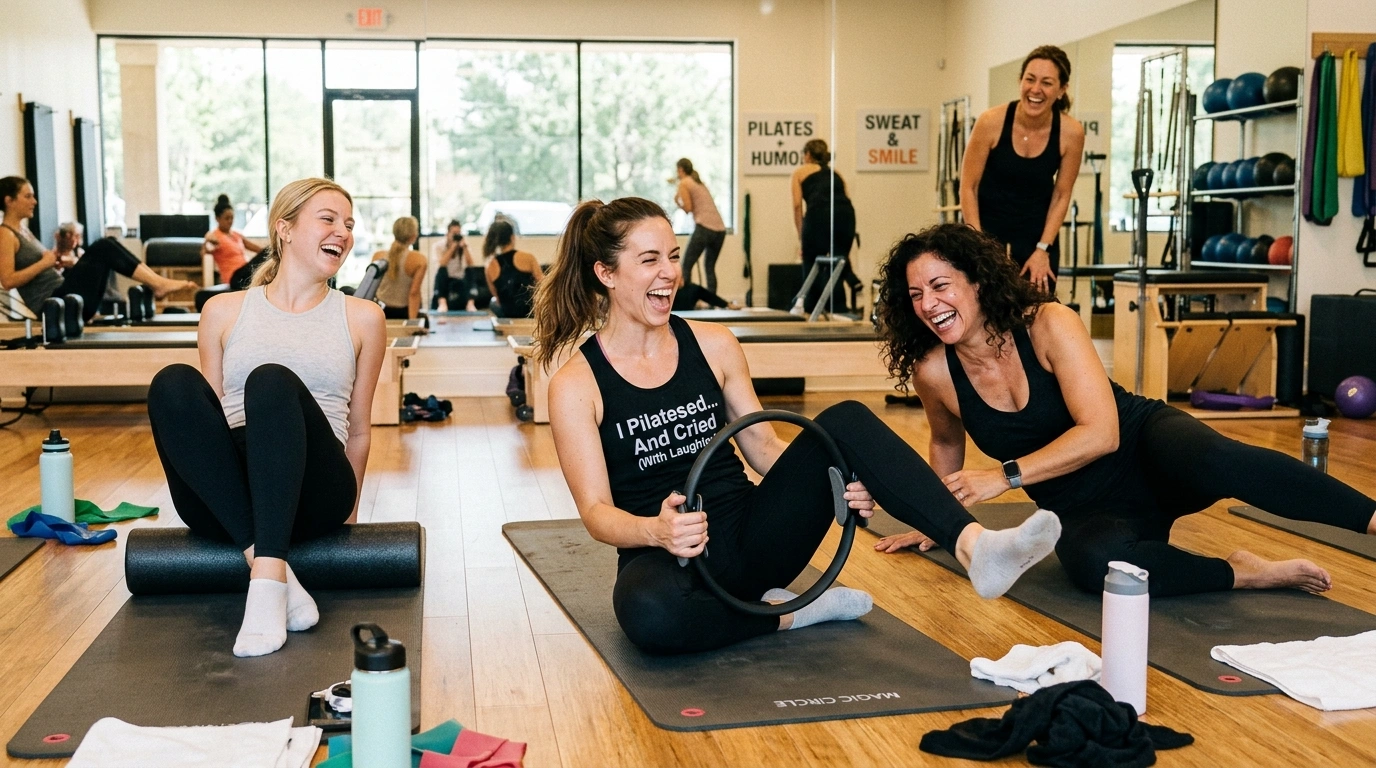
Mat Pilates is performed primarily on a mat and uses body weight and small equipment.
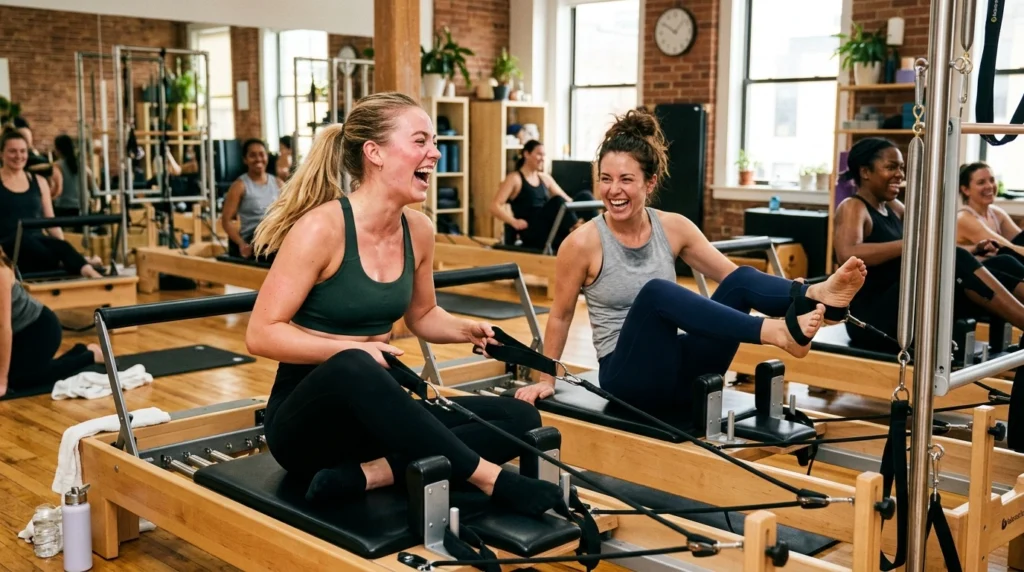
Reformer Pilates uses a specialized machine with springs, a moving carriage, straps, and other components to provide resistance.
Other forms may use equipment such as resistance rings, balls, or specialized Pilates machines.
A Short History of Pilates
Pilates was developed by Joseph Pilates in the early 20th century. He originally called his system “Contrology,” emphasizing controlled movement.
The method later became popular among dancers and fitness communities and eventually developed into the wide range of Pilates classes available today.
What Is a Gym?
Meaning of Gym
A gym is a facility where people exercise using equipment, free weights, machines, cardio equipment, or other training tools.
Unlike Pilates, a gym is not one specific type of exercise. It is a place where you can perform many different forms of training.
A gym workout might include:
Weightlifting
Resistance training
Running
Cycling
Rowing
Functional training
Bodyweight exercises
Circuit training
Stretching
How Does Gym Training Work?
Gym training depends on your chosen workout.
Someone interested in strength might use barbells, dumbbells, or resistance machines. Someone focused on cardiovascular fitness might use a treadmill, elliptical, stationary bike, or rowing machine.
For example:
“He goes to the gym after work.”
“She uses weights at the gym to improve her strength.”
“The gym has cardio machines and free weights.”
A Short History of Gyms
Organized physical training has existed for thousands of years, but modern commercial gyms developed significantly during the 19th and 20th centuries.
Today, gyms range from small independent facilities to large fitness centers offering strength equipment, cardio machines, classes, personal training, and other services.
Pilates or Gym: Key Differences
The Main Differences
The biggest differences between Pilates or gym involve the style and purpose of training.
Pilates emphasizes controlled movement and core stability.
Gym workouts can target strength, muscle growth, cardio, endurance, or general fitness.
Pilates often uses body weight and specialized equipment.
Gyms typically offer a much wider variety of equipment.
Pilates sessions are often structured around specific movement patterns.
Gym workouts can be highly customized.
Weight training is generally easier to progress systematically in a gym.
Pilates can be particularly useful for people who enjoy low-impact, controlled exercise.
A gym can support a broader range of fitness goals.
Pilates vs Gym Comparison Table
| Feature | Pilates | Gym |
|---|---|---|
| Main focus | Core, control, mobility, stability | Strength, cardio, muscle, fitness |
| Equipment | Mat, reformer, small equipment | Weights, machines, cardio equipment |
| Workout style | Controlled and precise | Highly varied |
| Weight training | Limited/moderate depending on setup | Extensive |
| Cardio options | Usually limited | Extensive |
| Flexibility work | Common | Depends on program |
| Core training | Major focus | Can be included |
| Muscle building | Possible but usually not the main focus | Strong option |
| Portability | Mat Pilates can be convenient | Usually requires gym access |
| Best for | Control, mobility, core work | Broad fitness goals |
Pilates or Gym for Strength
Pilates and Strength
Pilates can improve muscular endurance and help develop strength, especially in the core, hips, legs, and smaller stabilizing muscles.
However, traditional Pilates is not generally designed around progressively lifting heavier loads.
Gym and Strength
A gym provides much more flexibility for structured strength training.
You can progressively increase resistance using:
Dumbbells
Barbells
Cable machines
Resistance machines
Kettlebells
If your primary goal is building substantial muscle or maximizing strength, gym-based resistance training is usually the more direct option.
Pilates or Gym for Weight Loss
Pilates
Pilates can contribute to an active lifestyle and can improve strength, movement, and body awareness. However, weight change depends on overall energy balance, nutrition, activity levels, sleep, and other factors.
Pilates alone should not be viewed as a guaranteed weight-loss solution.
Gym
A gym gives you more ways to increase energy expenditure through resistance training, cardio, circuits, and other activities.
For weight management, the best exercise is usually one you can perform consistently while supporting it with appropriate nutrition and recovery.
Pilates or Gym for Flexibility
Pilates
Flexibility and mobility are common components of Pilates. Many exercises encourage controlled movement through a useful range of motion.
Gym
A gym can also support flexibility, but it depends on the workout program.
Someone who only performs heavy resistance exercises and never includes mobility or stretching may not get the same flexibility-focused training as someone following a balanced program.
🎯 Lesson: If flexibility and controlled mobility are major priorities, Pilates naturally places more emphasis on these areas.
Pilates or Gym for Core Strength
Pilates
Core control is one of Pilates’ defining characteristics.
Many Pilates exercises require you to stabilize your trunk while moving your arms or legs. This makes core engagement a major part of many sessions.
Gym
Gym workouts can also develop the core through exercises such as:
Planks
Cable exercises
Loaded carries
Squats
Deadlifts
Hanging leg raises
The difference is that core training in a gym is usually one component of a larger training program.
Pilates or Gym for Beginners
Pilates for Beginners
Pilates can be approachable for beginners because exercises can often be modified according to ability.
A beginner can start with basic mat movements and gradually learn more challenging exercises.
Gym for Beginners
A gym can also be beginner-friendly, but the huge variety of equipment can sometimes feel overwhelming.
A structured program or qualified trainer can help beginners learn proper exercise technique and develop a sensible routine.
Real-Life Conversation Examples
Conversation 1: Core Training
Emma: “I want to work on my core.”
Liam: “Have you considered Pilates?”
Emma: “I thought Pilates was just stretching.”
Liam: “It involves much more than that, including controlled core exercises.”
🎯 Lesson: Pilates is strongly associated with core control and stability, not just stretching.
Conversation 2: Building Muscle
Sarah: “I want to build more muscle.”
James: “A gym may give you more options.”
Sarah: “Because I can use weights?”
James: “Yes, and you can progressively increase resistance.”
🎯 Lesson: A gym offers more tools for structured resistance training and muscle development.
Conversation 3: Low-Impact Exercise
Mike: “I don’t enjoy jumping or running.”
Anna: “You might enjoy Pilates.”
Mike: “That sounds more controlled.”
Anna: “Exactly.”
🎯 Lesson: Pilates can be an appealing option for people who prefer controlled, lower-impact movement.
Conversation 4: Variety
Tom: “I get bored doing the same workout.”
Lisa: “Then a gym might suit you better.”
Tom: “Why?”
Lisa: “You can switch between weights, cardio, machines, and other exercises.”
🎯 Lesson: Gyms generally provide greater variety in workout styles and equipment.
When to Choose Pilates vs Gym
Choose Pilates When:
You enjoy controlled movements.
Core training is important to you.
You want to work on balance and body awareness.
You enjoy mobility and flexibility exercises.
You prefer structured classes.
You want a workout that emphasizes technique.
You like mat-based or reformer workouts.
Choose a Gym When:
You want to build significant strength.
Muscle growth is a major goal.
You enjoy weightlifting.
You want access to cardio machines.
You want many workout options.
You prefer creating your own training program.
You want to progressively increase resistance.
Choose Both When Possible
You don’t necessarily have to choose one.
Combining Pilates and gym training can give you a broader exercise routine.
For example, someone might use:
Gym: strength training three days a week.
Pilates: one or two sessions focused on controlled movement, core work, and mobility.
The exact schedule should depend on your fitness level, recovery, and goals.
Pilates or Gym for Women
Pilates
Pilates can appeal to women who enjoy structured classes, core-focused movement, mobility, and controlled exercise.
However, Pilates is not exclusively a women’s workout. Anyone can benefit from its principles.
Gym
Women can benefit from resistance training just as men can. Strength training can support muscular strength, bone health, physical function, and overall fitness.
The best choice is not determined by gender. Your goals should determine your training style.
Pilates or Gym for Men
Pilates
Men can also benefit from Pilates, particularly if they enjoy improving mobility, balance, core control, and movement quality.
Gym
Traditional gym training can be especially useful for men and women who want to focus on strength, muscle development, and progressive resistance.
Again, there is no reason to treat Pilates as exclusively for women or gym training as exclusively for men.
Pilates or Gym at Home
Pilates at Home
Mat Pilates can be relatively easy to practice at home because you may only need a mat and enough space to move comfortably.
Online classes and instructional programs can also make home Pilates accessible.
Gym at Home
Home gym training can range from a few dumbbells to a full strength setup.
The equipment you have will determine how many exercises and training styles are available.
If space and budget are limited, mat Pilates can be simpler to set up.
Which Is Better: Pilates or Gym?
For Muscle Growth
Gym generally has the advantage because it provides more resistance-training equipment and easier progression.
For Core-Focused Training
Pilates has a clear advantage because core control is central to the method.
For Cardio
Gym usually provides more options, including treadmills, bikes, rowing machines, stair climbers, and other equipment.
For Flexibility and Mobility
Pilates often places greater emphasis on controlled mobility and flexibility.
For Variety
Gym usually offers more exercise choices.
For Convenience at Home
Mat Pilates can be easier to perform with minimal equipment.
Fun Facts About Pilates and Gym Training
1. Pilates Was Originally Called Contrology
Joseph Pilates originally referred to his exercise system as Contrology, reflecting his emphasis on controlled movement.
2. Gyms Are Not Just for Weightlifting
Modern gyms can include cardio equipment, resistance machines, functional training areas, group classes, stretching areas, and other fitness resources.
Common Mistakes When Choosing Pilates or Gym
Choosing Based Only on Trends
An exercise routine should fit your goals rather than simply following what is popular.
Assuming Pilates Cannot Be Challenging
Pilates can become physically demanding as exercises become more advanced and require greater control.
Assuming Gym Training Means Only Heavy Weights
A gym can support many forms of training, from light resistance work to cardio and mobility exercises.
Ignoring Consistency
The best workout is one you can perform consistently and safely.