

What Is “Proving”?
Meaning and Usage
Proving is the present participle or gerund form of the verb prove.
The verb prove means to demonstrate that something is true, correct, valid, or genuine. Therefore, proving describes the action of doing that.
Examples include:
- “She is proving that her theory is correct.”
- “The evidence is proving useful.”
- “He spent years proving his ability.”
- “They are proving the results with additional tests.”
The word can appear after forms of be to create a continuous verb construction:
“She is proving her point.”
It can also function as a gerund:
“Proving your argument requires strong evidence.”
Why Is It Spelled “Proving”?
The spelling follows a common English rule for verbs ending in a silent e.
The base verb is:
prove
When we add -ing, the final silent e is normally dropped:
prove → proving
The same pattern appears in words such as:
- make → making
- write → writing
- drive → driving
- move → moving
- improve → improving
So there is no reason to add another o.
A Short History Note
Prove entered English through Anglo-French and Latin roots connected with demonstrating or establishing something as true. Over time, it developed into the modern English verb used in contexts ranging from everyday arguments to mathematics, science, law, and formal reasoning.
What Is “Prooving”?
Is “Prooving” Correct?
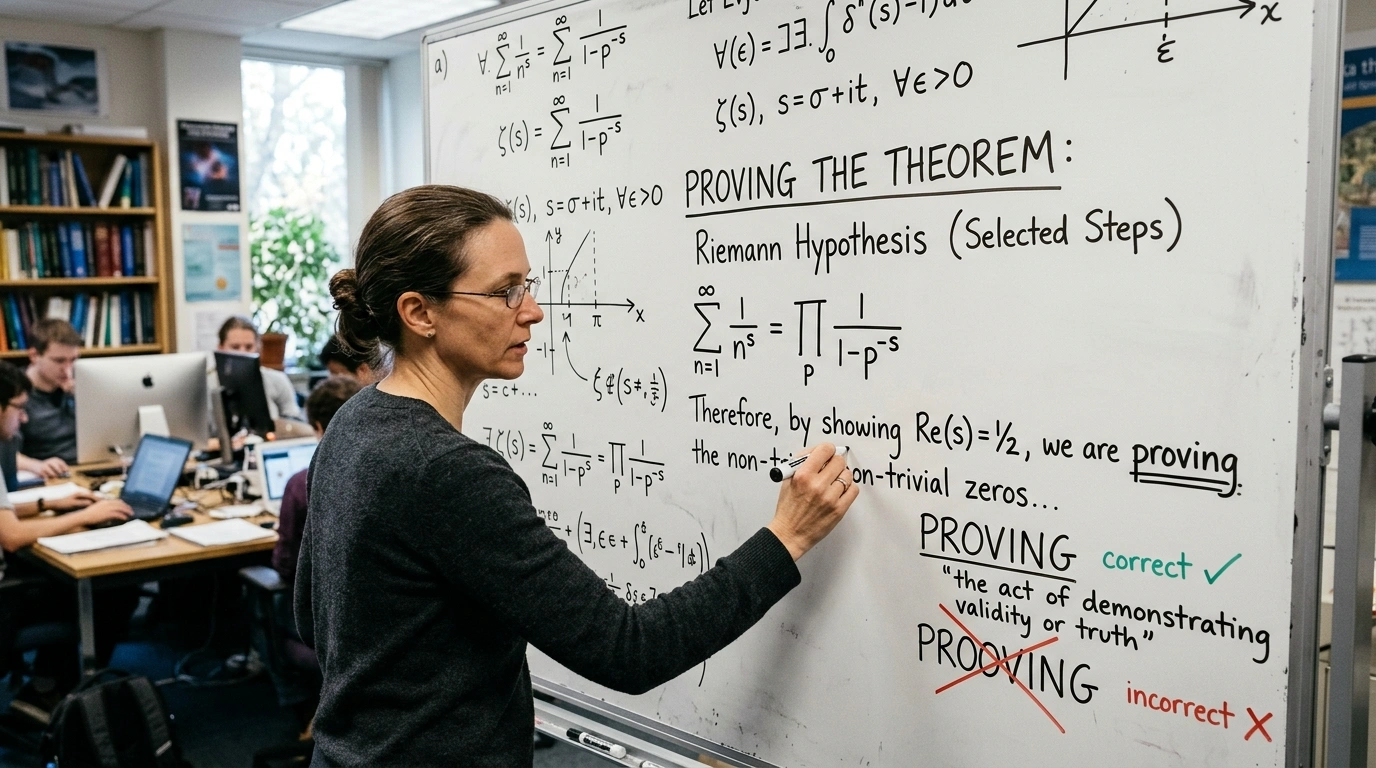
Prooving is not the standard English spelling. If you are writing ordinary English, the correct form is proving.
The mistake usually happens because writers see the two o letters in prove and assume that both should remain when -ing is added.
However:
prove + ing = proving
not:
prove + ing = prooving
Why Does the Mistake Happen?
English spelling can be confusing because adding -ing does not follow one single rule for every verb.
For prove, the final silent e disappears:
prove → proving
The spelling prooving incorrectly keeps the e out but adds an unnecessary extra o.
You can avoid the mistake by remembering the base word and applying the standard silent-e rule.
Examples of the Incorrect Form
These sentences contain the common spelling error:
- “She is prooving her point.”
- “The experiment is prooving successful.”
- “He is prooving that the claim is false.”
The corrected versions are:
- “She is proving her point.”
- “The experiment is proving successful.”
- “He is proving that the claim is false.”
Key Differences Between Proving or Prooving
There is one major difference between proving or prooving: only one is considered correct standard English spelling.
- Proving is correct.
- Prooving is incorrect in standard English.
- Proving comes from the verb prove.
- The final silent e in prove is dropped before -ing.
- Prooving adds an unnecessary second o.
- Use proving in academic, professional, casual, and formal writing.
- Spell-checkers will generally flag prooving as an error.
| Feature | Proving | Prooving |
|---|---|---|
| Correct standard spelling | Yes | No |
| Base verb | Prove | Intended to be “prove” |
| Formation | Prove → proving | Incorrect formation |
| Meaning | Demonstrating something is true | No standard separate meaning |
| Suitable for formal writing | Yes | No |
| Common mistake | No | Yes |
Real-Life Conversation Examples
Example 1: Academic Writing
Emma: “Is this sentence correct: ‘The study is prooving the theory’?”
Noah: “Almost. It should be ‘The study is proving the theory.’”
Emma: “Right, I forgot to drop the silent e.”
🎯 Lesson: The correct spelling is proving, not prooving.
Example 2: Everyday Conversation
Liam: “He’s proving that he can do the job.”
Sara: “Yes, his results have been impressive.”
🎯 Lesson: Proving is the standard present participle of prove.
Example 3: Writing an Email
Jack: “I wrote ‘prooving’ in my report.”
Mia: “Change it to ‘proving.’ The extra ‘o’ isn’t needed.”
🎯 Lesson: Double-check the spelling when adding -ing to prove.
Example 4: A Grammar Question
Alex: “Why isn’t it ‘prooving’ if the word starts with two o’s?”
Ben: “Because the original word is ‘prove,’ and the silent ‘e’ is removed before adding ‘-ing.’”
🎯 Lesson: Prove + ing becomes proving, following the silent-e spelling rule.
When to Use Proving or Prooving
Use “Proving”
Use proving whenever you mean demonstrating or establishing that something is true, correct, or valid.
Examples:
- “She is proving her case.”
- “The evidence is proving important.”
- “They are proving the results.”
- “He enjoys proving difficult problems.”
Never Use “Prooving” in Standard English
In standard English writing, prooving should be replaced with proving.
This applies to:
- School assignments
- Business emails
- Blog posts
- Academic writing
- Reports
- Social media
- Everyday messages
An Easy Memory Trick
Remember:
PROVE − E + ING = PROVING
The final silent e disappears before -ing.
You can use the same trick with:
- love → loving
- hope → hoping
- save → saving
- write → writing
- prove → proving
This makes the proving or prooving choice much easier to remember.