

What Is a Scab?
A scab is a protective crust that forms over damaged skin as part of the body’s healing process.
When you cut, scratch, scrape, or otherwise injure your skin, blood and other fluids can dry on the surface. This creates a crust that protects the tissue underneath while new skin develops.
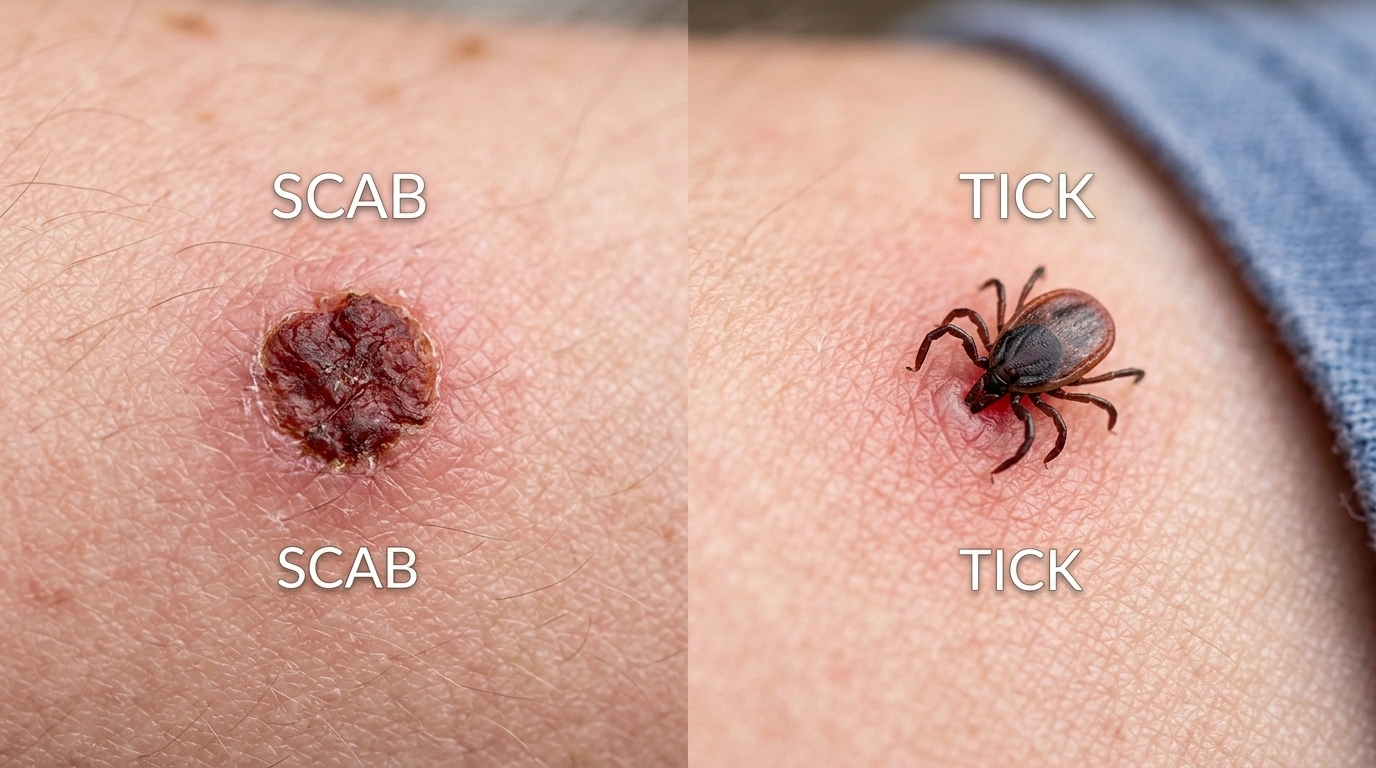
What Does a Scab Look Like?
A scab may appear:
- Brown
- Dark red
- Blackish
- Yellowish
- Tan
- Rough
- Crusty
- Slightly raised
Its appearance depends on the type of injury and how far the healing process has progressed.
A scab is generally part of the skin’s surface, rather than a separate living organism.
What Does a Scab Feel Like?
A scab often feels:
- Dry
- Hard
- Rough
- Crusty
- Slightly raised
It may also itch or feel mildly tender while the underlying skin heals.
What Causes a Scab?
Common causes include:
- Cuts
- Scratches
- Scrapes
- Minor burns
- Popped pimples
- Skin irritation
- Small wounds
Example
“I scraped my knee, and a small scab formed over the wound.”
What Is a Tick?
A tick is a small arachnid parasite that feeds on the blood of humans and animals.
Ticks are related to spiders and mites, so they are not insects.
An attached tick can appear as a small dark, brown, gray, or reddish object sitting on or embedded in the skin.
What Does a Tick Look Like?
Ticks vary by species and life stage, but they may appear:
- Brown
- Black
- Gray
- Reddish-brown
- Oval
- Rounder after feeding
A tick can become noticeably larger after it has fed.
Where Are Ticks Commonly Found?
Ticks can attach to many parts of the body. They may be particularly easy to miss in warm or hidden areas, including:
- Scalp
- Behind the ears
- Neck
- Armpits
- Waist
- Groin
- Behind the knees
- Between the toes
Important Point
An attached tick is not part of your skin. It is an external organism attached to the skin.
Scab or Tick: Key Differences
The main difference in scab or tick is simple:
A scab is a healing skin covering. A tick is a living parasite.
Key Differences
- Scab: Forms because of a skin injury or irritation.
- Tick: Attaches to skin to feed on blood.
- Scab: Usually feels dry and crusty.
- Tick: May feel like a small raised object.
- Scab: Is part of the healing process.
- Tick: Is an external organism.
- Scab: Usually forms over a wound.
- Tick: May have a distinct body shape.
- Scab: Can shrink, loosen, and fall away as the wound heals.
- Tick: Can remain attached and may enlarge after feeding.
Comparison Table
| Feature | Scab | Tick |
|---|---|---|
| What is it? | Protective material over healing skin | Blood-feeding arachnid |
| Living organism? | No | Yes |
| Usually caused by | Cut, scratch, scrape, or irritation | Tick exposure |
| Texture | Dry, rough, or crusty | Firm or smooth body |
| Attached to skin? | Forms on injured skin | Attaches to skin |
| Can enlarge? | No | May enlarge after feeding |
| Has a body shape? | No distinct animal body | Yes |
| May have legs? | No | Yes, although they can be difficult to see |
| Normal part of healing? | Yes | No |
| What to do | Usually allow it to heal naturally | Remove an attached tick promptly and properly |
Real-Life Conversation Examples
Conversation 1: A Dark Spot
Sarah: “There’s a dark spot on my leg. Could it be a tick?”
Emma: “It could also be a scab. Look closely at whether it appears to be part of the skin or a separate object.”
🎯 Lesson: A scab is associated with healing skin, while a tick is an attached organism.
Conversation 2: After a Scrape
Mike: “I scraped my arm yesterday, and now there’s a brown crust.”
James: “That sounds consistent with a scab.”
🎯 Lesson: A crust developing over a recent injury is commonly a scab.
Conversation 3: After Being Outdoors
Lina: “I found a small dark object attached to my skin after hiking.”
Sofia: “It could be a tick, so don’t simply assume it’s a scab.”
🎯 Lesson: Recent outdoor exposure can increase the possibility of tick attachment.
Conversation 4: Something With Legs
Alex: “The little object seems to have tiny legs.”
Ben: “That would be an important clue that you’re dealing with an organism rather than a scab.”
🎯 Lesson: Visible legs strongly suggest an arthropod such as a tick rather than a scab.
When to Consider a Scab or Tick
When deciding between scab or tick, consider both the object’s appearance and what happened before you noticed it.
A Scab May Be More Likely If:
- You recently cut or scratched the area.
- There was a scrape or wound before the spot appeared.
- The area is dry and crusty.
- It looks continuous with the surrounding skin.
- It gradually changes as the wound heals.
- You remember seeing bleeding or broken skin in the area.
A Tick May Be More Likely If:
- You’ve recently spent time outdoors where ticks are present.
- The object appeared without an obvious wound.
- It looks like a distinct small body attached to the skin.
- You can see tiny legs or a body outline.
- It seems to be increasing in size.
- It doesn’t look like dried material from an injury.
If you can’t tell what an attached object is, don’t repeatedly pick or scrape at it. Getting a clear look with good lighting or having a healthcare professional examine it can be safer than guessing.
Scab or Tick: Appearance
Color alone isn’t enough to tell a scab from a tick.
A scab can be dark brown, reddish-brown, or nearly black, particularly when blood has dried.
Ticks can also be brown, black, gray, or reddish, depending on their species and life stage.
Instead of focusing only on color, consider several clues.
Shape
Does the object have a recognizable body shape?
A tick may have an oval or rounded body, while a scab usually follows the shape of the wound underneath.
Texture
Does it look dry and crusty?
That can suggest a scab.
A tick generally has a more defined body rather than a layer of dried material.
Connection to the Skin
Does the object appear to be part of the wound?
A scab forms directly over damaged skin. A tick attaches to the skin as a separate organism.
Legs
Can you see tiny legs?
Visible legs strongly suggest a tick or another arthropod rather than a scab.
Recent Events
Think about what happened before you noticed the spot.
Recent injury → scab may be more likely.
Recent outdoor exposure → tick may be possible.
No single visual clue is perfect, especially when dealing with very small ticks.
What Should You Do If You Think It’s a Scab?
If it appears to be a normal scab over a minor wound, generally:
- Keep the area clean.
- Avoid picking or peeling the scab.
- Let it heal naturally.
- Protect the area from repeated irritation.
- Follow appropriate wound-care instructions if the injury is significant.
Picking a scab can reopen the wound and may increase the risk of infection or scarring.
What Should You Do If You Think It’s a Tick?
If you find an attached tick, prompt removal is generally recommended.
A commonly recommended approach is to use fine-tipped tweezers, grasp the tick as close to the skin’s surface as possible, and pull upward with steady, even pressure.
After removing it:
- Clean the bite area.
- Wash your hands.
- Dispose of the tick safely.
- Monitor the area and your health afterward.
Avoid methods such as covering the tick with petroleum jelly, burning it, or applying chemicals to make it detach.
If you develop concerning symptoms afterward, contact a healthcare professional and mention the possible tick exposure.
Scab or Tick: Symptoms
A scab itself doesn’t cause illness because it is part of the body’s healing process.
The skin underneath may be:
- Tender
- Itchy
- Slightly red
- Sensitive
- Healing from a previous injury
A tick bite may initially cause a small area of:
- Redness
- Swelling
- Itching
- Irritation
Some tick-borne infections can cause additional symptoms. Depending on the infection, symptoms may include fever, fatigue, headache, muscle aches, or an expanding rash.
If you develop significant or unusual symptoms after a tick bite, seek medical advice.
When Should You Seek Medical Attention?
A healthcare professional should evaluate a skin lesion or bite if you notice concerning changes such as:
- Increasing redness or swelling
- Significant pain
- Pus or drainage
- Fever
- Red streaking
- A rapidly expanding rash
- Severe illness or weakness
- A wound that isn’t healing normally
If you believe a tick has been attached for an extended period or you’re concerned about a possible tick-borne illness, contact a healthcare professional for personalized advice.
Scab or Tick After Outdoor Activities
Outdoor activities can make tick exposure more likely, particularly in areas where ticks are common.
After hiking, camping, gardening, or spending time in tall grass or wooded areas, check your skin and clothing for ticks.
Pay particular attention to hidden areas such as:
- Hairline
- Behind the ears
- Armpits
- Waist
- Groin
- Behind the knees
- Between the toes
Finding something attached to your skin after outdoor activity doesn’t automatically mean it’s a tick, but it is a reason to examine the area carefully.
Can a Scab Look Like a Tick?
Yes.
A dark, raised scab can sometimes look surprisingly similar to an attached tick, especially when the scab is small or located in an area that’s difficult to see.
A scab may have:
- An irregular shape
- A rough surface
- Dark coloration
- A crusty appearance
- A direct connection to a wound
A tick may look more like a distinct object with a recognizable body.
However, very small ticks can be difficult to identify visually, so don’t rely on appearance alone if you’re uncertain.
Can a Tick Look Like a Scab?
Yes.
An attached tick can resemble:
- A dark mole
- A small scab
- A skin tag
- A tiny bump
- A piece of dried blood
This is one reason people sometimes mistake ticks for ordinary skin marks.
If the object appeared suddenly, especially after outdoor exposure, inspect it carefully rather than assuming it’s a scab.
A Simple Memory Trick
Here’s an easy way to remember scab or tick:
Scab = Skin Healing
A scab is produced by your body after skin damage.
Think:
Scab → wound
Tick = Tiny Parasite
A tick is a living organism that attaches to you and feeds on blood.
Think:
Tick → bite
So the simplest memory trick is:
Scab = healing
Tick = parasite