
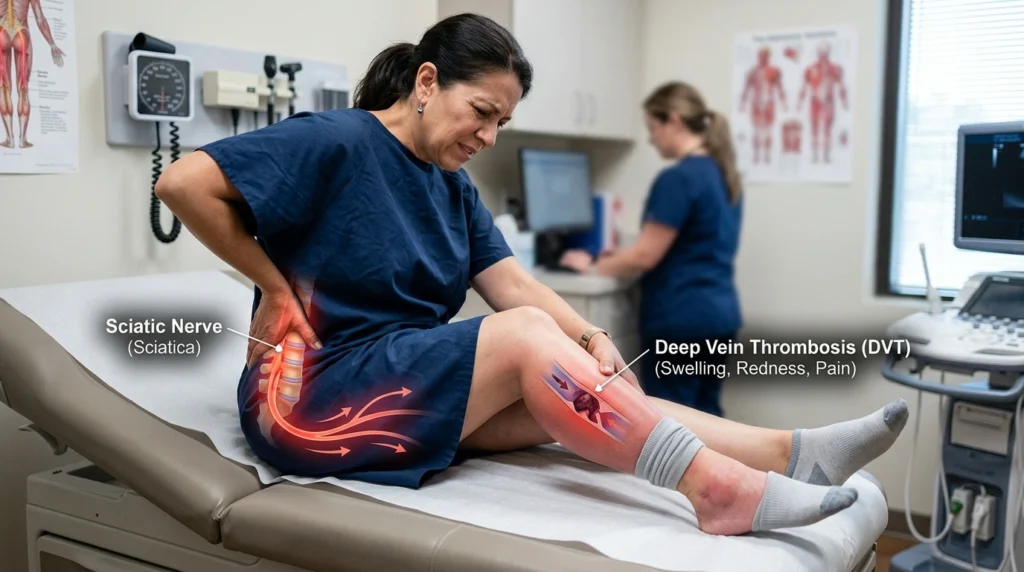
What Is Sciatica?
Sciatica is a term used for pain caused by irritation, inflammation, or compression of the sciatic nerve or its nerve roots. The sciatic nerve is the body’s largest nerve and runs from the lower back through the buttocks and down each leg.
When comparing sciatica or DVT, the biggest clue is often the pattern of pain. Sciatica commonly begins in the lower back or buttock and travels down the back or side of the leg. It may affect one side of the body.
Common Symptoms of Sciatica
Typical symptoms include:
- Sharp or burning pain that travels down the leg
- Pain beginning in the lower back or buttock
- Tingling or a “pins and needles” sensation
- Numbness in the leg or foot
- Muscle weakness in the affected leg or foot
- Pain that becomes worse with certain movements, coughing, or sneezing
Some people describe sciatica as an electric-shock-like sensation. Others experience a dull ache combined with tingling or numbness.
What Causes Sciatica?
Sciatica most often develops when something irritates or compresses a nerve root in the lower spine. A herniated disk is one common cause. Other possibilities include spinal narrowing, bone changes associated with aging, or certain injuries.
Your symptoms may also change depending on your posture. Sitting, bending, or certain movements can aggravate nerve-related pain.
Regional and Medical Usage
The word sciatica is used consistently in both American and British English. It is a medical term rather than a regional spelling difference.
A simple example would be:
“She developed sciatica after experiencing persistent lower-back pain.”
Another example:
“His sciatica causes pain that travels down his right leg.”
The important point when considering sciatica or DVT is that sciatica is fundamentally associated with nerve irritation, not a blood clot.
What Is DVT?
DVT stands for deep vein thrombosis. It occurs when a blood clot forms in a deep vein, most commonly in the lower leg or thigh.
Unlike sciatica, DVT is a circulatory condition. A clot can partially or completely block blood flow through a vein. The condition deserves prompt medical attention because part of the clot can sometimes break away and travel to the lungs, causing a pulmonary embolism.
Common Symptoms of DVT
DVT may cause:
- Swelling, usually in one leg
- Pain or tenderness in the calf or thigh
- Warmth over the affected area
- Redness or discoloration
- A feeling of heaviness or discomfort in the leg
However, DVT does not always produce obvious symptoms. Some people may have few or no noticeable signs.
This is an important difference between sciatica or DVT: you cannot reliably rule out DVT simply because your leg does not look dramatically swollen.
What Causes DVT?
DVT risk increases when blood flow slows or when the blood has an increased tendency to clot. Risk factors can include prolonged immobility, recent surgery, serious injury, certain medical conditions, pregnancy, some medications, and previous blood clots.
Long periods of sitting, such as during certain long-distance journeys, can also increase the risk.
Example Sentences
“The doctor wanted to rule out DVT because her leg had become swollen and painful.”
“DVT can occur in a deep vein in the leg.”
The term DVT is widely used in both American and British medical English.
Sciatica or DVT: Key Differences
Although both conditions can involve leg discomfort, their underlying causes and typical symptoms are quite different.
- Sciatica affects nerves, while DVT affects veins.
- Sciatica often causes pain that travels from the lower back or buttock down the leg.
- DVT commonly causes swelling, warmth, tenderness, or discoloration in one leg.
- Sciatica can produce numbness, tingling, or weakness.
- DVT can occur without obvious nerve symptoms.
- Changing position or certain movements may aggravate sciatica.
- DVT requires medical evaluation because of the risk of a pulmonary embolism.
- Neither condition should be diagnosed solely from a symptom checklist.

Comparison Table
| Feature | Sciatica | DVT |
|---|---|---|
| Main problem | Nerve irritation or compression | Blood clot in a deep vein |
| Body system | Nervous system | Circulatory system |
| Typical location | Lower back, buttock, back/side of leg | Usually calf or thigh |
| Pain pattern | Often travels down the leg | Often localized to the affected area |
| Numbness/tingling | Common | Not typical |
| Muscle weakness | Can occur | Not a typical feature |
| Swelling | Usually not a defining feature | Common, especially in one leg |
| Warmth/redness | Not typical | May occur |
| Possible emergency | Severe neurological symptoms can require urgent care | Pulmonary embolism can be life-threatening |
| Diagnosis | Medical history and examination, sometimes imaging | Medical assessment and tests such as ultrasound |
Real-Life Conversation Examples
Example 1: Pain Traveling From the Back
Alex: “The pain starts in my lower back and shoots down my leg.”
Sam: “That pattern can happen with sciatica. You should still get medical advice if it’s severe or persistent.”
🎯 Lesson: Pain traveling from the lower back into the leg is a classic pattern associated with sciatica.
Example 2: Swollen Calf
Mia: “My calf suddenly looks swollen compared with the other one, and it’s tender.”
Sara: “That shouldn’t be assumed to be sciatica. You need prompt medical evaluation.”
🎯 Lesson: One-sided swelling and tenderness can be warning signs of DVT and deserve medical attention.
Example 3: Tingling and Numbness
James: “My foot keeps tingling, and I have pain running down the back of my leg.”
Tom: “That sounds more consistent with nerve-related symptoms, but a clinician should determine the cause.”
🎯 Lesson: Tingling and numbness are more characteristic of nerve involvement, such as sciatica.
Example 4: Sudden Breathing Trouble
Nina: “My leg has been painful, and now I’m suddenly having trouble breathing.”
Emma: “Call emergency medical services immediately.”
🎯 Lesson: Possible DVT combined with sudden shortness of breath or chest symptoms can indicate a pulmonary embolism, which is an emergency.
When to Use Sciatica or DVT
The best way to remember sciatica or DVT is to focus on the body system involved.
Think “Nerve” for Sciatica
A useful memory trick is:
Sciatica = sciatic nerve = radiating pain.
If discomfort starts around the lower back or buttock and travels down the leg, especially with tingling, numbness, or weakness, a nerve-related condition such as sciatica may be involved.
For example:
“The pain shoots from my back into my foot.”
That description points toward a nerve pattern rather than automatically indicating a blood clot.
Think “Vein” for DVT
For DVT, think:
DVT = deep vein = clot.
One-sided leg swelling, warmth, tenderness, or unexplained pain can be warning signs. These symptoms do not prove that someone has DVT, but they warrant appropriate medical assessment.
US vs. UK Usage
There is no major American-versus-British spelling difference between sciatica and DVT. Both terms are used in healthcare settings in the United States and United Kingdom.
The larger difference is often everyday language. Someone may simply say “a blood clot” rather than “deep vein thrombosis,” while healthcare professionals commonly use DVT.
When Should You Seek Urgent Help?
Do not try to determine sciatica or DVT solely through an online symptom comparison.
Seek urgent medical assessment for new unexplained one-sided leg swelling, significant leg pain, warmth, or redness, particularly when DVT is possible.
More importantly, seek emergency help if leg symptoms occur with signs that could indicate a pulmonary embolism, such as:
- Sudden difficulty breathing
- Chest pain, particularly with breathing
- Coughing up blood
- Fainting or severe dizziness
- A rapid or irregular heartbeat
These symptoms can have other causes, but they require immediate evaluation.
Likewise, severe back-related symptoms accompanied by significant or worsening weakness, numbness around the groin or saddle area, or new loss of bladder or bowel control require urgent medical attention.
How Doctors Tell Sciatica and DVT Apart
Symptoms provide clues, but medical evaluation is what establishes the diagnosis.
For suspected sciatica, a clinician may ask about the location and pattern of pain, check muscle strength and sensation, and assess reflexes and movement. Imaging may sometimes be recommended depending on the symptoms and suspected cause.
For suspected DVT, clinicians may assess risk factors and physical symptoms and use diagnostic testing. Ultrasound is commonly used to evaluate blood flow and look for a clot in the veins.
This distinction is important because treating the wrong condition on your own can be risky. Painkillers, stretching, massage, or exercise may be inappropriate depending on the underlying problem.