
What Is Voluntary?
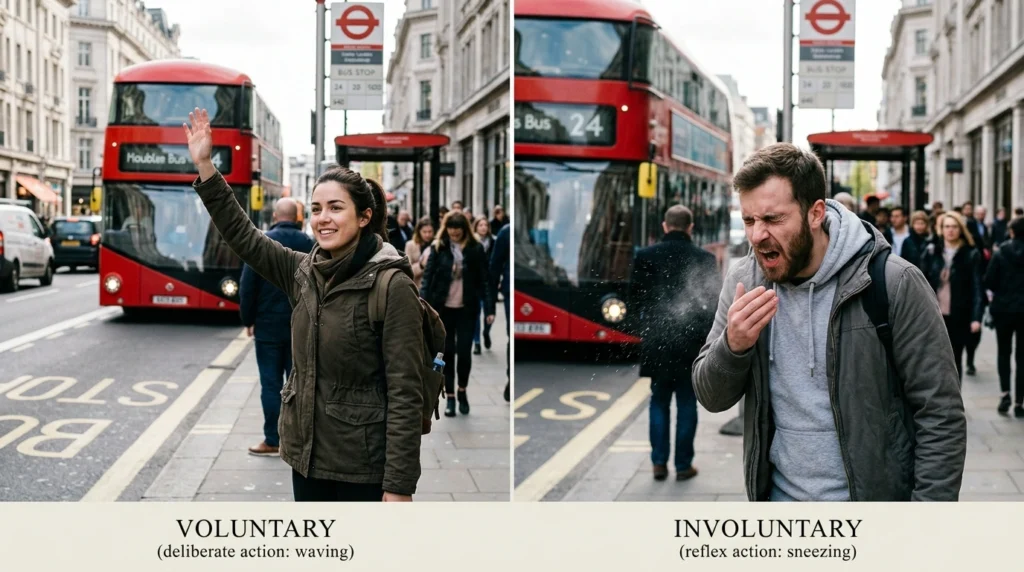
Voluntary means something is done willingly, intentionally, or by personal choice. If you have the ability to decide whether to participate and choose to do so, the action is generally voluntary.
The word can describe actions, decisions, activities, organizations, services, and agreements.
Meaning and Usage
Common examples include:
- Voluntary participation
- Voluntary work
- Voluntary resignation
- Voluntary donation
- Voluntary agreement
- Voluntary movement
- Voluntary decision
For example:
She made a voluntary decision to leave the organization.
This means she chose to leave rather than being forced to do so.
Another example:
He volunteers at the shelter on a voluntary basis.
Here, the idea is that he chooses to provide his time.
Voluntary in Everyday Life
Many ordinary activities are voluntary:
- Choosing what to eat
- Joining a club
- Donating money
- Raising your hand
- Taking a walk
- Accepting an invitation
- Signing up for an activity
These actions generally involve conscious choice.
Voluntary in Biology
In biology and medicine, voluntary movement usually refers to movement that you consciously control.
For example:
- Walking
- Raising your arm
- Writing
- Picking up a cup
- Kicking a ball
You decide to perform these movements, even though the detailed muscle activity happens automatically once your brain initiates the movement.
Grammar and Word Forms
Voluntary is an adjective.
Related forms include:
- Voluntarily — adverb
- Volunteer — noun or verb
- Voluntariness — noun
Example:
She voluntarily agreed to help.
Short History of the Word
Voluntary comes from Latin voluntarius, meaning “willing” or “of one’s free will.” It is related to voluntas, meaning “will” or “choice.”
The central idea has remained connected to willingness and personal choice.
What Is Involuntary?
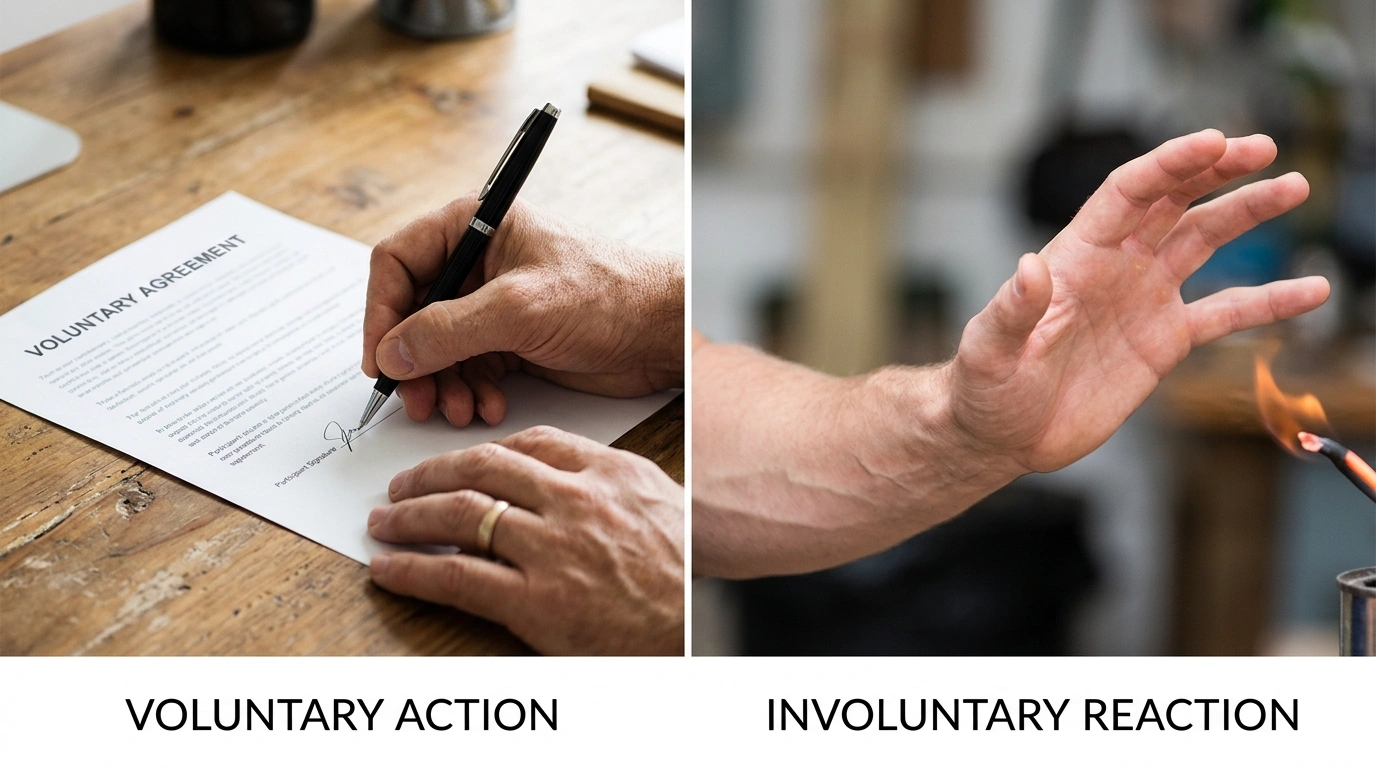
Involuntary means something happens without conscious choice, deliberate intention, or voluntary control.
It is the opposite of voluntary.
Meaning and Usage
Common examples include:
- Involuntary movement
- Involuntary reaction
- Involuntary muscle contraction
- Involuntary response
- Involuntary action
- Involuntary behavior
- Involuntary admission
For example:
The loud noise caused an involuntary reaction.
The person didn’t deliberately decide to react that way.
Another example:
Blinking can happen involuntarily.
Although you can consciously blink, much of your blinking normally happens automatically.
Involuntary in Biology
Your body performs many functions without requiring conscious control.
Examples include:
- Heartbeat
- Digestion
- Certain reflexes
- Pupil responses
- Many automatic breathing processes
- Some muscle contractions
These are commonly described as involuntary processes.
However, biology can be more complicated than a simple voluntary/involuntary split. Some functions, such as breathing, can involve both conscious and automatic control.
Involuntary Reactions
An involuntary reaction can happen before you consciously think about it.
For example:
She jumped involuntarily when the balloon popped.
The sudden movement wasn’t planned.
Similarly:
He involuntarily closed his eyes when the object moved toward his face.
Grammar and Word Forms
Involuntary is an adjective.
Its related adverb is:
Involuntarily
Example:
He involuntarily laughed at the unexpected comment.
Short History of the Word
Involuntary combines the prefix in-, meaning “not,” with voluntary. Its basic meaning is therefore not voluntary or not performed through deliberate choice.
Key Differences Between Voluntary or Involuntary
The simplest way to understand voluntary or involuntary is to ask one question: Did the person consciously choose to do it?
- Voluntary means done willingly or intentionally.
- Involuntary means done without deliberate choice or conscious control.
- Voluntary actions generally involve conscious decision-making.
- Involuntary actions often happen automatically or unexpectedly.
- A person can sometimes consciously influence an otherwise automatic process.
- Voluntary is associated with choice and willingness.
- Involuntary is associated with automatic responses or lack of control.
- The two words are opposites.
- Both can describe actions, movements, decisions, and processes.
- Context matters because some actions can involve both conscious and automatic components.
Voluntary or Involuntary Comparison Table
| Feature | Voluntary | Involuntary |
|---|---|---|
| Basic meaning | Done by choice | Done without deliberate choice |
| Main idea | Control and willingness | Lack of conscious control |
| Intentional? | Generally yes | Generally no |
| Example | Raising your hand | Sneezing |
| Common body example | Walking | Heartbeat |
| Common everyday example | Volunteering | Jumping at a sudden noise |
| Adverb | Voluntarily | Involuntarily |
| Opposite | Involuntary | Voluntary |
| Requires conscious choice? | Usually | Usually not |
Real-Life Conversation Examples
Dialogue 1: Volunteering
Sarah: “Was your participation voluntary?”
Emma: “Yes. I chose to join the project.”
Sarah: “So nobody required you to do it?”
Emma: “Exactly.”
🎯 Lesson: Something is voluntary when a person willingly chooses to participate.
Dialogue 2: A Sudden Reaction
Mike: “Why did you jump?”
James: “The door slammed unexpectedly.”
Mike: “Did you mean to jump?”
James: “No, it was completely involuntary.”
🎯 Lesson: A sudden reaction without conscious intention can be involuntary.
Dialogue 3: Body Movement
Nina: “Can you control your heartbeat?”
Alex: “Not in the same direct way I control my arm.”
Nina: “So your heartbeat is involuntary?”
Alex: “Generally, yes.”
🎯 Lesson: Many essential body functions occur automatically rather than through conscious control.
Dialogue 4: Choosing to Help
Tom: “Did you agree to help voluntarily?”
Chris: “Yes. Nobody pressured me.”
Tom: “Then it was your own choice.”
Chris: “Exactly.”
🎯 Lesson: Willing participation is a key feature of something voluntary.
When to Use Voluntary or Involuntary
Knowing when to use voluntary or involuntary is mostly about identifying choice, intention, and control.
Use “Voluntary” When Someone Chooses
Use voluntary when a person willingly decides to do something.
Examples:
- Voluntary work
- Voluntary donation
- Voluntary participation
- Voluntary resignation
- Voluntary agreement
A simple test is:
“Did the person choose to do it?”
If yes, voluntary is often the appropriate word.
Use “Involuntary” When Something Happens Automatically
Use involuntary when an action or response happens without deliberate intention.
Examples:
- Involuntary movement
- Involuntary reaction
- Involuntary muscle contraction
- Involuntary response
- Involuntary behavior
Ask:
“Did it happen without the person’s conscious decision?”
If yes, involuntary may be appropriate.
A Simple Memory Trick
Think:
Voluntary = volunteer = choice.
Involuntary = not voluntary = no deliberate choice.
If you remember the connection between voluntary and volunteer, the distinction becomes much easier.
Voluntary vs Involuntary in Medicine
Medical language uses these terms frequently.
Voluntary movement generally means movement under conscious control.
Involuntary movement refers to movement that occurs without intentional control.
However, medical terminology can be more specific than everyday English. If you’re describing a medical symptom, it’s better to use the exact term provided by a healthcare professional rather than assuming that every unexpected movement has the same cause.
Voluntary vs Involuntary in Law and Work
The distinction can also matter in formal situations.
For example:
The employee submitted a voluntary resignation.
This suggests the employee chose to resign.
By contrast:
The employee was involuntarily terminated.
This indicates that the employee did not choose to end the employment.
The precise legal meaning of these terms can vary by jurisdiction, so formal legal situations require context.
US vs UK Notes
Voluntary and involuntary are standard words in both American and British English. Their meanings are essentially the same in both varieties.
Differences may arise from the specific legal, medical, or workplace context rather than from the English variety itself.