

What Is Wax?
Waxing is a temporary hair-removal method that removes unwanted hair from the root. Warm or cold wax is applied to the skin and then pulled away, taking the attached hairs with it.
Waxing can be performed on many areas, including the legs, arms, underarms, face, bikini area, and back. Professional salons commonly offer waxing services, although home waxing kits are also available.
How Waxing Works
The basic process is straightforward. Wax sticks to the hair, and when it is removed, the hair comes out from the follicle. Because the hair is removed at the root rather than simply cut at the skin’s surface, the skin can remain smooth for several weeks.
However, waxing does not permanently destroy the follicle. The follicle remains capable of producing another hair.
Example of Waxing
Imagine someone wants smooth legs before a holiday. They might wax their legs a few days before traveling. The hair is removed from the root, and the skin may stay relatively smooth for several weeks before noticeable regrowth appears.
That makes waxing convenient when you want relatively quick, short-term results.
Waxing and Hair Regrowth
Hair does not necessarily return all at once because individual hairs grow at different stages. With repeated waxing, some people notice that regrowth appears finer or less noticeable, although this does not mean waxing permanently removes the follicles.
Waxing can also cause temporary redness, sensitivity, bumps, or ingrown hairs, particularly if the skin is sensitive or the technique is poor.
A Brief History of Waxing
Hair removal by methods resembling waxing has existed for centuries. Various cultures used natural substances and techniques to remove unwanted body hair long before modern salon waxing became popular.
Modern waxing products are much more standardized, making the process quicker and more predictable than many traditional methods.
What Is Laser Hair Removal?
Laser hair removal is a treatment that uses concentrated light energy to target hair follicles. The pigment in the hair absorbs the light, generating heat that damages the follicle and reduces its ability to produce hair.
Unlike waxing, laser treatment is intended to provide long-term hair reduction, rather than simply removing the hair that is currently visible.
How Laser Hair Removal Works
During treatment, a laser device delivers controlled pulses of light to the skin. The energy is absorbed primarily by the hair pigment and converted into heat.
Because hair grows in different cycles, not every follicle is equally responsive during one session. That is why people generally need multiple treatments rather than expecting all hair to disappear after a single appointment.
Is Laser Hair Removal Permanent?
It is more accurate to describe laser hair removal as long-term hair reduction rather than guaranteed permanent hair removal.
After a treatment course, many people experience substantially less hair growth. Some remaining hairs may become finer or lighter. Maintenance sessions can sometimes be needed because hormonal changes and naturally cycling follicles can contribute to regrowth.
Who Can Have Laser Hair Removal?
Modern laser technology can be used across a wider range of skin tones than older systems, but the type of laser and treatment settings matter.
A qualified professional should assess your skin tone, hair color, hair thickness, and treatment area before treatment. Laser tends to work best when there is sufficient contrast between the hair and surrounding skin, although newer technologies have expanded treatment possibilities.
Very light, gray, white, or red hair can be more challenging because some laser systems rely heavily on pigment in the hair.
A Brief History of Laser Hair Removal
Laser hair removal developed from advances in medical and cosmetic laser technology during the late 20th century. As devices improved, laser treatment became increasingly common in dermatology and aesthetic clinics.
Today, different laser technologies are used for different combinations of skin tones and hair characteristics.
Key Differences Between Wax or Laser
The biggest difference is simple: wax removes existing hair, while laser targets the follicle to reduce future growth.
Here are the main differences:
- Purpose: Waxing provides temporary hair removal; laser aims for long-term hair reduction.
- Mechanism: Wax pulls hair out from the root; laser uses light energy to heat and damage targeted follicles.
- Results: Waxing usually lasts weeks; laser results can last much longer after a series of treatments.
- Number of sessions: Waxing is repeated whenever hair regrows; laser generally requires a treatment course.
- Pain: Both can be uncomfortable, but the sensation is different for each person.
- Skin reaction: Waxing can cause redness, irritation, or ingrown hairs. Laser can cause temporary redness or swelling around treated follicles.
- Hair color: Laser effectiveness depends partly on hair pigment, while waxing can remove hair regardless of color.
- Cost pattern: Waxing has a lower cost per appointment but requires ongoing maintenance. Laser has a higher upfront cost but may reduce long-term maintenance.
- Speed: Waxing can treat an area relatively quickly. Laser sessions vary according to the size of the treatment area.
- Long-term maintenance: Waxing requires regular repeat appointments. Laser may require occasional maintenance after the initial treatment course.
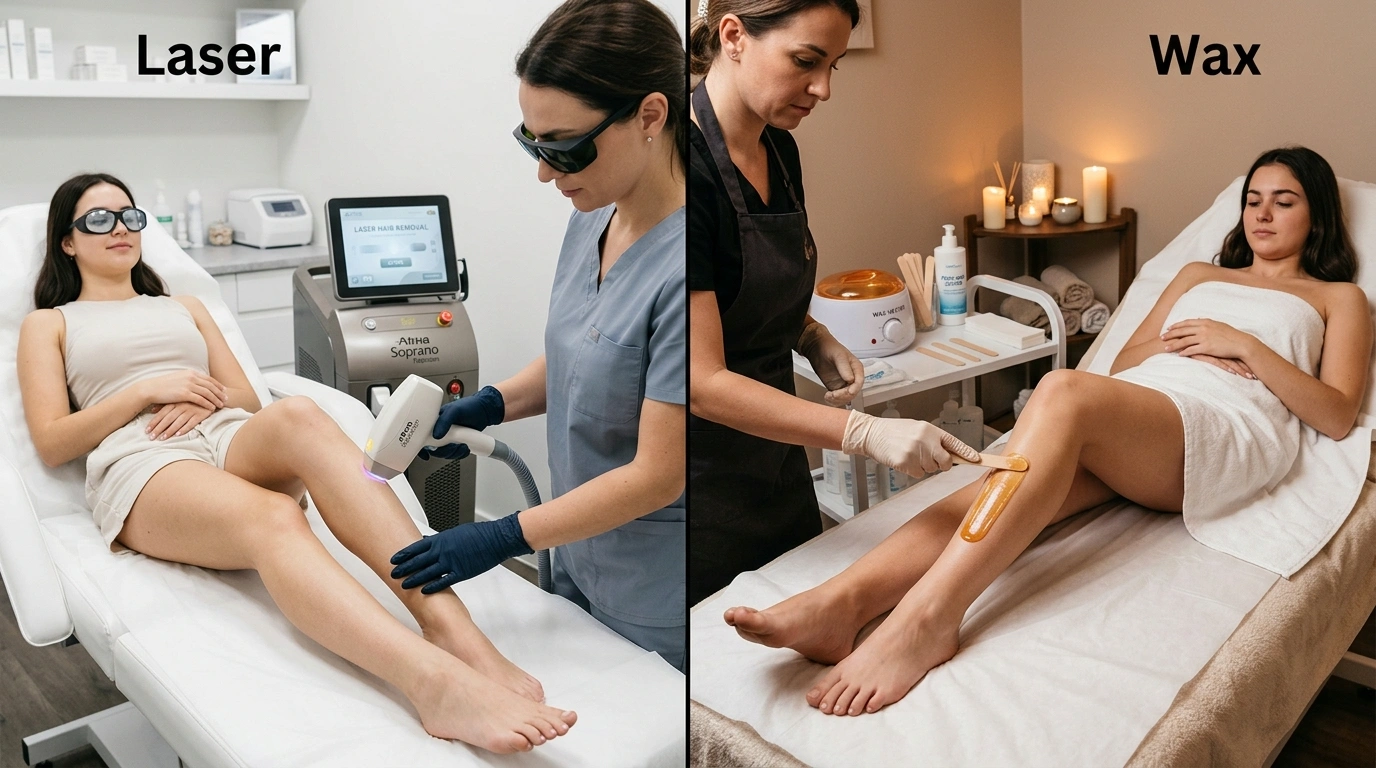
Wax or Laser Comparison Table
| Feature | Wax | Laser |
|---|---|---|
| Main purpose | Temporary hair removal | Long-term hair reduction |
| Hair removal | Pulls hair from the root | Targets the follicle with light energy |
| Results | Usually several weeks | Can last much longer after multiple sessions |
| Treatment frequency | Repeated as hair grows | Multiple sessions followed by possible maintenance |
| Hair color limitations | Very few | More dependent on hair pigment |
| Upfront cost | Usually lower | Usually higher |
| Long-term maintenance | Frequent | Generally less frequent |
| Ingrown-hair risk | Possible | May decrease hair-related ingrown hairs over time |
| Skin reaction | Redness, bumps, irritation | Temporary redness or swelling |
| Best suited for | Quick temporary smoothness | People seeking longer-term reduction |
Real-Life Conversation Examples
Dialogue 1: The Quick Holiday Fix
Mia: “I’m going on vacation next week. Should I get laser?”
Sara: “If you want a quick temporary solution, waxing may make more sense. Laser usually takes multiple sessions.”
Mia: “So laser isn’t a one-and-done appointment?”
Sara: “Exactly.”
🎯 Lesson: Choose wax when you need quick temporary hair removal; laser is a longer-term process.
Dialogue 2: The Budget Question
Ali: “Laser seems expensive.”
Sam: “It can cost more upfront.”
Ali: “Then waxing is cheaper?”
Sam: “Per appointment, usually. But remember that waxing needs to be repeated regularly.”
🎯 Lesson: Compare the long-term cost, not just the price of one appointment.
Dialogue 3: The Hair Color Problem
Nora: “Will laser work on my very light hair?”
Leah: “It depends on the laser and your hair color. Laser relies on pigment, so very light or gray hair can be difficult to target.”
Nora: “Would waxing work instead?”
Leah: “Waxing physically removes the hair, so hair color isn’t the same limitation.”
🎯 Lesson: Hair color matters more for laser than for waxing.
Dialogue 4: The Long-Term Goal
James: “I’m tired of shaving and waxing every few weeks.”
Daniel: “If you’re looking for longer-term reduction, laser might be worth discussing with a qualified professional.”
James: “So the goal isn’t necessarily zero hair forever?”
Daniel: “Right. Think long-term reduction rather than a guaranteed permanent result.”
🎯 Lesson: Laser is better suited to people seeking reduced long-term hair growth.
When to Use Wax or Laser
Choosing between wax or laser depends mainly on your goals, timeline, hair characteristics, skin, and budget.
Choose Wax If You Want Temporary Results
Waxing may be a practical choice if you:
- Need smooth skin for an upcoming event.
- Prefer a treatment that works immediately.
- Have hair that is very light or difficult for laser to target.
- Want a lower upfront treatment cost.
- Do not want to commit to a series of appointments.
Waxing is particularly useful when your priority is temporary smoothness rather than long-term reduction.
Choose Laser If You Want Long-Term Reduction
Laser may be worth considering if you:
- Are tired of frequent hair removal.
- Want to reduce the amount of hair that grows back.
- Are comfortable committing to multiple treatment sessions.
- Have hair and skin characteristics suitable for the specific laser being used.
- Prefer potentially less frequent maintenance over time.
Before treatment, have a qualified professional assess your skin and hair and explain realistic expectations.
A Simple Memory Trick
Think of it this way:
Wax = remove today’s hair.
Laser = target tomorrow’s growth.
Waxing focuses on the hair you already have, while laser treatment focuses on the follicle responsible for producing hair.
US vs UK Terminology
The terminology is largely the same in the United States and United Kingdom. Waxing and laser hair removal are widely understood in both regions.
The main differences you may encounter involve salon terminology, pricing, and the specific devices or treatment protocols used—not the basic meaning of the terms.
Important Skin and Safety Considerations
Neither method is completely risk-free.
With waxing, avoid waxing skin that is significantly irritated, damaged, or sunburned. Certain skincare products and medications can also affect how your skin responds to waxing.
With laser, proper assessment is especially important. Laser settings should be selected according to your skin type, hair characteristics, and the device being used. Poorly selected settings can increase the risk of burns or pigment changes.
For either treatment, follow the provider’s preparation and aftercare instructions.